Does high quality digital cables matter?
Comments
-
Question for you blind test supporters. What other item/product do you use in your lives that you rely on and/or insist blind test results for?
Be honest.
The most obvious answer is medication/pharmaceutical products and healthcare.
I don't "insist" on blinding for much else, but I'm a behavioral scientist so I have a general curiosity in all things related to subjective experience and perception. Under anecdotal situations, I've played with blinding methods to all sorts of things: wine, food, dietary supplements, purses and fashion accessories etc.
I think its interesting to see what differences people can pick up on, and what they cannot.Polk Fronts: RTi A7's
Polk Center: CSi A6
Polk Surrounds: FXi A6's
Polk Rear Surround: RTi4
Sub: HSU VTF-3 (MK1)
AVR: Yamaha RX-A2010
B&K Reference 200.7
TV: Sharp LC-70LE847U
Oppo BDP-103 -
Question for you blind test supporters. What other item/product do you use in your lives that you rely on and/or insist blind test results for?
Be honest.
Largest and most important is Pharma.
Also done this for Bourbon/Whiskey/Wine. Was able to pick out 4 Roses vs Knob Creek vs Bernhiem. Also some store label food where I couldn't tell the difference and some I could. Found that soup I could tell the difference on Chicken Noodle and Bean w/ Bacon. -
Question for you blind test supporters. What other item/product do you use in your lives that you rely on and/or insist blind test results for?
Be honest.The most obvious answer is medication/pharmaceutical products and healthcare.
I don't "insist" on blinding for much else, but I'm a behavioral scientist so I have a general curiosity in all things related to subjective experience and perception. Under anecdotal situations, I've played with blinding methods to all sorts of things: wine, food, dietary supplements, purses and fashion accessories etc.
I think its interesting to see what differences people can pick up on, and what they cannot.Habanero Monk wrote: »Largest and most important is Pharma.
Also done this for Bourbon/Whiskey/Wine. Was able to pick out 4 Roses vs Knob Creek vs Bernhiem. Also some store label food where I couldn't tell the difference and some I could. Found that soup I could tell the difference on Chicken Noodle and Bean w/ Bacon.
According to two of the standard references in the field of sensory science:
1. The 2nd edition (1996) of the ASTM (American Society for Testing and Materials) Sensory Testing Methods Manual,
2. "Sensory Evaluation Techniques" by Meilgaard, Civille, and Carr,
blind tests are indicated when the subjects are untrained and descriptive tests are indicated when the subjects are trained.
In the case of medical drug trials, there is no way to train a person to react to a drug in a specific way. Furthermore, drugs and medical therapies do not heal the body, they only assist the body in healing itself. Setting and casting a broken bone does not mend the fracture, it only stabilizes the fracture so that the bones can mend themselves. Antibiotics do not cure infections, they only weaken an infection enough so that the body's infection fighting mechanisms can clear the infection.
Healing is also a function of the mind as well as the body. A person's resistance to and healing of, disease is affected by their mental state. In order to more accurately gauge a drug's effect(s), the effects of the mind must be taken out of the evaluation as much as possible.
The above contrasts with the perception of a stereo sound field in that medical trials seek to remove the influence of the mind whereas stereo sound field perception is totally dependent on the mind. Stereo perception is a psychoacoustic phenomenon dependent on the listener's mind for creating an illusion of sounds occurring in three dimensional space. The better the person's mind is at perceiving the aural cues that create the stereo illusion, the better and more lifelike the illusion.
In the cases of food and wine, blind tests are used when untrained subjects are used. Untrained subjects are very susceptible to influence by factors, such as appearance, cost, brand name, etc. that have nothing to do with performance. Non-blind descriptive tests are used when the subjects are trained, and therefore not influenced by factors such as appearance, cost, brand name, etc.
Listening to stereophonic music, by its very definition, is an activity for trained listeners. Most people who listen to stereo systems know nothing about the "stereo sweet spot", imaging, sound stage dimensions, and other performance measurements pertaining to stereo perception. As I have asked before, how many blind trials do you know of where the subjects were
1. adept in evaluating stereo performance and were asked to do so,
2. the test scenario was indicative of how stereo systems are used under normal circumstances.
The "used under normal circumstances" is a huge difference that people ignore when throwing up the fact that blind trials are used extensively in medicine. In blind medical trials, medicine is administered the way it would be under normal treatment circumstances. In blind stereo trials, the listening experience is altered, often radically, from what it would be under normal circumstances in the home. As I have said before, there is nothing in the design specifications for home stereo systems that indicate that the listener is required to obtain the assistance of one or more persons whenever a new piece of stereo equipment is to be evaluated. It is amazing to me that so many people cannot understand how ridiculous is the concept that you cannot properly evaluate a piece of audio equipment without requiring the assistance of one or more other persons.
Getting back to F1nut's question:Question for you blind test supporters. What other item/product do you use in your lives that you rely on and/or insist blind test results for?
Be honest.
If we were honest, most of us would have to say that we rely or insist on blind test results for few to none of the products we use, including medicines. How often have you, or anyone you know, asked a doctor to provide the clinical trial results of a prescription medicine. How often have you, or anyone you know, asked a store or manufacturer to provide the clinical trial results of an over the counter medicine?
Moving away from drug products, how many people use blind trials when evaluating an automobile or house? Shouldn't we? Homes and vehicles are typically the two biggest purchases that most people make, yet no one is clamoring for the application of blind trial techniques to insure that the consumer is not taken advantage of by unscrupulous sellers. How do people avoid being taken advantage of by unscrupulous vehicle and real estate sales people? How do people avoid being unduly influenced by the appearance, price, and brand name of a vehicle or house? Training! People become debiased vehicle and real estate consumers by educating themselves to evaluate performance based on established criteria. There is no "school" you have to attend to learn how to be a savvy vehicle or real estate consumer. There is no certification program for buying vehicles and homes. In these regards, the evaluation of stereo equipment is no different.
There are some aspects of automotive performance that could be blind tested, such as cabin quietness, seat comfort, and ride stability. You could sit in a car blindfolded while someone else drives. However, I think it is possible for someone to train themselves to evaluate cabin quietness, seat comfort, and ride stability between a Mercedes and a comparable BMW or between a Mecedes and a Chevrolet while they are driving. The latter case is more indicative of how the car will be used. No one uses an automobile while being driven around blindfolded.
There is nothing mysterious or "golden eared" about stereo equipment evaluation. Similar to evaluating vehicles and homes or anything else, you must use evaluation criteria and methods that are appropriate to the thing being evaluated and you must evaluate the thing under circumstances representative of how it will actually be used.
With regard to the subject of this thread, I will just quote my statement from another thread:DarqueKnight wrote: »I have never heard or seen a difference in audio or video performance with any digital cable I've tried, whether it was optical, coax, or HDMI. The last digital cable comparison I did was in 2009:
Tweaking-Home-Theater-Pt.-3-The-Pioneer-Elite-BDP-09FD-Blu-ray-Player.
I compared HDMI cables made by Acoustic Research ($20), Rocketfish ($85), and Monster Cable ($130). There was no performance difference among them. I subsequently compared the $20 Acoustic Research HDMI cables to $8 Monoprice HDMI cables, didn't see or hear a difference between them, then returned the AR cables.
I did see and hear a big difference in audio and video quality when I switched from a PS Audio Power Plant Premier AC regenerator to a PS Audio P5 AC regenerator. The difference in pixel sharpness is easily seen in figures 6, 7, and 8 of this thread:
Tweaking-Home-Theater-Part-7-PS-Audio-PerfectWave-P5-and-P10-AC-Regenerators.
If power quality can affect the integrity of a digital signal it is reasonable that transmission line quality could also affect digital signal integrity.
Notwithstanding my personal experiences, I don't doubt that different digital cables might make a difference in some systems. I have never compared digital cables in a high end, high resolution stereo system.Proud and loyal citizen of the Digital Domain and Solid State Country! -
**Clearing my throat** So, what you are saying Ray is that blind tests shouldn't be used to evaluate stereophonic audio. (If trained listeners are used for the evaluation). Am I getting this correctly?


Taken from a recent Audioholics reply regarding "Club Polk" and Polk speakers:
"I'm yet to hear a Polk speaker that merits more than a sentence and 60 seconds discussion."
My response is: If you need 60 seconds to respond in one sentence, you probably should't be evaluating Polk speakers.....
"Green leaves reveal the heart spoken Khatru"- Jon Anderson
"Have A Little Faith! And Everything You'll Face, Will Jump From Out Right On Into Place! Yeah! Take A Little Time! And Everything You'll Find, Will Move From Gloom Right On Into Shine!"- Arthur Lee -
DarqueKnight wrote: »In the cases of food and wine, blind tests are used when untrained subjects are used. Untrained subjects are very susceptible to influence by factors, such as appearance, cost, brand name, etc. that have nothing to do with performance. Non-blind descriptive tests are used when the subjects are trained, and therefore not influenced by factors such as appearance, cost, brand name, etc.
Listening to stereophonic music, by its very definition, is an activity for trained listeners. Most people who listen to stereo systems know nothing about the "stereo sweet spot", imaging, sound stage dimensions, and other performance measurements pertaining to stereo perception. As I have asked before, how many blind trials do you know of where the subjects were
1. adept in evaluating stereo performance and were asked to do so,
2. the test scenario was indicative of how stereo systems are used under normal circumstances.
(I wanted to point out as well Ray) how many blind tests test for differences in specific audio aspects such as soundstage, imaging, detail, transparency, image weight, tone(s), etc. etc, etc.? Previous tests done and proposed tests by blind-test proponents simply ask listeners (trained or untrained) to tell the difference between to pieces of audio equipment. What good does simply knowing if there is a difference between two pieces of equipment do to furthering sterophonic listening sessions and enjoyment of them? If listeners (consumers) are wanting to know differences in soundstage, imaging detail, etc. and blind test results do not test for these then the blind tests are not giving trained listeners (consumers) what they are looking for. That is, the specific differences in imaging, detail, soundstage, etc. between two peices of gear.
Taken from a recent Audioholics reply regarding "Club Polk" and Polk speakers:
"I'm yet to hear a Polk speaker that merits more than a sentence and 60 seconds discussion."
My response is: If you need 60 seconds to respond in one sentence, you probably should't be evaluating Polk speakers.....
"Green leaves reveal the heart spoken Khatru"- Jon Anderson
"Have A Little Faith! And Everything You'll Face, Will Jump From Out Right On Into Place! Yeah! Take A Little Time! And Everything You'll Find, Will Move From Gloom Right On Into Shine!"- Arthur Lee -
**Clearing my throat** So, what you are saying Ray is that blind tests shouldn't be used to evaluate stereophonic audio. (If trained listeners are used for the evaluation). Am I getting this correctly?
This is entirely incorrect.
Your subject selection is a basic study design parameter. You can select whatever participants you want, but it needs to be kept in mind when interpreting the results.Polk Fronts: RTi A7's
Polk Center: CSi A6
Polk Surrounds: FXi A6's
Polk Rear Surround: RTi4
Sub: HSU VTF-3 (MK1)
AVR: Yamaha RX-A2010
B&K Reference 200.7
TV: Sharp LC-70LE847U
Oppo BDP-103 -
This is entirely incorrect.
Your subject selection is a basic study design parameter. You can select whatever participants you want, but it needs to be kept in mind when interpreting the results.
In what way(s) is this "entirely incorrect"?
More specifically, please tell us WHY blind tests SHOULD BE used for stereophonic audio evaluation (when trained listeners are used) . I asked this of Habanero Monk, but received no answer.
It has already been established numberous times why blind tests should not be used to evaluate sterophonic audio equipment (in this thread and numerous other threads) thanks to Ray's excellent documentation.
Finally, can you please address my second post (below the one you quoted) which further demonstrates why blind tests should not be used to evaluate stereophonic audio equipment and further it's enjoyment.
I am discerning more and more that cable naysayers only quote and address things they feel will *attempt* to further their agenda. If what is said (naysayers feel) does not fit their agenda, it is simply ignored. It has been shown multiple times in this thread alone.
Taken from a recent Audioholics reply regarding "Club Polk" and Polk speakers:
"I'm yet to hear a Polk speaker that merits more than a sentence and 60 seconds discussion."
My response is: If you need 60 seconds to respond in one sentence, you probably should't be evaluating Polk speakers.....
"Green leaves reveal the heart spoken Khatru"- Jon Anderson
"Have A Little Faith! And Everything You'll Face, Will Jump From Out Right On Into Place! Yeah! Take A Little Time! And Everything You'll Find, Will Move From Gloom Right On Into Shine!"- Arthur Lee -
The only time blind testing has every made any sense is with bottles of wine! PERIOD!!
By the time we got to the end of the bottles nobody cared about the results as we were all have to much dang fun!!2 ch- Polk CRS+ * Vincent SA-31MK Preamp * Vincent Sp-331 Amp * Marantz SA8005 SACD * Project Xperience Classic TT * Sumiko Blue Point #2 MC cartridge
HT - Polk 703's * NAD T-758 * Adcom 5503 * Oppo 103 * Samsung 60" series 8 LCD -
DarqueKnight wrote: »If we were honest, most of us would have to say that we rely or insist on blind test results for few to none of the products we use, including medicines. How often have you, or anyone you know, asked a doctor to provide the clinical trial results of a prescription medicine. How often have you, or anyone you know, asked a store or manufacturer to provide the clinical trial results of an over the counter medicine?
That's what the FDA is for. And yes, for prescription drugs to make it to market, efficacy must be proven through double blind clinical studies with control groups. -
The only time blind testing has every made any sense is with bottles of wine! PERIOD!!
By the time we got to the end of the bottles nobody cared about the results as we were all have to much dang fun!!
I'll second that notion. All cable evaluations should include wine.HT SYSTEM-
Sony 850c 4k
Pioneer elite vhx 21
Sony 4k BRP
SVS SB-2000
Polk Sig. 20's
Polk FX500 surrounds
Cables-
Acoustic zen Satori speaker cables
Acoustic zen Matrix 2 IC's
Wireworld eclipse 7 ic's
Audio metallurgy ga-o digital cable
Kitchen
Sonos zp90
Grant Fidelity tube dac
B&k 1420
lsi 9's -
In what way(s) is this "entirely incorrect"?
More specifically, please tell us WHY blind tests SHOULD BE used for stereophonic audio evaluation (when trained listeners are used) . I asked this of Habanero Monk, but received no answer.
Double-blind testing is an experimental design/method. There is no compelling reason why it can only be used in "experienced" or "unexperienced" participants, regardless of the subject matter. Your subject selection depends on the question you're attempting to answer. In our case (audio cables), it seems to make more sense to perform the test in experienced users because they are more sensitive to hearing the subtleties that result from small changes that may (or may not) be present from cables.
If you asked someone that hated wine which wine was their favorite, that seems somewhat silly doesn't it? Similarly, why would you ask a novice listener about his/her listening preferences?It has already been established numberous times why blind tests should not be used to evaluate sterophonic audio equipment (in this thread and numerous other threads) thanks to Ray's excellent documentation.
The documentation identified a number of weaknesses and limitations to EXISTING studies. There is no reason why these cannot be FIXED to perform a properly blinded study. This is exactly what the paper submitted for publication proposed: Notice-Of-Sensory-Science-Journal-Publication
Further, double-blind testing has been used in all sorts of "complex" things, like food tasting, wine tasting, even assessments of mood and religious experience. There is no compelling reason to think audio is an exception.Finally, can you please address my second post (below the one you quoted) which further demonstrates why blind tests should not be used to evaluate stereophonic audio equipment and further it's enjoyment.(I wanted to point out as well Ray) how many blind tests test for differences in specific audio aspects such as soundstage, imaging, detail, transparency, image weight, tone(s), etc. etc, etc.? Previous tests done and proposed tests by blind-test proponents simply ask listeners (trained or untrained) to tell the difference between to pieces of audio equipment.
Telling the "difference" (discrimination) is different than asking which is "better." This goes back to my first point: the fact that previous tests were inadequate, doesn't mean an entire methodology is not relevant.What good does simply knowing if there is a difference between two pieces of equipment do to furthering sterophonic listening sessions and enjoyment of them? If listeners (consumers) are wanting to know differences in soundstage, imaging detail, etc. and blind test results do not test for these then the blind tests are not giving trained listeners (consumers) what they are looking for. That is, the specific differences in imaging, detail, soundstage, etc. between two peices of gear.
I agree with this. Telling the "difference" has no bearing on what sounds "better". To address this question, one would merely ask: "What sounds better?"
That is a pretty simple question isn't it? We could word it as: "Taking into account soundstage, imaging, detail, transparency, image weight, and tone(s), which sounds better?"
Now, before you respond with "My music is so complex, I couldn't possibly answer a straightforward question like that!"
we can get a bit fancier, and have you rate a series of questions on a scale from 1-10, such as:
1. Which audio selection has the best soundstage?
2. Which audio selection provides the best imaging?
3. Which audio selection provides the best detail?
4. Which audio selection provides the transparency?
Now, if someone asked YOU those questions, I'm sure you could provide an answer, right? If I sat you in front of your system, and only changed ONE cable, powercord etc. without telling you, that would be a double-blind study. It's not hard, so why would you even consider double-blind testing inadequate?Polk Fronts: RTi A7's
Polk Center: CSi A6
Polk Surrounds: FXi A6's
Polk Rear Surround: RTi4
Sub: HSU VTF-3 (MK1)
AVR: Yamaha RX-A2010
B&K Reference 200.7
TV: Sharp LC-70LE847U
Oppo BDP-103 -
Bunch of hot air being blown around, mountains out of mole hills.
Since some are stuck on the merits of blind testing....here's a thought....
DO IT YOURSELF AND FIND OUT !!
Try some different cables yourself instead of telling others how to do it or not do it. Some common sense can go along way for Pete's sake.HT SYSTEM-
Sony 850c 4k
Pioneer elite vhx 21
Sony 4k BRP
SVS SB-2000
Polk Sig. 20's
Polk FX500 surrounds
Cables-
Acoustic zen Satori speaker cables
Acoustic zen Matrix 2 IC's
Wireworld eclipse 7 ic's
Audio metallurgy ga-o digital cable
Kitchen
Sonos zp90
Grant Fidelity tube dac
B&k 1420
lsi 9's -
Bunch of hot air being blown around, mountains out of mole hills.
Since some are stuck on the merits of blind testing....here's a thought....
DO IT YOURSELF AND FIND OUT !!
Try some different cables yourself instead of telling others how to do it or not do it. Some common sense can go along way for Pete's sake.
I have. Why does the idea of someone else trying it threaten you so much? -
I read through a bunch of DKs previous posts last night, and I believe the crux of the argument is if double-blind testing is a valid method to compare gear.....such as Amp A sounds better than Amp B. Correct??
What I am curious to know is if there is a database of results based on this testing method which demonstrates either:
1. There is a correlation between listeners preferring the more expensive piece of gear over the less expensive (ie amps, cables, whatever).
2. There IS NO correlation between " ".
I guess regardless of the methodology, does such a database exist... -
teekay0007 wrote: »That's what the FDA is for. And yes, for prescription drugs to make it to market a lot of palms are greased.
Fixed it for you.Political Correctness'.........defined
"A doctrine fostered by a delusional, illogical minority and rabidly promoted by an unscrupulous mainstream media, which holds forth the proposition that it is entirely possible to pick up a t-u-r-d by the clean end."
President of Club Polk -
The most obvious answer is medication/pharmaceutical products and healthcare.
I don't "insist" on blinding for much else, but I'm a behavioral scientist so I have a general curiosity in all things related to subjective experience and perception. Under anecdotal situations, I've played with blinding methods to all sorts of things: wine, food, dietary supplements, purses and fashion accessories etc.
I think its interesting to see what differences people can pick up on, and what they cannot.Habanero Monk wrote: »Largest and most important is Pharma.
Also done this for Bourbon/Whiskey/Wine. Was able to pick out 4 Roses vs Knob Creek vs Bernhiem. Also some store label food where I couldn't tell the difference and some I could. Found that soup I could tell the difference on Chicken Noodle and Bean w/ Bacon.
Ah yes, I figured pharmaceutical products would be the number one answer. So, you mean to tell me that for each medication your doctor prescribes, you first research the blind test results before getting the prescription filled?
Do you also post on Internet forums the importance of blind testing in relation to any of the items/products you mentioned? If not, why not?Political Correctness'.........defined
"A doctrine fostered by a delusional, illogical minority and rabidly promoted by an unscrupulous mainstream media, which holds forth the proposition that it is entirely possible to pick up a t-u-r-d by the clean end."
President of Club Polk -
I have. Why does the idea of someone else trying it threaten you so much?
Doesn't threaten me all....why ? Because I could care less if you can or can't hear a difference. Since you said you have though, then you won't mind telling us what specific cables you tried out in your system.HT SYSTEM-
Sony 850c 4k
Pioneer elite vhx 21
Sony 4k BRP
SVS SB-2000
Polk Sig. 20's
Polk FX500 surrounds
Cables-
Acoustic zen Satori speaker cables
Acoustic zen Matrix 2 IC's
Wireworld eclipse 7 ic's
Audio metallurgy ga-o digital cable
Kitchen
Sonos zp90
Grant Fidelity tube dac
B&k 1420
lsi 9's -
Does Stevie Wonder ever hear a difference in his stereo?Lumin X1 file player, Westminster Labs interconnect cable
Sony XA-5400ES SACD; Pass XP-22 pre; X600.5 amps
Magico S5 MKII Mcast Rose speakers; SPOD spikes
Shunyata Triton v3/Typhon QR on source, Denali 2000 (2) on amps
Shunyata Sigma XLR analog ICs, Sigma speaker cables
Shunyata Sigma HC (2), Sigma Analog, Sigma Digital, Z Anaconda (3) power cables
Mapleshade Samson V.3 four shelf solid maple rack, Micropoint brass footers
Three 20 amp circuits. -
Doesn't threaten me all....why ? Because I could care less if you can or can't hear a difference. Since you said you have though, then you won't mind telling us what specific cables you tried out in your system.
I can answer that question, at least in my own rig.
Lamp cord, 14AWG, three different types; brown, white, and clear. I can definitely say without hesitation that I prefer the clear variety, I dunno, it just seems more... transparent to me.So, are you willing to put forth a little effort or are you happy sitting in your skeptical poo pile?
http://audiomilitia.proboards.com/ -
**Clearing my throat** So, what you are saying Ray is that blind tests shouldn't be used to evaluate stereophonic audio. (If trained listeners are used for the evaluation). Am I getting this correctly?
Standard procedures in sensory science indicate that blind testing in multi-dimensional stimuli scenarios with trained subjects is not needed. Going back to my examples of shopping for vehicles and homes, if a person is an educated shopper, why would the identity of the item under evaluation need to be hidden?This is entirely incorrect.
Your subject selection is a basic study design parameter. You can select whatever participants you want, but it needs to be kept in mind when interpreting the results.teekay0007 wrote: »That's what the FDA is for. And yes, for prescription drugs to make it to market, efficacy must be proven through double blind clinical studies with control groups.
Physicians do not accept on blind faith that a particular FDA medicine will have the desired effect. Physicians often have to try a variety of medicines before they find one that works for a particular patient.
Just because a medicine performed well in clinical trials with the trial subjects, it does not mean the medicine will provide the desired and expected benefit for everyone.
Likewise, stereo listeners should not accept on blind faith that a particular piece of audio gear with have the advertised and desired effect.
Just because a piece of audio gear performed well in blind or nonblind trials, it does not mean the gear will provide the desired and expected benefit for everyone.
Blind testing in medicine does not "prove" anything. All it does is indicate whether or not a medicine is *might be* effective in certain situations. The FDA's oversight of blind trials is in no way similar to what audio blind test proponents demand. In medicine, a physician does not blind test each and every one of his patients (consumers) when prescribing medicine. In audio, blind test proponents say they will not accept that a piece of audio gear performs as advertised until every consumer who claimed to hear a benefit validates it with a blind test.Double-blind testing is an experimental design/method. There is no compelling reason why it can only be used in "experienced" or "unexperienced" participants, regardless of the subject matter.
You are absolutely wrong.
I provided two excellent globally accepted sensory science references that explain in detail why different types of tests should be used for trained and untrained subjects (participants). You are also confusing "experience" with "training". They are two different things. One can be experienced at some task and do it improperly. Many people are experienced at listening to stereo systems, yet they are untrained in sound localization and sound characterization techniques.
This is from one of my threads from 2010:DarqueKnight wrote: »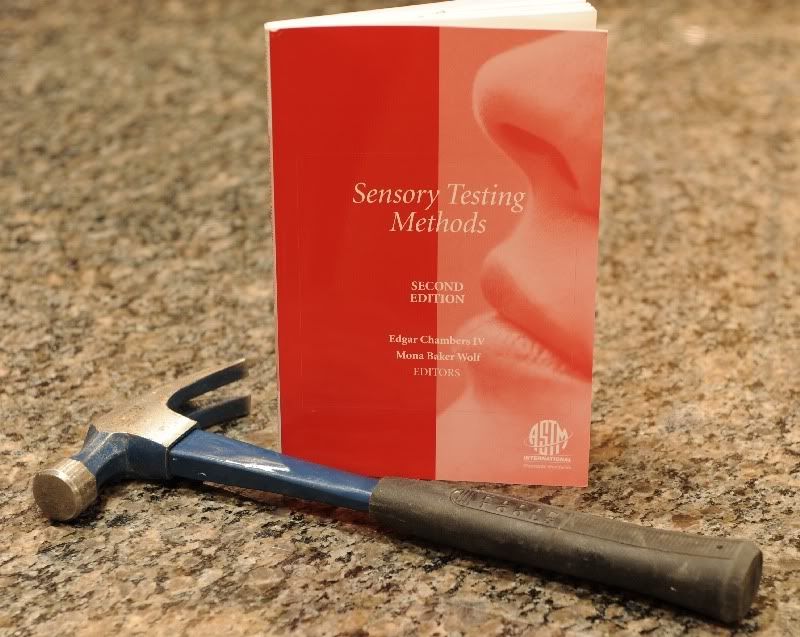
ASTM International (originally known as the American Society for Testing and Materials), is one of the largest voluntary standards development organizations in the world. ASTM is a trusted source for voluntary consensus technical standards for a wide range of materials, products, systems, and services. Standards developed at ASTM are the work of over 30,000 ASTM members. These technical experts represent producers, users, consumers, government and academia from over 120 countries. [Source: ASTM website, www.astm.org.]
The 2nd edition (1996) of the ASTM Sensory Testing Methods Manual is a revision to the classic STP 434 Manual on Sensory Testing Methods published in 1968. It discusses the science of sensory evaluation and its broad spectrum of methods and techniques that encompass psychology; statistics; product sciences, such as food science or cosmetic chemistry; physics and engineering; and other mathematics, sciences, and humanities. It provides a base of practical techniques and the controls that are necessary to conduct simple sensory studies. [Source: Amazon.com product description.]
Selected Quotes From The ASTM Sensory Testing Methods Manual (In Blue Bold Type)
"Although much of the early science on which sensory evaluation is based was developed by psychologists using simple taste solutions, and much of the development of sensory methods has taken place by sensory scientists working in the food industry, the methods have been adapted to a number of other categories of products and services.
In fact, any product or service that can be looked at, felt, smelled, tasted, heard, or any combination of those sensory modalities (that is, almost all products and services) can be analyzed using sensory methods." [From page 1, Introduction]
The duo-trio balanced reference test (commonly called the ABX test) is within the class of tests known as discrimination tests. The ASTM Sensory Testing Manual was the first literature source I found that referred to the discrimination test class as "forced choice discrimination methods"...but it makes perfect sense.:)
"The forced choice discrimination tests are used to confirm suspected small differences in product characteristics or product quality and to select respondents for discrimination tests.
Several variants of discrimination tests are described. If the frequency of correct solutions is higher than that expected by chance, then a difference is declared.
If the number of correct responses is lower than that needed to declare the samples are different then it is often incorrectly stated that the samples are "the same". Traditional difference tests do not measure sameness; they are designed to measure difference. Although difficult to understand, a rejection of difference is not a measure of similarity. When the test is conducted properly and "difference" is not found we infer that the samples are similar, and often state "the same", but proof of similarity was not measured using these test methods. This distinction is especially important when small numbers of respondents are used, because we now have low statistical power in the test and may incorrectly infer samples are the same when they are not." [Chapter 2 - Forced Choice Discrimination Methods, page 25]
On descriptive analysis tests:
"Descriptive analysis is one of the most common forms of sensory testing. Descriptive methods are used to measure the type and intensity of attributes in a product. Thus, these methods require the respondent to describe a product in terms of its characteristics and to measure the intensity of those characteristics using scaling procedures. Although some attributes are fairly simple and can be measured easily by almost anyone, real understanding of a product's specific characteristics and the strength of the attributes requires the use of respondents trained to describe sensory stimuli and to measure intensity of perception.
Descriptive sensory information is used in a variety of ways. It may serve to "fingerprint" a product for later comparison to new batches or other products." [Chapter 5 - Descriptive Analysis, page 58]
The "great debate" on cables only came about because people who are not trained and experienced in stereophonic perception do not have a framework of understanding to relate to the experiences of those who are trained and experienced in stereophonic perception. Here is another analogy that sums up the situation:
1. Two NFL quarterbacks are in an airport discussing the strategies they use to get gorgeous supermodels in bed and how easy it is for them to do so.
2. The quarterbacks are overheard by a male clothing store salesman who is incensed by what he assumes to be wild, fanatical tales. The salesman demands proof that it is as easy to get gorgeous supermodels in bed as the quarterbacks claim. He considers such women "unobtainable". He dismisses the media reports of people actually dating and marrying supermodels as "media hype". The salesman wants the NFL quarterbacks to prove that they can get supermodels in bed using the same methods the salesman uses to get retail store cashiers and department store cosmetic counter sales ladies in bed.
3. The quarterbacks explain, or try to explain, that the methods the salesman uses to get the women he can get would not be relevant to the pursuit of supermodels. The quarterbacks further explain that they live in a "different world" with different social, economic, and occupational rules.
4. The salesman smugly assumed and concluded that, since the NFL quarterbacks refused to demonstrate that they could get supermodels in bed using an irrelevant and ineffective testing methodology, there really is no proof that their previously discussed methods work as claimed.Proud and loyal citizen of the Digital Domain and Solid State Country! -
Ah yes, I figured pharmaceutical products would be the number one answer. So, you mean to tell me that for each medication your doctor prescribes, you first research the blind test results before getting the prescription filled?
Do you also post on Internet forums the importance of blind testing in relation to any of the items/products you mentioned? If not, why not?
Yes. However, this is because I'm a pharmacologist by trade. My profession involves designing and evaluating the studies used to assess the effectiveness of drugs. Since I focus on the subjective effects of drugs, nearly all of the studies are in fact, double-blind. So sure, I review the blinded test results for my meds.
From my experience doing double-blind studies, I'm always interested in the effects can (or cannot) report while under the blind. So I'd certainly engage someone regarding the merits of double-blind testing if given the chance (and I do). For example, I often have spirited debates with my "wine snob" father about the blinded testing of wine.
Regarding the "cables debate" specifically, I do think double-blind testing is perfectly suitable for evaluating audio equipment. Beyond that though, I don't really don't have a dog in the fight (so to speak). I think if someone loves their cables they should give them a big hug.Polk Fronts: RTi A7's
Polk Center: CSi A6
Polk Surrounds: FXi A6's
Polk Rear Surround: RTi4
Sub: HSU VTF-3 (MK1)
AVR: Yamaha RX-A2010
B&K Reference 200.7
TV: Sharp LC-70LE847U
Oppo BDP-103 -
Regarding the "cables debate" specifically, I do think double-blind testing is perfectly suitable for evaluating audio equipment. Beyond that though, I don't really don't have a dog in the fight (so to speak). I think if someone loves their cables they should give them a big hug.
Please clarify:
1. What specific performance aspects of stereo do you think are particularly well-suited to double blind testing and why?
2. In order to be fair, shouldn't you be advocating that every consumer blind test prescribed and over the counter medicines similar to the way that audio blind test proponents advocate that every audio consumer blind test every piece of audio gear they purchase or are considering purchasing?
3. Do you think we should expand blind testing into other consumer areas such as shopping for vehicles and shopping for homes? Couldn't a strong case for blind testing houses be made since people are often influenced by the outer appearance of a home and the neighborhood it is in rather than the more pertinent performance factors such as construction quality, room arrangement, and foundation integrity? When considering a vehicle purchase, shouldn't we get someone to drive us around while we are blindfolded so that we can assess a vehicle's ride comfort, cabin quietness, climate controls without being visually influenced by brand name, price, and model?Proud and loyal citizen of the Digital Domain and Solid State Country! -
badchad, I cannot better Ray's (DarqueKnight's) post so I will not attemp to.
I did want to point out that: I did not ask why blind tests *could* be used to evaluate streophonic audio. I asked why they *should* be used to evaluate stereophonic audio. If you can answer this (which is actually ralated to Ray's part #1 above) as well as Ray's other questions we would appreciate it. Thanks very much.
Taken from a recent Audioholics reply regarding "Club Polk" and Polk speakers:
"I'm yet to hear a Polk speaker that merits more than a sentence and 60 seconds discussion."
My response is: If you need 60 seconds to respond in one sentence, you probably should't be evaluating Polk speakers.....
"Green leaves reveal the heart spoken Khatru"- Jon Anderson
"Have A Little Faith! And Everything You'll Face, Will Jump From Out Right On Into Place! Yeah! Take A Little Time! And Everything You'll Find, Will Move From Gloom Right On Into Shine!"- Arthur Lee -
DarqueKnight wrote: »Standard procedures in sensory science indicate that blind testing in multi-dimensional stimuli scenarios with trained subjects is not needed. Going back to my examples of shopping for vehicles and homes, if a person is an educated shopper, why would the identity of the item under evaluation need to be hidden?
The purpose of the blind is to eliminate pre-existing bias. We all have these inherent biases, many of which we are unaware of. These biases are not always synonymous with education/training/etc.
Consider the interpretation of the study: Do you want to know whether noobs like the audio equipment, or whether audiophiles? There are certain scenarios where one may be more favorable than the other. A great example is Bose. People by it because of marketing, and because when they get you in their little demo room it sounds "good" because people don't know what to listen for.DarqueKnight wrote: »Physicians do not accept on blind faith that a particular FDA medicine will have the desired effect. Physicians often have to try a variety of medicines before they find one that works for a particular patient.
Just because a medicine performed well in clinical trials with the trial subjects, it does not mean the medicine will provide the desired and expected benefit for everyone. Likewise, stereo listeners should not accept on blind faith that a particular piece of audio gear with have the advertised and desired effect.
The purpose of an "experiment" is to select a sample population to gain data. The data is then extrapolated to the population as a whole. Of course physicians don't accept that a drug will work based on blind faith. They have a reasonable expectation of the likelihood that a drug will "work" (and its side effects) based on the completed data.DarqueKnight wrote: »Just because a piece of audio gear performed well in blind or nonblind trials, it does not mean the gear will provide the desired and expected benefit for everyone.
Agreed. It helps me determine the likelihood of the desired and expected benefit.DarqueKnight wrote: »Blind testing in medicine does not "prove" anything. All it does is indicate whether or not a medicine is *might be* effective in certain situations.
agreed.DarqueKnight wrote: »The FDA's oversight of blind trials is in no way similar to what audio blind test proponents demand. In medicine, a physician does not blind test each and every one of his patients (consumers) when prescribing medicine. In audio, blind test proponents say they will not accept that a piece of audio gear performs as advertised until every consumer who claimed to hear a benefit validates it with a blind test.
I would trust a reasonably well designed study (along with other factors) to inform my purchasing decisions. I never got the impression blind proponents demanded testing in every consumer. I certainly would not advocate that. That defeats the purpose of the testing.DarqueKnight wrote: »
You are absolutely wrong.
I provided two excellent globally accepted sensory science references that explain in detail why different types of tests should be used for trained and untrained subjects (participants).
I'll search the literature. I've attended more science-based meetings than I can remember with all sorts of blinded studies involving "experienced" and/or "trained" volunteers. I have personally completed studies in "experienced" and "trained" drug users evaluating their perceptions of effects.DarqueKnight wrote: »You are also confusing "experience" with "training". They are two different things. One can be experienced at some task and do it improperly. Many people are experienced at listening to stereo systems, yet they are untrained in sound localization and sound characterization techniques.
Depends on what your asking. If its a simple question such as: "Which sound do you prefer?" Neither may be needed. In some situations Both may be required, or a mixture of the two.DarqueKnight wrote: »This is from one of my threads from 2010:
A note that "forced discrimination" designs don't have to blinded. As the name implies, they simply "force" a subject to choose (usually between two alternatives). I'm curious what the text says about interpreting negative result. For example, it says:
"When the test is conducted properly and "difference" is not found we infer that the samples are similar, and often state "the same", but proof of similarity was not measured using these test methods."
So then, what does it mean? If subjects can't tell a difference between two treatments, then what?DarqueKnight wrote: »The "great debate" on cables only came about because people who are not trained and experienced in stereophonic perception do not have a framework of understanding to relate to the experiences of those who are trained and experienced in stereophonic perception. Here is another analogy that sums up the situation:
1. Two NFL quarterbacks are in an airport discussing the strategies they use to get gorgeous supermodels in bed and how easy it is for them to do so.
2. The quarterbacks are overheard by a male clothing store salesman who is incensed by what he assumes to be wild, fanatical tales. The salesman demands proof that it is as easy to get gorgeous supermodels in bed as the quarterbacks claim. He considers such women "unobtainable". He dismisses the media reports of people actually dating and marrying supermodels as "media hype". The salesman wants the NFL quarterbacks to prove that they can get supermodels in bed using the same methods the salesman uses to get retail store cashiers and department store cosmetic counter sales ladies in bed.
3. The quarterbacks explain, or try to explain, that the methods the salesman uses to get the women he can get would not be relevant to the pursuit of supermodels. The quarterbacks further explain that they live in a "different world" with different social, economic, and occupational rules.
4. The salesman smugly assumed and concluded that, since the NFL quarterbacks refused to demonstrate that they could get supermodels in bed using an irrelevant and ineffective testing methodology, there really is no proof that their previously discussed methods work as claimed.
Well, if someone approached me and said "I'm an NFL quarterback I lay tons of women", I'm not sure I'd believe them either. How about this: "I'm a science guy, you should see the chicks I lay". <--- whatcha think?Polk Fronts: RTi A7's
Polk Center: CSi A6
Polk Surrounds: FXi A6's
Polk Rear Surround: RTi4
Sub: HSU VTF-3 (MK1)
AVR: Yamaha RX-A2010
B&K Reference 200.7
TV: Sharp LC-70LE847U
Oppo BDP-103 -
No agenda here Greg but it can't be without merit when you have clever folks at companies like Harman(Revel,JBL) and those that utilize the facilities at the NRC(PSB) using it for loudspeaker R&D.More specifically, please tell us WHY blind tests SHOULD BE used for stereophonic audio evaluation (when trained listeners are used) . -
badchad, I cannot better Ray's (DarqueKnight's) post so I will not attemp to.
I did want to point out that: I did not ask why blind tests *could* be used to evaluate streophonic audio. I asked why they *should* be used to evaluate stereophonic audio. If you can answer this (which is actually ralated to Ray's part #1 above) as well as Ray's other questions we would appreciate it. Thanks very much.
I would provide the rather boring answer of "simple curiosity." But that is merely my personal opinion. I think human perception is a fascinating thing.
One could also make the "snake oil" argument that IF these differences provided by audio equipment are NOT detectable when examined free of bias, people are being unfairly swindled and taken advantage of. I don't particularly care for con artists, but on the other hand, I think if you can sell an eskimo a fridge, then go for it. So, I'm kinda torn on this.Polk Fronts: RTi A7's
Polk Center: CSi A6
Polk Surrounds: FXi A6's
Polk Rear Surround: RTi4
Sub: HSU VTF-3 (MK1)
AVR: Yamaha RX-A2010
B&K Reference 200.7
TV: Sharp LC-70LE847U
Oppo BDP-103 -
The purpose of the blind is to eliminate pre-existing bias. We all have these inherent biases, many of which we are unaware of. These biases are not always synonymous with education/training/etc.
The purpose of consumer training is to eliminate the effects of bias. If the effect of bias is eliminated, what is the basis then for blind tests? You seem to think that consumer bias is an insurmountable obstacle. If that were true, people would need to do blind testing for the most major purchases in life, such as homes and vehicles. Curiously, I don't see people advocating that, although blind tests could be adapted for such purchases.Consider the interpretation of the study: Do you want to know whether noobs like the audio equipment, or whether audiophiles? There are certain scenarios where one may be more favorable than the other. A great example is Bose. People by it because of marketing, and because when they get you in their little demo room it sounds "good" because people don't know what to listen for.
It was established in the literature many decades ago that home stereo systems were not designed for noobs and other naProud and loyal citizen of the Digital Domain and Solid State Country! -
The purpose of the blind is to eliminate pre-existing bias. We all have these inherent biases, many of which we are unaware of. These biases are not always synonymous with education/training/etc.
The purpose of consumer training is to eliminate the effects of bias. If the effect of bias is eliminated, what is the basis then for blind tests? You seem to think that consumer bias is an insurmountable obstacle. If that were true, people would need to do blind testing for the major purchases in life, such as homes and vehicles. Curiously, I don't see people advocating that, although blind tests could be adapted for such purchases.
There are biases much stronger than consumer bias, such as racial bias and gender bias, that people have overcome, yet blind test proponents act like visual bias is an insurmountable obstacle. Explain to me how this makes sense.Consider the interpretation of the study: Do you want to know whether noobs like the audio equipment, or whether audiophiles? There are certain scenarios where one may be more favorable than the other. A great example is Bose. People by it because of marketing, and because when they get you in their little demo room it sounds "good" because people don't know what to listen for.
It was established in the literature many decades ago that home stereo systems were not designed for noobs and other naProud and loyal citizen of the Digital Domain and Solid State Country! -
Well, if someone approached me and said "I'm an NFL quarterback I lay tons of women", I'm not sure I'd believe them either. How about this: "I'm a science guy, you should see the chicks I lay". <--- whatcha think?
My analogy was that of actual NFL quarterbacks and not of people pretending to be NFL quarterbacks. The quarterbacks in my analogy also did not approach anyone with claims of laying tons of women. It was two NFL colleagues discussing an aspect of their lives, when someone else with no relevant knowledge or experience barged in on their conversation demanding proof of what they were saying.
The situation in my analogy is similar to what happened in my thread here:
Five-Speaker-Jumper-Comparisons-For-The-SDA-SRS-1.2TL
where I was discussing cable performance evaluation results with some stereo performance enthusiasts, and someone with no knowledge of the subject matter decided to display their ignorance:I just lol'd...hard! Thread is so full of win! I just thought it was funny that the conclusion made was that the most expensive jumper was the "Best".
Just thought it was kinda ironic, I was warned about threads like these! Next thing you know I'll be getting asked to trade pinks..or in audiophile terms "Weber and Rinne results".Proud and loyal citizen of the Digital Domain and Solid State Country! -
DarqueKnight wrote: »The purpose of consumer training is to eliminate the effects of bias.
In the instance of audio, using Philips GoldenEar web site tools as example, the purpose of training is to increase the awareness of what to listen for.
You self administer and it's blind.
https://www.goldenears.philips.com/en/introduction.html
The single blind, which is adequate IMO for audio evaluation, is used to eliminate the effects of bias. You can only remove bias, you can't entirely train it away. The training is to help you with discerning differences that your hearing threshold allows.DarqueKnight wrote: »If the effect of bias is eliminated, what is the basis then for blind tests? You seem to think that consumer bias is an insurmountable obstacle. If that were true, people would need to do blind testing for the most major purchases in life, such as homes and vehicles. Curiously, I don't see people advocating that, although blind tests could be adapted for such purchases.
What does a car or home purchase have to do with blinded testing? I'm not testing ZLTFUL's cables. I'm testing his claim to discern the audible difference in the confines of a cable the meets CAT6 spec in a packet switched network.
People make car, house, furniture, paint, carpet decisions because they are items of sight. They are purchased on one of many criteria. Looks being one of the primary. You certainly won't find me challenging anyone because they purchased an Audio Quest $80 Ethernet cable because of it's looks. You like the way it dresses up your system that's great.
When you take the dubious step of saying it does X/Y/Z to the sound vs another competent CAT6 cable then I have to take issue since I understand how packet switched networks operate.








This discussion has been closed.