Dumb things you've heard from "audiophiles"...
Options
Comments
-
When did I ever claim that I had high-end gear???
You didn't, read what I said again.--Gary--
Onkyo Integra M504, Bottlehead Foreplay III, Denon SACD, Thiel CS2.3, NHT VT-2, VT-3 and Evolution T6, Infinity RSIIIa, SDA1C and a few dozen other speakers around the house I change in and out. -
I did reread it, and edited my post about the same time you posted this. Sorry.You didn't, read what I said again. -
Right, and there is still no scientific evidence of an audible difference from power cables. DK's post doesn't pretend that is what he's measuring, so why you do you keep trying to pretend it does?
How can you argue the lack of audibility when you've never tried to audibly hear the difference? That is the silliest thing I have ever read. To a person who has poor hearing they can look at the controlled measured frequency response (scientific evidence you require) of two speakers but will never be able to know if they can hear a difference. They measure to show a difference but until that person uses (in your world) a blind ABX test they won't know just by looking at a frequency plot.
You make an assumption that because the frequency response is different for two sets of speakers EVERYONE will hear the differences because the variation of frequency response MUST correlate to an audible difference for EVERYONE.
Again your bias is showing through because you won't apply the same assumption to the power cable.
H9"Appreciation of audio is a completely subjective human experience. Measurements can provide a measure of insight, but are no substitute for human judgment. Why are we looking to reduce a subjective experience to objective criteria anyway? The subtleties of music and audio reproduction are for those who appreciate it. Differentiation by numbers is for those who do not".--Nelson Pass Pass Labs XA25 | Galion TS P75 Pre | Holo Audio Cyan 2 Dac | MIT Shotgun S1 | Puritan Audio PSM136 Pwr Condtioner & Classic PC's | Legend L600 | Roon Nucleus 1 w/LPS - Tubes add soul! -
I'm at least willing to do it, and a proper scientific way at that.How can you argue the lack of audibility when you've never tried to audibly hear the difference?
There are also other measurements one can look at beyond a simply frequency plot.That is the silliest thing I have ever read. To a person who has poor hearing they can look at the controlled measured frequency response of two speakers but will never be able to know if they can hear a difference. They measure to show a difference but until that person uses (in your world) a blind ABX test they won't know just by looking at a frequency plot.
Different people will hear things differently, that is very true. Even if an ABX proves someone else can hear a difference in power cords, that doesn't mean I will. However, the fact that there is at least some audible difference is still enough for me to consider trying them. But as of now, there is no scientific evidence proving any audible difference.
Nope. However, if even a single person can't prove audibility, why should I bother? If at least someone can hear it, that shows there is at least some (albeit minute) audible difference, and it's worth my time and money to delve into.You make an assumption that because the frequency response is different for two sets of speakers anyone will hear the differences because the variation of frequency response MUST correlate to an audible difference for EVERYONE.
Sure I will. However, there are no measurements showing difference in the final output due to different power cables. There are also no DBT/ABX's to support claims either. My speakers at least have one of those two.Again your bias is showing through because you won't apply the same assumption to the power cable. -
Different people will hear things differently, that is very true. Even if an ABX proves someone else can hear a difference in power cords, that doesn't mean I will. However, the fact that there is at least some audible difference is still enough for me to consider trying them. But as of now, there is no scientific evidence proving any audible difference.
If different people hear things differently then how in the hell can scientific evidence prove something sounds different. By what standard are we using to make a measurement and then a correlation. By that statement you just admitted that there is a strong subjective aspect to this. So now what?
Your statement above is one huge contradiction. Unbelieveable, your logic is completely insane, I am in awe and speechless after reading the above quote. On one hand we all hear things differently, but you want a scientific method proving there is an audible difference for all...........I can't even begin to deternime where you get that sort of logic from. One of the sinle most illogical things I've ever read.
I'm out
H9"Appreciation of audio is a completely subjective human experience. Measurements can provide a measure of insight, but are no substitute for human judgment. Why are we looking to reduce a subjective experience to objective criteria anyway? The subtleties of music and audio reproduction are for those who appreciate it. Differentiation by numbers is for those who do not".--Nelson Pass Pass Labs XA25 | Galion TS P75 Pre | Holo Audio Cyan 2 Dac | MIT Shotgun S1 | Puritan Audio PSM136 Pwr Condtioner & Classic PC's | Legend L600 | Roon Nucleus 1 w/LPS - Tubes add soul! -
Nothing subjective about it. Either a person will hear a difference or not. We're not talking about describing how it is different, or which is preferred, as that actually would be subjective. Nope, we're simply talking about whether or not there is a difference. There are going to be things that no human can hear the difference in, which is the category that I claim power cables fall into. There will be things that some people will hear and others not. However, a study demonstrating that scenario still shows that there is some audible difference. It's not as complicated as you are making it out to be, and it is a purely objective study.If different people hear things differently then how in the hell can scientific evidence prove something sounds different. By what standard are we using to make a measurement and then a correlation. By that statement you just admitted that there is a strong subjective aspect to this. So now what?
Nothing contradictory about it. However, it is clear that you will make every effort to twist my words around to make them into what you want them to be.Your statement above is one huge contradiction. Unbelieveable, your logic is completely insane, I am in awe and speechless after reading the above quote. On one hand we all hear things differently, but you want a scientific method proving there is an audible difference for all...........I can't even begin to deternime where you get that sort of logic from. One of the sinle most illogical things I've ever read.
Have fun! :cheesygrin:I'm out -
If different people hear things differently then how in the hell can scientific evidence prove something sounds different. By what standard are we using to make a measurement and then a correlation.
By one single person demonstrating they can hear the difference in a controlled test. Is it really that hard to understand? -
So, keep on babbling. All you are accomplishing is to dig yourself deeper into the hole of absurdity and irrelevance, and are becoming an object to be mocked, ridiculed, and scorned.
Deeper and deeper he gets. He has passed beyond absurdity and irrelevance, and is quickly reaching the point of no return.Lumin X1 file player, Westminster Labs interconnect cable
Sony XA-5400ES SACD; Pass XP-22 pre; X600.5 amps
Magico S5 MKII Mcast Rose speakers; SPOD spikes
Shunyata Triton v3/Typhon QR on source, Denali 2000 (2) on amps
Shunyata Sigma XLR analog ICs, Sigma speaker cables
Shunyata Sigma HC (2), Sigma Analog, Sigma Digital, Z Anaconda (3) power cables
Mapleshade Samson V.3 four shelf solid maple rack, Micropoint brass footers
Three 20 amp circuits. -
And yet you dance around the obvious point. His tests don't show audible differences or measurements in the final audio output. This key, because this is what my argument actually centers around. I'm not arguing differences between the power cables themselves, I'm arguing the lack of audibility. Until you actually acknowledge that this is the center of my contention, your just using straw-man arguments.
Right, and there is still no scientific evidence of an audible difference from power cables. DK's post doesn't pretend that is what he's measuring, so why you do you keep trying to pretend it does?
Somehow I'm okay with your views on me. However, I have been consistent in my claims. You keep mentioning things that don't prove my claims wrong, particularly DK's post. Have you even read his post? I did.
Actually, I did discuss audibility. These quotes are from noise study #2:DarqueKnight wrote: »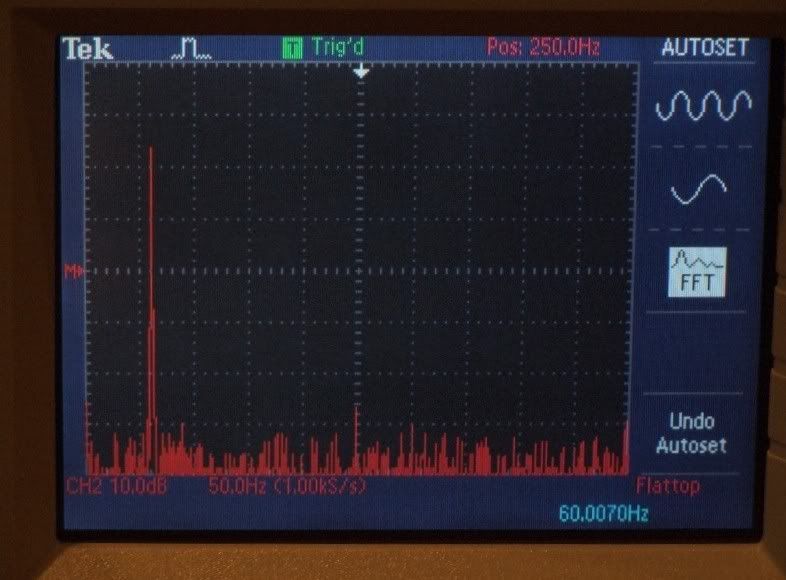
Figure 12. FFT plot at input of left speaker with stock power cord.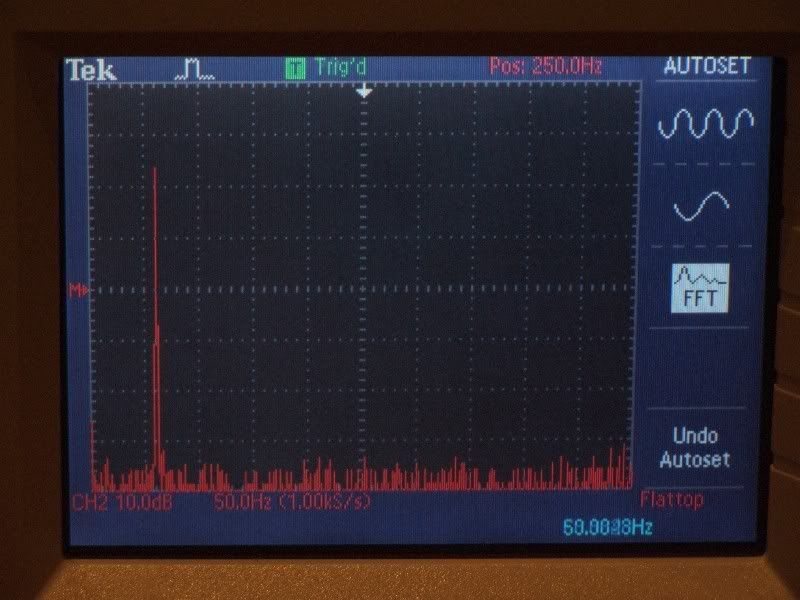
Figure 14. FFT plot at input of left speaker with Statement SC power cord.
If you copy figures 12 and 14 and flip between them, you will see an increase in the noise density throughout the frequency range. You will also see an average 4 dB increase in noise magnitude. That means over twice as much noise power was being dumped into my extensively modified and esteemed SDA SRS 1.2TL speakers with the stock power cord than with the Statement SC power cord.DarqueKnight wrote: »It was interesting to "fall back" and listen with the stock power cords. It was not unpleasant, but I was very surprised at the amount of musical details on familiar recordings that went missing. I was constantly listening for details that were either hard to hear or simply weren't there anymore. The sound stage shrank quite a bit also.
In the FFT plots, the rms voltage level of the 60 Hz test tone is 70 volts. The average rms noise around 60 Hz was 0.11 volt with the stock power cord and 0.07 volt with the Statement SC power cord.
The questions now are:
1. In a 70 volt signal, is a noise amplitude of 0.11 volt audible?
2. In a 70 volt signal, is a noise amplitude of 0.07 volt audible?
3. In a 70 volt signal, is a 64% reduction in noise amplitude (0.11 volt to 0.07 volt) audible?
The journal article cited below offers some insight.DarqueKnight wrote: »The title of the paper is "Psychoacoustic Detection Threshold of Transient Intermodulation Distortion, by M. Petri-Larmi, M. Otala and J. Lammasniemi. It was published in the March 1980 issue of the Journal of the Audio Engineering Society. The abstract is as follows:
"The audible threshold of transient intermodulation distortion (TIM) was determined for the six most sensitive subjects of the previously reported test series of 68 listeners. Improved equipment, carefully controlled listening environment, a digital TIM generator, and five recorded stereophonic music samples were used. The results show that in certain types of passages of music, a trained and sensitive listener can reliably detect extremely low values of distortion. Low distortion values were perceived only as changes in sound character, and not as distortion."
Some excerpts:
"The thresholds reported are for experienced, well-rehearsed subjects, and are therefore believed to be conservative. Further improvements in equipment and records may, however, yield lower thresholds in the future."
"The test records were selected on the basis of the experience gained from the previous investigation to represent technically excellent and audibly "clean" recordings."
"The subject was allowed to play the record for 15-30 minutes."
"Comprehensive auditory tests were performed for all the subjects."
"At the end of the learning period the subject was asked to indicate the distortion level he thought he could perceive in a blind A/B test."
"It can be noted that the reliable [distortion] detection threshold was 0.003% rms or 3% (peak), both for piano."
In the FFT plot of the speaker signal input, the noise is 0.11 volt or 0.16% of the total signal amplitude. Thirty-two years ago, a scholarly study showed that trained listeners using high quality media and equipment could detect noise as low as 0.003% of the total signal amplitude.
If it has been scientifically demonstrated that 0.003% noise is audible and the noise content in my study was 0.16% (over 53 times greater), is it reasonable to accept that my claim that an audible difference was realized when the power cords were switched?
With the better power cord, the noise content was 0.1%, which was over 33 times greater than the audibility threshold in the Petri-Larmi study.Proud and loyal citizen of the Digital Domain and Solid State Country! -
That's wonderful, but doesn't demonstrate any so-called difference between digital audio cables.
"Digital".... You keep using this word. I don't think it means what you think it means.
Not all "Digital" cables are the same. They are constructed differently and thus have different impedance regardless of what their use is for. Calling them "Digital" cables doesn't completely describe them.
My little anecdote is to show that the trace of a digital signal line and its resistance (I added resistance with a resistor but wires, cables, traces all have impedance) has a great effect on how it carries the signal. So the construction of a digital cable (all different by different manufacturers) will effect how well the signal is carried because the cable's impedance could vary greatly between manufacturers. Whether or not that has an effect in your system depends on the rest of your system. Again, the blanket statement that "it's digital, it shouldn't matter" is incorrect because there is no such thing as "digital". -
This kind of stuff is what makes Club Polk FUN. If we didn't have the occasional throw down, I probably wouldn't come around much. Just stay light hearted and keep the anti-panty bunch powder around.
-
^ +1
I got tired of arguing at another site. Being told that ALL SS amps sound exactly alike because it says so on paper. :rolleyes: My ears are f'ing liars! :evil: lol--Gary--
Onkyo Integra M504, Bottlehead Foreplay III, Denon SACD, Thiel CS2.3, NHT VT-2, VT-3 and Evolution T6, Infinity RSIIIa, SDA1C and a few dozen other speakers around the house I change in and out. -
Actually I'm still waiting for specific answers to everything posed in this post
http://www.polkaudio.com/forums/showthread.php?131666-Dumb-things-you-ve-heard-from-quot-audiophiles-quot-...&p=1756690&viewfull=1#post1756690
Why haven't you answered the very specific questions in detail? I would love to hear how you would set up a DBT and what scientific parameters you'd use as a basis for proper evaluation?
H9"Appreciation of audio is a completely subjective human experience. Measurements can provide a measure of insight, but are no substitute for human judgment. Why are we looking to reduce a subjective experience to objective criteria anyway? The subtleties of music and audio reproduction are for those who appreciate it. Differentiation by numbers is for those who do not".--Nelson Pass Pass Labs XA25 | Galion TS P75 Pre | Holo Audio Cyan 2 Dac | MIT Shotgun S1 | Puritan Audio PSM136 Pwr Condtioner & Classic PC's | Legend L600 | Roon Nucleus 1 w/LPS - Tubes add soul! -
I just want to clarify: even though my questions were directed to BJ, anyone should feel welcome to share their insights and knowledge.
Thanks.DarqueKnight wrote: »In the FFT plots, the rms voltage level of the 60 Hz test tone is 70 volts. The average rms noise around 60 Hz was 0.11 volt with the stock power cord and 0.07 volt with the Statement SC power cord.
The questions now are:
1. In a 70 volt signal, is a noise amplitude of 0.11 volt audible?
2. In a 70 volt signal, is a noise amplitude of 0.07 volt audible?
3. In a 70 volt signal, is a 64% reduction in noise amplitude (0.11 volt to 0.07 volt) audible?
In the FFT plot of the speaker signal input, the noise is 0.11 volt or 0.16% of the total signal amplitude. Thirty-two years ago, a scholarly study showed that trained listeners using high quality media and equipment could detect noise as low as 0.003% of the total signal amplitude.
If it has been scientifically demonstrated that 0.003% noise is audible and the noise content in my study was 0.16% (over 53 times greater), is it reasonable to accept that my claim that an audible difference was realized when the power cords were switched?
Scientific theory and evidence relating to why the noise amplitudes in my noise study could not have been audible would be very helpful to my understanding.Proud and loyal citizen of the Digital Domain and Solid State Country! -
BeefJerky, when you say Digital cable do you mean fiber optic? I am not sure if you know what Digital cables are. You say it like there is no way a digital signal can degrade.
Also, I am unsure if I would have believed that there is an audible difference in power cables or any cables for that matter until I heard it for myself. You need to keep an open mind. Science and Maths will only get you so far. Sooner or later you need to light that candle.
No scientific study is ever gonna tell my ears what they hear. If I didn't hear a difference I would have said you guys are full of **** but I do hear a difference. And sometimes a substantial difference at that. -
DarqueKnight wrote: »If it has been scientifically demonstrated that 0.003% noise is audible and the noise content in my study was 0.16% (over 53 times greater), is it reasonable to accept that my claim that an audible difference was realized when the power cords were switched?
With the better power cord, the noise content was 0.1%, which was over 33 times greater than the audibility threshold in the Petri-Larmi study.
I thought blind testing didn't work for audio? I see you are willing to accept it when it has the results you want.
If the Petri-Larmi study is correct, then it should be easy to demonstrate the difference a power cord can make, in a blind study, since the difference is 33 to 53 times greater than the audibility threshold. -
Wow,,,,,,,,,,,the silence is deafening!
Like I said, no amount of scientific proof is ever good enough for a naysayer.
H9"Appreciation of audio is a completely subjective human experience. Measurements can provide a measure of insight, but are no substitute for human judgment. Why are we looking to reduce a subjective experience to objective criteria anyway? The subtleties of music and audio reproduction are for those who appreciate it. Differentiation by numbers is for those who do not".--Nelson Pass Pass Labs XA25 | Galion TS P75 Pre | Holo Audio Cyan 2 Dac | MIT Shotgun S1 | Puritan Audio PSM136 Pwr Condtioner & Classic PC's | Legend L600 | Roon Nucleus 1 w/LPS - Tubes add soul! -
Yep...I just do what I do because, well, I can. Those who want to experiment, don't let "science" discourage you; especially since much of it is theory. If everything was so cut & dry, we'd all have the same system.Source: Bluesound Node 2i - Preamp/DAC: Benchmark DAC2 DX - Amp: Parasound Halo A21 - Speakers: MartinLogan Motion 60XTi - Shop Rig: Yamaha A-S501 Integrated - Source: Rotel CD14MkII CD Player - Speakers: Elac Debut 2.0 B5.2
-
You guys are more fun than a monkey's uncle !!!!!If you can't hear a difference, don't waste your money.
-
If different people hear things differently then how in the hell can scientific evidence prove something sounds different. By what standard are we using to make a measurement and then a correlation. By that statement you just admitted that there is a strong subjective aspect to this. So now what?
Your statement above is one huge contradiction. Unbelieveable, your logic is completely insane, I am in awe and speechless after reading the above quote. On one hand we all hear things differently, but you want a scientific method proving there is an audible difference for all...........I can't even begin to deternime where you get that sort of logic from. One of the sinle most illogical things I've ever read.
I'm out
H9
......Hyperbole much?:eek: -
As much as you and the other guys in this thread. One good hyperbole deserves another...........don't you think. Let me guess you are on the naysayers side because while there is as much hyperbole coming from them.....you just decided to pick mine out. Love the selective posting that goes on.
H9"Appreciation of audio is a completely subjective human experience. Measurements can provide a measure of insight, but are no substitute for human judgment. Why are we looking to reduce a subjective experience to objective criteria anyway? The subtleties of music and audio reproduction are for those who appreciate it. Differentiation by numbers is for those who do not".--Nelson Pass Pass Labs XA25 | Galion TS P75 Pre | Holo Audio Cyan 2 Dac | MIT Shotgun S1 | Puritan Audio PSM136 Pwr Condtioner & Classic PC's | Legend L600 | Roon Nucleus 1 w/LPS - Tubes add soul! -
As much as you and the other guys in this thread. One good hyperbole deserves another...........don't you think. Let me guess you are on the naysayers side because while there is as much hyperbole coming from them.....you just decided to pick mine out. Love the selective posting that goes on.
H9
....says the kettle,to the black......btw,skippy.....when are you actually,totally,completely....OUT?....let us know:rolleyes: -
Didn't know you cared so much about whether I was in or out? I'm out arguing with Beef as we are never going to resolve our POV's. Doesn't mean I can't comment further on the discussion with others. Or did I break some arbitrary rule I wasn't aware of?
Glad you stopped by to offer so much substance to the discussion, I'm sure it's appreciated :rolleyes:
H9"Appreciation of audio is a completely subjective human experience. Measurements can provide a measure of insight, but are no substitute for human judgment. Why are we looking to reduce a subjective experience to objective criteria anyway? The subtleties of music and audio reproduction are for those who appreciate it. Differentiation by numbers is for those who do not".--Nelson Pass Pass Labs XA25 | Galion TS P75 Pre | Holo Audio Cyan 2 Dac | MIT Shotgun S1 | Puritan Audio PSM136 Pwr Condtioner & Classic PC's | Legend L600 | Roon Nucleus 1 w/LPS - Tubes add soul! -
Again the silence is deafening.
H9"Appreciation of audio is a completely subjective human experience. Measurements can provide a measure of insight, but are no substitute for human judgment. Why are we looking to reduce a subjective experience to objective criteria anyway? The subtleties of music and audio reproduction are for those who appreciate it. Differentiation by numbers is for those who do not".--Nelson Pass Pass Labs XA25 | Galion TS P75 Pre | Holo Audio Cyan 2 Dac | MIT Shotgun S1 | Puritan Audio PSM136 Pwr Condtioner & Classic PC's | Legend L600 | Roon Nucleus 1 w/LPS - Tubes add soul! -
As I read through this thread I am considering a donation to the Institute for the Deaf Dumb and Blind.Vinyl, the final frontier...
Avantgarde horns, 300b tubes, thats the kinda crap I want...
-
Lol!!Source: Bluesound Node 2i - Preamp/DAC: Benchmark DAC2 DX - Amp: Parasound Halo A21 - Speakers: MartinLogan Motion 60XTi - Shop Rig: Yamaha A-S501 Integrated - Source: Rotel CD14MkII CD Player - Speakers: Elac Debut 2.0 B5.2
-
pffftt....I read today that a solid state Behringer pro amp sounds exactly the same as any solid state amp made by Krell or Conrad Johnson! :eek:--Gary--
Onkyo Integra M504, Bottlehead Foreplay III, Denon SACD, Thiel CS2.3, NHT VT-2, VT-3 and Evolution T6, Infinity RSIIIa, SDA1C and a few dozen other speakers around the house I change in and out. -
As I read through this thread I am considering a donation to the Institute for the Deaf Dumb and Blind.
Going to need a LOT of donations to take care of everyone.
H9"Appreciation of audio is a completely subjective human experience. Measurements can provide a measure of insight, but are no substitute for human judgment. Why are we looking to reduce a subjective experience to objective criteria anyway? The subtleties of music and audio reproduction are for those who appreciate it. Differentiation by numbers is for those who do not".--Nelson Pass Pass Labs XA25 | Galion TS P75 Pre | Holo Audio Cyan 2 Dac | MIT Shotgun S1 | Puritan Audio PSM136 Pwr Condtioner & Classic PC's | Legend L600 | Roon Nucleus 1 w/LPS - Tubes add soul! -
One clown shy of a circus I tell ya.....no....wait, I see one....yep, a full blown circus. Cotton candy anyone ?HT SYSTEM-
Sony 850c 4k
Pioneer elite vhx 21
Sony 4k BRP
SVS SB-2000
Polk Sig. 20's
Polk FX500 surrounds
Cables-
Acoustic zen Satori speaker cables
Acoustic zen Matrix 2 IC's
Wireworld eclipse 7 ic's
Audio metallurgy ga-o digital cable
Kitchen
Sonos zp90
Grant Fidelity tube dac
B&k 1420
lsi 9's -
I thought blind testing didn't work for audio? I see you are willing to accept it when it has the results you want.
What I said was:DarqueKnight wrote: »
The application of blind and double-blind tests is thought by a small, but vocal, minority in the audio community to be the supreme evaluation standard for detecting audible differences in audio systems. It is true that some types of audio systems are well suited for blind and double-blind A/B or A/B/X type tests. A/B and A/B/X tests are useful in scenarios when the two audio signals being compared are simple in nature. For example, telephone company engineers have routinely used, and continue to use, A/B and A/B/X tests to evaluate improvements in voice circuit quality. However, we must realize and understand that a test that is suitable for one type of audio system might not be suitable for another. It is worth noting that the same company (the Bell Telephone System) that was responsible for the invention and implementation of telephone service was the same company that was responsible for the invention and implementation of home stereophonic audio systems. It is even more interesting to note that while A/B and A/B/X tests were found to be appropriate for evaluating voice quality improvements on bandwidth-limited telephone circuits, subjective, non-blind listening tests based on careful listening, evaluator training and realistic home listening conditions were the scientific standards for the evaluation of stereophonic audio systems.If the Petri-Larmi study is correct, then it should be easy to demonstrate the difference a power cord can make, in a blind study, since the difference is 33 to 53 times greater than the audibility threshold.
The ability to perceive an audible difference in any trial will depend on many factors such as listener ability and system resolution. I could hear a difference between the two power cords in my system. If I had listened to both cords in another system, I might not have been able to distinguish between them. In another system, the difference(s) may be many multiples of some prior established audibility threahold, but could still be masked by other factors, such as the distortion performance of the loudspeaker or the room acoustics.
One thing to consider is that the Petri-Larmi study was a study in simple SIGNAL DISCRIMINATION. They were comparing signals corrupted with various levels of noise. They were not evaluating audible differences in similar types of AUDIO EQUIPMENT. Therefore, since Petri-Larmi was testing the discrimination ability of subjects, a discrimination test like A/B was appropriate.
Also worth considering is the fact that, before the Petri-Larmi A/B tests were conducted, much ground work was done to establish control factors. Listener hearing capability, listener experience with stereo sound, listener seating position, the resolution quality of equipment and length of trials were all appropriate to stereophonic testing. The Petri-Larmi study didn't put a group of random people in a room and start swapping gear in a low resolution system.
One final thing to consider is that I, and other audiophiles, conduct many "accidental" blind tests throughout the year. These "blind tests" occur when we change something in our system and some disinterested party, (wife, girlfriend, random visitor) notices that "something sounds different".
Did you find my research, comments and calculations to be reasonable with regard to the audibility of measured differences in noise content between two power cables?Proud and loyal citizen of the Digital Domain and Solid State Country!


This discussion has been closed.