Bi Amping with a AVR

Ok,
This is something I never feel is necessary or a good idea YET I might mess around with this feature. It's been a long time since I even considered this to be an option.
Now for those who have done it, does it really make any difference at all when you already have more power than you need? I didn't read the manual on what exactly the AVR does to the signal, does it just feed full range out of both amps or I'm wondering if there is crossover settings you can change in the AVR to limit the amount of frequencies on each amp channel. My AVR shows using one set as the top of your speaker and the other as the bottom of your speaker. That got me thinking that maybe they allow you to use an internal AVR crossover as an external crossover ? I'm probably way over thinking this.
What has been your experience messing around with this feature?
This is something I never feel is necessary or a good idea YET I might mess around with this feature. It's been a long time since I even considered this to be an option.
Now for those who have done it, does it really make any difference at all when you already have more power than you need? I didn't read the manual on what exactly the AVR does to the signal, does it just feed full range out of both amps or I'm wondering if there is crossover settings you can change in the AVR to limit the amount of frequencies on each amp channel. My AVR shows using one set as the top of your speaker and the other as the bottom of your speaker. That got me thinking that maybe they allow you to use an internal AVR crossover as an external crossover ? I'm probably way over thinking this.
What has been your experience messing around with this feature?
Dan
My personal quest is to save to world of bad audio, one thread at a time.
My personal quest is to save to world of bad audio, one thread at a time.
Comments
-
Maybe you should read the manual, then throw it away, you cannot double the power no matter what it says....
-
The amplifier would still be running off the same power supply, and I doubt there would be any type of active crossover built into the AVR. Even if the AVR had an active crossover for this, which I doubt it does what would be gained when it's still going through a passive crossover.
-
I think one of my Pioneer Elite receivers with the class D amp section has an internal setting to "biamp" the main speakers with power that would otherwise go to unused channels. I haven't noticed that doing that helps or harms anything.
-
The amplifier would still be running off the same power supply, and I doubt there would be any type of active crossover built into the AVR. Even if the AVR had an active crossover for this, which I doubt it does what would be gained when it's still going through a passive crossover.
Modern AVRs all have active crossovers. How do you think the subwoofer/bass management works? Each channel has an active crossover with high pass and the sub channel is low pass. It would be very easy for the manufacturer to write the software to do band-pass for 80Hz through ~3KHz and high pass for tweeter.
However, the AVR is still limited by the power supply, more so than the current capabilities of each channel. So, in my opinion, it is mostly a gimmick feature that won't improve the sound. It just adds more speaker wire into the mix.
-
Maybe you should read the manual, then throw it away, you cannot double the power no matter what it says....
I plan on reading the manual tonight, just a thought as my AVR has a mad amount of channels.
I have the Integra DRX 8.4.Dan
My personal quest is to save to world of bad audio, one thread at a time. -
The amplifier would still be running off the same power supply, and I doubt there would be any type of active crossover built into the AVR. Even if the AVR had an active crossover for this, which I doubt it does what would be gained when it's still going through a passive crossover.
Not sure if any. It does it so I figured why not mess around with it. it will cost me absolutely nothing to do so, I have plenty of equal length speaker cables and the speakers can be bi amped and the AVR can bi amp, I figured if it does nothing, at least I gave it a go.
But I hear yeah, it's basically how I felt when AVR's started offering this feature. Many AVR's have more channels than ever get used.Dan
My personal quest is to save to world of bad audio, one thread at a time. -
I think one of my Pioneer Elite receivers with the class D amp section has an internal setting to "biamp" the main speakers with power that would otherwise go to unused channels. I haven't noticed that doing that helps or harms anything.
I'm gonna find this out myself as well, I'm gonna do it tomorrow.Dan
My personal quest is to save to world of bad audio, one thread at a time. -
The amplifier would still be running off the same power supply, and I doubt there would be any type of active crossover built into the AVR. Even if the AVR had an active crossover for this, which I doubt it does what would be gained when it's still going through a passive crossover.
Modern AVRs all have active crossovers. How do you think the subwoofer/bass management works? Each channel has an active crossover with high pass and the sub channel is low pass. It would be very easy for the manufacturer to write the software to do band-pass for 80Hz through ~3KHz and high pass for tweeter.
However, the AVR is still limited by the power supply, more so than the current capabilities of each channel. So, in my opinion, it is mostly a gimmick feature that won't improve the sound. It just adds more speaker wire into the mix.
Kinda where my thinking went. I don't expect any improvements, just curious if anything. I never bi amped anything I have ever owned.Dan
My personal quest is to save to world of bad audio, one thread at a time. -
It's a gimmick/marketing hype.Political Correctness'.........defined
"A doctrine fostered by a delusional, illogical minority and rabidly promoted by an unscrupulous mainstream media, which holds forth the proposition that it is entirely possible to pick up a t-u-r-d by the clean end."
President of Club Polk -
Same concept…
“Human beings are born with different capacities. If they are free, they are not equal. And if they are equal, they are not free.”
― Aleksandr Solzhenitsyn -
The amplifier would still be running off the same power supply, and I doubt there would be any type of active crossover built into the AVR. Even if the AVR had an active crossover for this, which I doubt it does what would be gained when it's still going through a passive crossover.
Modern AVRs all have active crossovers. How do you think the subwoofer/bass management works? Each channel has an active crossover with high pass and the sub channel is low pass. It would be very easy for the manufacturer to write the software to do band-pass for 80Hz through ~3KHz and high pass for tweeter.
However, the AVR is still limited by the power supply, more so than the current capabilities of each channel. So, in my opinion, it is mostly a gimmick feature that won't improve the sound. It just adds more speaker wire into the mix.
That is not how the manuals usually say how to bi-amp, they say to use the main left/right and the surround channels. -
Modern AVRs all have active crossovers. How do you think the subwoofer/bass management works? Each channel has an active crossover with high pass and the sub channel is low pass.
That's seriously stretching things and one would still be using the passive crossover in the speakers.Political Correctness'.........defined
"A doctrine fostered by a delusional, illogical minority and rabidly promoted by an unscrupulous mainstream media, which holds forth the proposition that it is entirely possible to pick up a t-u-r-d by the clean end."
President of Club Polk -
Modern AVRs all have active crossovers. How do you think the subwoofer/bass management works? Each channel has an active crossover with high pass and the sub channel is low pass.
That's seriously stretching things and one would still be using the passive crossover in the speakers.
Not too mention that most AVR'S I've ever used have that crossover at line level so if you are using passive speakers where would the amplification come from. -
I think you guys don't understand how modern AVRs work. The DSP can time shift, apply multiple parametric eqs, level control, and high/low pass filters.
Again, we all agree that the biamp feature is a gimmick, so no need to argue.
-
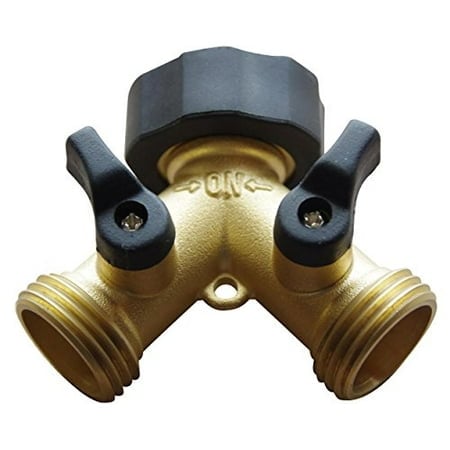
Same concept…
If that doubled the volume of water, just wait until you try the four hose version. I halved my water bill with it, doubled times!
Double the water, double times!!! -
Ok so I decided last night to give this a go as it's not going to cost me any money, I have everything I need to try it out and why not? This is a hobby and why not have fun with it?
Anyway I'm using an AVR to do the Bi amping. I have a Integra Flagship DRX8.4
Here are the amp spec's
11-channel amplifier
150 watts per channel into 8 ohms (20-20,000 Hz) at 0.08% THD, with 2 channels driven (FTC Power Output Rating)
symmetric Class AB amplifier design
two ESS Sabre ES9026PRO 32-bit Hyperstream® II DACs provide high dynamic range and low distortion
Integra engineered chassis and audio signal path for optimum noise reduction and signal clarity
The AVR weighs in at a hefty 49.6 LBS.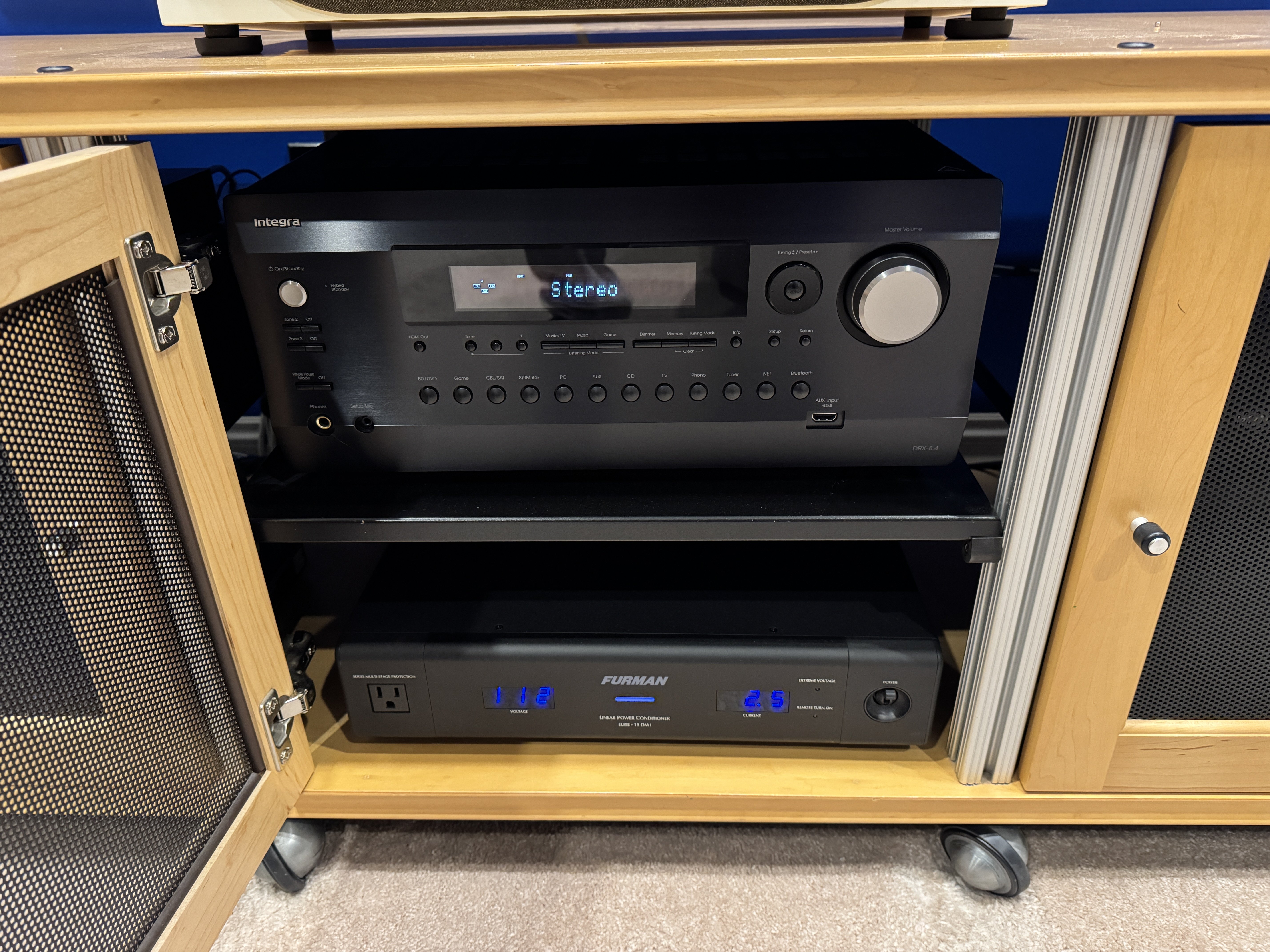
So the Integra is not a typical AVR, it has a massive amp section and it's stupid powerful.
Anyway, This is basically a 1 to 2 minute setup especially when using banana plug equipped speaker wire. I just grabbed my premade Rocket 33's and my Type 9's both audioquest cables to get this wired and try it out.
On the AVR side, you wire one set to the main Left or right out then you also use the surround back channels to wire the other terminals. So now you're using 4 amp internal amp channels of the AVR instead of just 2. Here is what that looks like on the speaker ends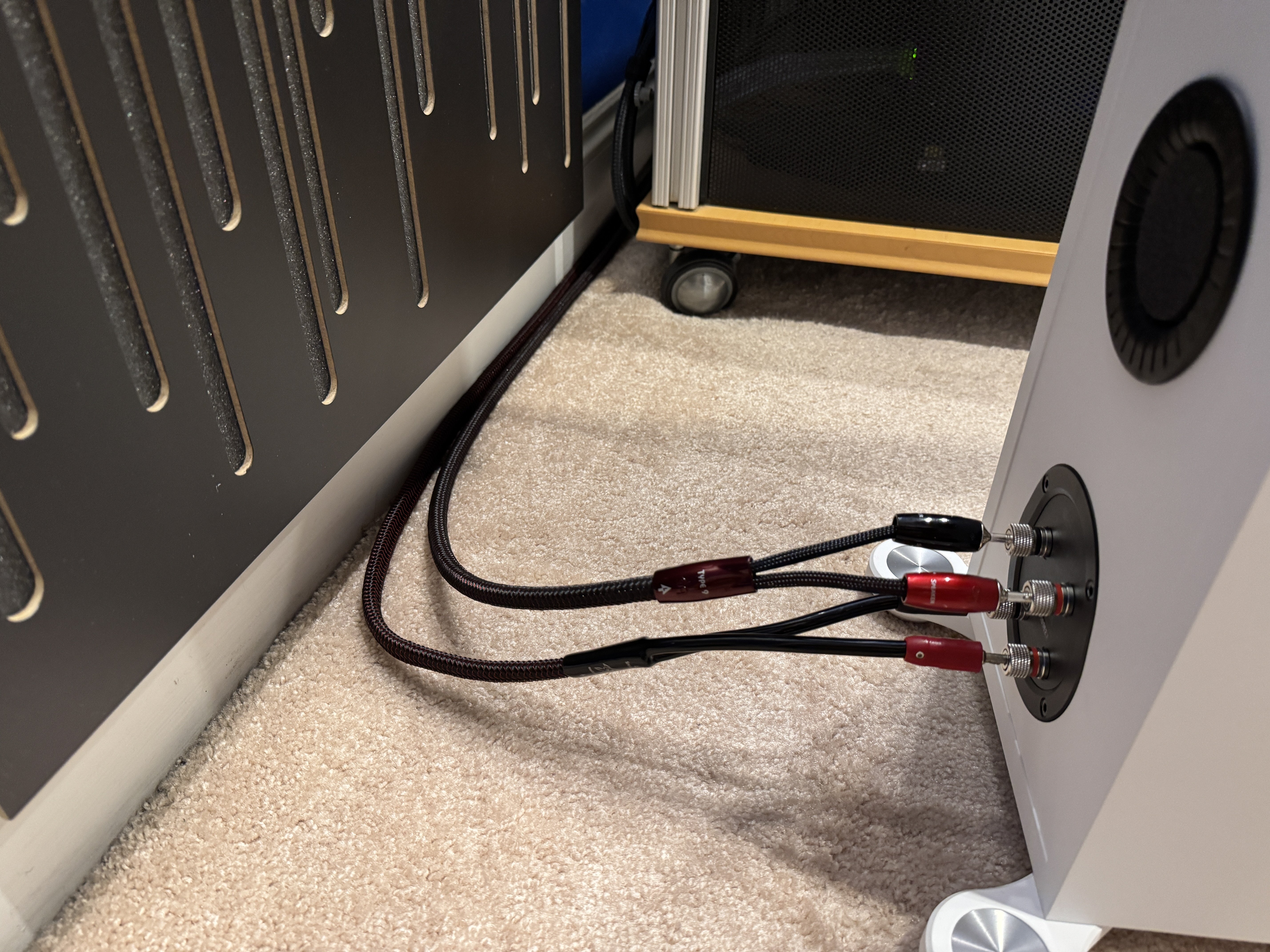
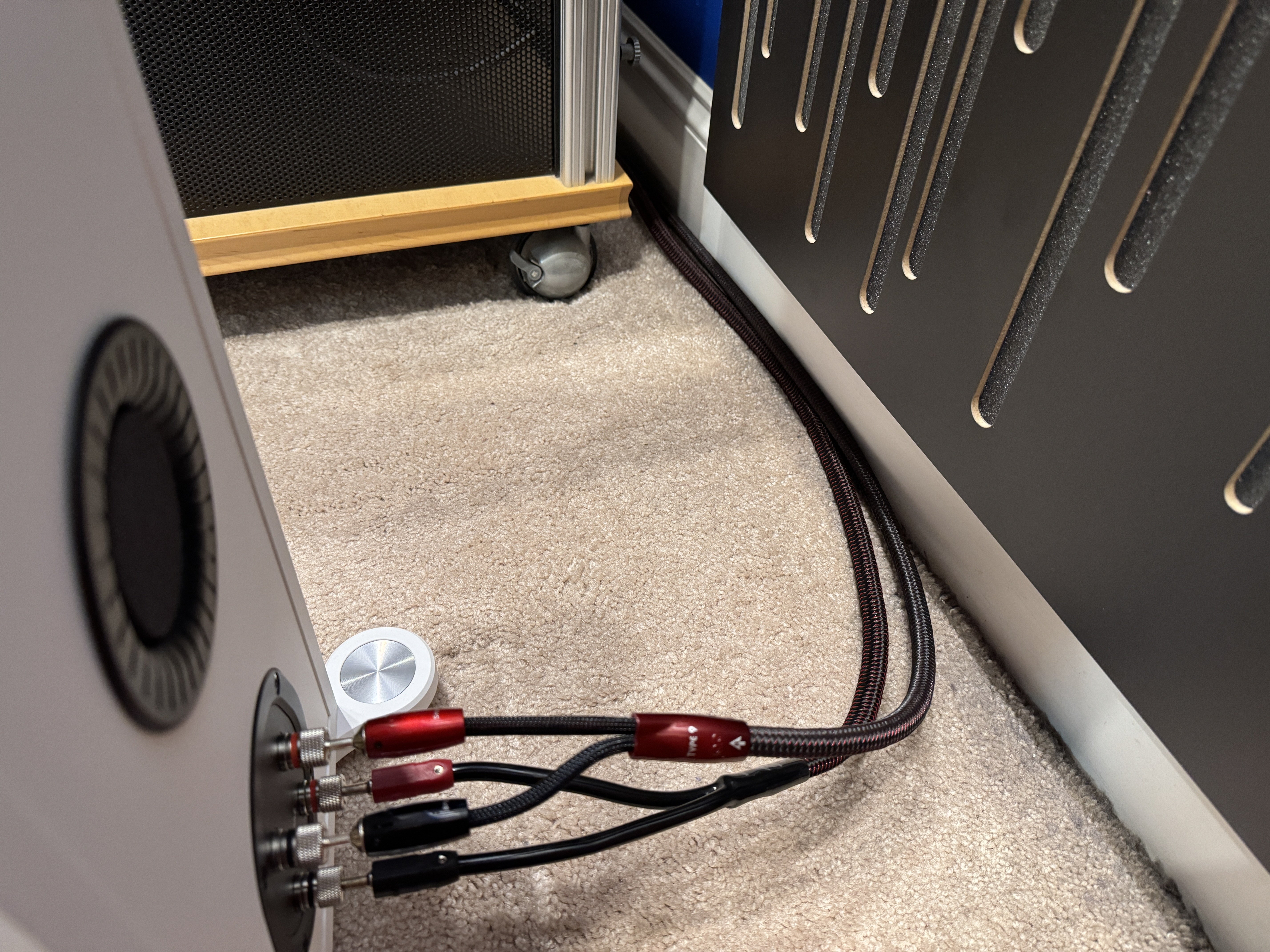
So before I tell you what I heard or lack there of, if you have to go spend a ton of money to get this done, is this worth doing? Well if you want higher end speaker cables, this can be a costly adventure and IMO I don't think the small gain I got would be worth investing that much money into this. If you were to buy just the Type 9 speaker cables at 8 feet, they retail for $819.99. Then if you where to buy the Rocket 33 in the same length 8 feet your looking at another $769.99. That's a considerable amount of money spent on just speaker wire.
I'd also say if you have a lower than flagship AVR that doesn't have the current and big power supply like the Integra does, I would skip out on this.
So with all that in mind, what happened here?
I got a small improvement in dynamic range. This wasn't night and day or anything like that. But at higher volumes, I noticed a slight increase in dynamics. So what I did was un configure the bi amping and went to single amp configuration but I used the Rocket 33's so I wasn't also using different speaker wire to get this done. I have the jumpers and some 14 gauge speaker wire to also see if the jumpers or wire jumpers make any changes at higher volumes I can hear so my test isn't skewed.
The dynamics are still basically the same. You don't really lose much when running just 2 amps vs 4 amps. When I listen at normal listening levels for me, there wasn't much of a difference at all. It was only when I cranked up damn loud that you noticed a slight difference in dynamics which also gave the impression of better separation of sound, clearer presentation and you can pin point out sounds that seemed to have more air around them than when single wired.
So again, I don't think anyone should run out and purchase more speaker wire and expect this huge difference. It's not, it's small and under normal listening levels, not noticeable at all.
I even gave a few movie clips a go and this is where I noticed nothing different. I don't think the main channels need more power than the Integra already puts out with 1 amp channel. Running 2 to a single speaker does make a difference but it's small and situational.
At this point, I might leave it be and live with it for a week, then remove it live with it for another week and see if I want to have all this damn speaker wire running. I like simple at this point in my life but I also enjoy having fun and doing personal tests like this.
We can all listen to each other's advice and opinions on what works what doesn't post funny faucet splitters and make fun of a feature most newer AVR's have in them. And without actually doing it yourself, experiencing the differences no matter how big or small, I'll take experience over opinion every day of the week. Not to discount opinion I still find value in that but I also favor experienced opinions over I THINK opinions. If you haven't tried this, I don't think your opinion holds enough weight other then your experiences and thinking this through logically which I'm in that boat with you as I never bothered to do this as I felt it was a waste of time and money. BUT It's freezing outside, I'm working from home, I have the house to myself and what the hell. Learn to learn I say.
I had fun either way.
Dan
My personal quest is to save to world of bad audio, one thread at a time. -
Cool. Having fun is what it is all about. I really think there could be a noticeable improvement IF the speaker had a way to bypass the passive crossover AND the AVR software was written to provide a true active crossover bi-amp like I mentioned above. I firmly believe the DSP hardware is more than capable of doing it, but I was unable to determine if any of the manufacturers have actually written the software to implement it that way.
-
I guess I do know how modern AVR'S work.
-
Not too mention that most AVR'S I've ever used have that crossover at line level so if you are using passive speakers where would the amplification come from.I guess I do know how modern AVR'S work.
Your comment above is contradictory to that claim. -
So you are saying that when you bi-amp with the front left/right and 2 surround channels you can split the signal before it goes to the AVR power amplifier output stage? -
So you are saying that when you bi-amp with the front left/right and 2 surround channels you can split the signal before it goes to the AVR power amplifier output stage?
I was saying the manufacturers "could" do it that way since the speaker setup/bass management is all in the preamp "digital domain" stage. The hardware DSP chips are more than capable of doing it, but I don't know for sure if any of the manufacturers have written the setup software to actually do it that way. Car audio DSP's have had that ability for more than 20 years. My newest AVR came out in 2016, so it's not exactly cutting edge. Dan's Integra receiver is much newer and he might have that option since Integra caters to custom installers, but I'm not sure if he explored it. -
I know Yamaha is crossing over the signal before it reaches the amplifier section- Not Tom ::::::: Any system can play Diana Krall. Only the best can play Limp Bizkit.
-
I know Yamaha is crossing over the signal before it reaches the amplifier section
Then it should work just like an active crossover and you shouldn't need the passive crossover network in the speaker. -
How the Integra Works is it just adds the amps. You use Surround back channels and you re assign them to Bi amp the fronts.
However Small settings still apply and the crossover is also still applied inside the AVR. However you don't manage the 4 internal amps to crossover each amp , it still acts as if you only had a single amp channel driving your mains.
Now another feature my AVR has is also Bi Amping the Center channel, which is kinda cool? I might fool around with that configuration as well. You can BI Amp the Left - Right - Center all at one time. You can do this in a 7.1 configuration which is still considered a Atmos setup. I think I lose one pair of atoms channels IF I wanted to Bi amp the center channel as well. Crazy how many configurations this AVR has.
Another feature that's pretty unique is I can run Balanced connections for Left Center and right channels to an external amp PLUS I can run Balanced connections to 2 Subwoofer all at the same time. The Preamp section in this AVR is feature and connection Packed .
Dan
My personal quest is to save to world of bad audio, one thread at a time. -
You were still not bi-amping, full stop.Political Correctness'.........defined
"A doctrine fostered by a delusional, illogical minority and rabidly promoted by an unscrupulous mainstream media, which holds forth the proposition that it is entirely possible to pick up a t-u-r-d by the clean end."
President of Club Polk -
I think you are not understanding.
It is a hi pass for the speakers cutting out bass. This frees up headroom for the amps and speakers. It does not replace a passive crossover- Not Tom ::::::: Any system can play Diana Krall. Only the best can play Limp Bizkit. -
Ok ,
so after all the configuration discussions, I wanted to further comment on this AVR's performance with Bi Amping your speakers. I'm starting to notice more things. I worked from home today and no one was home most of the day so I got to play around more.
What I'm noticing is an increase in SPL. I think the dynamic range absolutely improved over just single channel wiring. This AVR has power reserves so I assume they used some good Capasitors in it. I'm now more interested in researching the build of this internal amp design. I know Pioneer and Onkyo both worked on its abilities and redesigned how they did things in the past. It was hyped up a lot when it came out .
I'm also noticing more detail. I was just watching some YouTube videos and I'm hearing more sounds in the videos than I did before. I'm sure the sounds where there like back ground sounds, echo from the room the person is in, outdoor sounds from inside the house on the person talking, distance alarm sounds, all kinds of silly things I didn't notice before. Again I think all of this was there just recessed back into the soundtrack and now it seems more forward.
Music is on another level as I'm getting the widest soundstage . Now some of that also could be the number of hours I'm clocking in on my speakers, they are brand new but honestly they got a lot of playtime on them from me and my family. My system is controlled by a home automation system so the system is on anytime anything is watched or listened to.
So for those who are on the fence with bi amping from your AVR, and you're close to or have a flagship model, I say give it a try. For me again this didn't cost me a dime. I have all the parts I needed to give this a try and if it sucked or yielded the same exact results, no loss other than time spent on a freezing day .Dan
My personal quest is to save to world of bad audio, one thread at a time. -
Dan
My personal quest is to save to world of bad audio, one thread at a time. -
DelusionalPolitical Correctness'.........defined
"A doctrine fostered by a delusional, illogical minority and rabidly promoted by an unscrupulous mainstream media, which holds forth the proposition that it is entirely possible to pick up a t-u-r-d by the clean end."
President of Club Polk -
I think you are not understanding.
It is a hi pass for the speakers cutting out bass. This frees up headroom for the amps and speakers. It does not replace a passive crossover
Not quite sure who you are commenting on. It internal passive crossovers inside the speakers are still intact. I would not attempt to remove them and go direct with external passive, digital or external crossovers of any kind. I don't know what frequencies are best placed where. My Speakers are a 2 and a half way design so the Mid bass driver gets the mid range plus low extension, the lower bass driver only gets low bass info and I have no idea where those crossover points are.
Dan
My personal quest is to save to world of bad audio, one thread at a time.