Bi Amping with a AVR
Options
Comments
-
Without going to crazy into this, the fact you are utilizing the same power supplies negates any perception of biamping to me- Not Tom ::::::: Any system can play Diana Krall. Only the best can play Limp Bizkit.
-
That's fine, you can have your opinion but today's AVR's have this capability and it works just fine. You can clearly hear a difference between single amp and bi amp in this " Delusional configuration".
I know external amps, external active crossovers are where you are coming from but this is a feature that is pretty fun and cool to mess with. Again for me, if it sucks , who cares I just reconfigure back to the way it was and it was an experience.Dan
My personal quest is to save to world of bad audio, one thread at a time. -
That's one big reason you are not actually bi-amping.I would not attempt to remove them and go direct with external passive, digital or external crossovers of any kind. -
Without going to crazy into this, the fact you are utilizing the same power supplies negates any perception of biamping to me
By definition , wouldn't that be considered Vertical Bi Amping? Just like if you used an external Multi Channel amp? In order to Bi Amp, is your definition Mono blocks only?
People use 2 channel Bryston amps 2 of them and bi amp thier speakers. What is that called then?Dan
My personal quest is to save to world of bad audio, one thread at a time. -
Passive crossover networks found in consumer speakers waste an enormous amount of power. The often complex network is made up of large coils, chokes, capacitors and resistors. The circuit splits the full range signal into different frequencies (low, mid and high) appropriate for the different drivers in the speaker. Further, a crossover network compensates for efficiency differences in the drivers; woofers demand mode power than midrange drivers which in turn demand more power than tweeters, etc. Further, each of the drivers has different sensitivities, with some requiring far more (of far less) power than other drivers in the same speaker system. In a passive crossover, the excess power not required is dumped into resistors and burned off as heat. This makes for an incredible waste of power.
in addition, passive crossovers do much to degrade the signals that pass through them, and wastes a good deal of amplifier power, so bi-amping is an attractive idea. But there are pitfalls to be recognized before one embarks on that journey.
As we have seen, the key part of the equation is the electronic crossover. Splitting the signal at line level allows us to bypass the lowly passive network. So, buy another amp, an electric crossover and you are off to races. Ah, but it's not that simple. Now comes the task of calibrating the crossover to your speakers; making sure that the drivers are sent the specific frequencies their designers intended, and that slopes (the rate at which the transition between the frequencies occur, and how much they overlap) are correctly set. These adjustments are key to not only optimum performance, but system safety; operating a driver beyond its range will likely result in its failure. Maybe you've read the book, "Poof the Mangled Driver"?
Ok, so what about just using two amplifiers and forgetting about the electronic crossover? Simply using two amplifiers is not true bi-amping and does not offer the same advantages; we still face the limitations of the passive crossover. What about the notion that bi-amping reduces stress on the amplifiers since they are powering only limited frequency ranges? That would be true in a true bi-amp configuration where the frequencies are split ahead of the amplifiers, but in a passive environment both amplifiers receive a full range signal from the preamp and dump that power into the speakers, regardless of whether one is connected to the tweeter or woofer inputs. The only benefit (and it marginal at best) is simply the additional power offered by the second amp. -
That's one big reason you are not actually bi-amping.I would not attempt to remove them and go direct with external passive, digital or external crossovers of any kind.
Speaker bi-amping is an audio technique that uses two separate amplifier channels to drive a single loudspeaker, with one channel powering the high-frequency driver (tweeter) and the other powering the low-frequency driver (woofer). This approach separates signal paths to reduce intermodulation distortion, improve sound, and increase dynamic headroom.
Key Aspects of Bi-Amping:
Requirements: Speakers must have dual binding posts (four terminals total) with the connecting metal straps (jumpers) removed.
Connection: Two sets of speaker wires are used per speaker—one set from Amp A to the high-frequency terminals, and another from Amp B to the low-frequency terminals.
Types:
Passive Bi-amping: Uses the speaker's internal crossover, allowing two stereo amps or a single receiver with assignable channels to power the highs and lows separately.
Active Bi-amping: Removes the internal crossover, utilizing an external electronic crossover before the amplifiers for higher efficiency.
Benefits: Enhanced sound separation, greater power, and reduced interaction between high-current low frequencies and low-current high frequencies.Dan
My personal quest is to save to world of bad audio, one thread at a time. -
You can actually bi-amp at line level with a passive line level crossover, but it only works well in very select amplifier and speaker combinations.
-
Nota bene: That 150 watt "FTC" rating only applies when only two channels are operated (i.e., traditional stereo, into 'full-range' loudspeakers, with their own crossovers) -- in other words, one load per channel, two channels in toto.
If any of the other amplifier channels are doing anything (mulitchannel or bi/tri/hetero/active/passive/aggressive, whatever)... well...it won't apply. There is only one power supply for them all.
-
Wishful thinking.
-
-
This content has been removed.
-
Damn!! All this talk about bi-amping has me thinking that just maybe I need to get my hands on another Benchmark AHB2 amp to see what benefits it would have on my JBL monitors. 🤔
-
nooshinjohn wrote: »I have Mono's, one for each speaker. That is not Bi-amping either, so you sure as hell are not doing it from a single power supply. I don't care what the individual channels are or how you assign them. The very definition of bi-amping itself negates your point.
Passive Bi-amping: Uses the speaker's internal crossover, allowing two stereo amps or a single receiver with assignable channels to power the highs and lows separately.Dan
My personal quest is to save to world of bad audio, one thread at a time. -
Dan
My personal quest is to save to world of bad audio, one thread at a time. -
mhardy6647 wrote: »Nota bene: That 150 watt "FTC" rating only applies when only two channels are operated (i.e., traditional stereo, into 'full-range' loudspeakers, with their own crossovers) -- in other words, one load per channel, two channels in toto.
If any of the other amplifier channels are doing anything (mulitchannel or bi/tri/hetero/active/passive/aggressive, whatever)... well...it won't apply. There is only one power supply for them all.
Go to 12.54 and learn about the Onkyo version which is the lowest end model to use this amp section. The Pioneer Elite and Integra all use the same amp section. It actually put out 170 watts 20 to 20 2 channels driven which is pretty damn powerful for a AVR. 7 channels driven 133 watts 20 to 20. Again that is a hell of an amp section inside a AVR.
Check out the video https://youtu.be/AhUPirMGydQ?si=m4DZV4Oa4pKyCDsq Dan
My personal quest is to save to world of bad audio, one thread at a time. -
Then why doesn't any AVR I've tried drive my polk sda2a speakers without the protection circuit tripping or the drivers blowing, not enough current that's why.
-
Dan, from your own post.Passive Bi-amping: Uses the speaker's internal crossover, allowing two stereo amps or a single receiver with assignable channels to power the highs and lows separately.
Active Bi-amping: Removes the internal crossover, utilizing an external electronic crossover before the amplifiers for higher efficiency.
Benefits: Enhanced sound separation, greater power, and reduced interaction between high-current low frequencies and low-current high frequencies.
What's missing from the passive description?
BENEFITS!!!
Why you ask?
The passive crossovers. A point you seem to be missing...entirely. -

Gustard X26 Pro DAC
Belles 21A Pre Upgraded with Mundorf Supremes
B&K M200 Sonata monoblocks refreshed and upgraded
Polk SDA 1C's modded / 1000Va Dreadnaught
Wireworld Silver Eclipse IC's and speaker cables
Harman Kardon T65C w/Grado Gold. (Don't laugh. It sounds great!)
There is about a 5% genetic difference between apes and men …but that difference is the difference between throwing your own poo when you are annoyed …and Einstein, Shakespeare and Miss January. by Dr. Sardonicus -
I think it's just a case of whether the amp identifies as "bi" or not.

-
Bypassing a speaker’s internal passive crossover to achieve true bi-amping (or tri-amping) is not as simple as it may seem. I’ve seen several instances where people have figured out the crossover points (and maybe even slopes), re-wired the drivers and went “active” crossover and amping. More often than not, the outcome is less than desirable. Why? Because quality crossovers do MORE than just split frequencies. They adjust for driver/enclosure response peaks/valleys, filter out resonance frequencies, and adjust for impedance issues with specific drivers. That’s why even some 2-way crossovers contain upwards of 12-15 capacitors, coils, and resistors. If all you were doing was splitting frequencies, you’d need a coil and maybe 2 capacitors…“Human beings are born with different capacities. If they are free, they are not equal. And if they are equal, they are not free.”
― Aleksandr Solzhenitsyn -
mhardy6647 wrote: »Nota bene: That 150 watt "FTC" rating only applies when only two channels are operated (i.e., traditional stereo, into 'full-range' loudspeakers, with their own crossovers) -- in other words, one load per channel, two channels in toto.
If any of the other amplifier channels are doing anything (mulitchannel or bi/tri/hetero/active/passive/aggressive, whatever)... well...it won't apply. There is only one power supply for them all.
Go to 12.54 and learn about the Onkyo version which is the lowest end model to use this amp section. The Pioneer Elite and Integra all use the same amp section. It actually put out 170 watts 20 to 20 2 channels driven which is pretty damn powerful for a AVR. 7 channels driven 133 watts 20 to 20. Again that is a hell of an amp section inside a AVR.
Check out the videohttps://youtu.be/AhUPirMGydQ?si=m4DZV4Oa4pKyCDsq
You should ask yourself another question: If it can do 133 x 7 = 931 watts of total output; how come it can only do 2 x 150 = 300 watts?
Also: what is the size of the input fuse? More to the point, what is the receiver's the rated maximum power consumption (per UL listing, e.g.)? Can the power supply actually deliver 931 watts output power continuously? A Class AB amplifier is typically ca. 60 percent efficient. 931 watts out means a continuous 1552 watts provided by the power supply. Just for the power amplifiers.
There's other power consumption in the receiver's "front end" that must also be accommodated.
-
By the way, the remaining 40% of that 1552 watts has to be dissipated as heat.
-
Onkyo used to make a ballsy high current AVR that would actually power 5 channels to rated power, 20-20k. And it would still do 120w with 7 channels driven. It was the legendary SR805. I'd probably still be running mine, but the HDMI cr4pped out after about 4 years.
BTW, it has no problem powering the SDA-1C that I had at the time.
https://www.soundandvision.com/content/bampw-600-series-speaker-system-and-onkyo-tx-sr805-av-receiver-ht-labs-measures-onkyo-tx-sr8
-
Dan, from your own post.Passive Bi-amping: Uses the speaker's internal crossover, allowing two stereo amps or a single receiver with assignable channels to power the highs and lows separately.
Active Bi-amping: Removes the internal crossover, utilizing an external electronic crossover before the amplifiers for higher efficiency.
Benefits: Enhanced sound separation, greater power, and reduced interaction between high-current low frequencies and low-current high frequencies.
What's missing from the passive description?
BENEFITS!!!
Why you ask?
The passive crossovers. A point you seem to be missing...entirely.
It sounds better, that's all I need out of all of this. If it didn't I would also report that and move one. Just like any subjective thing in out hobby here, if it's better to you , then it's worth doing.
Just like cable discussions.Dan
My personal quest is to save to world of bad audio, one thread at a time. -
mhardy6647 wrote: »mhardy6647 wrote: »Nota bene: That 150 watt "FTC" rating only applies when only two channels are operated (i.e., traditional stereo, into 'full-range' loudspeakers, with their own crossovers) -- in other words, one load per channel, two channels in toto.
If any of the other amplifier channels are doing anything (mulitchannel or bi/tri/hetero/active/passive/aggressive, whatever)... well...it won't apply. There is only one power supply for them all.
Go to 12.54 and learn about the Onkyo version which is the lowest end model to use this amp section. The Pioneer Elite and Integra all use the same amp section. It actually put out 170 watts 20 to 20 2 channels driven which is pretty damn powerful for a AVR. 7 channels driven 133 watts 20 to 20. Again that is a hell of an amp section inside a AVR.
Check out the videohttps://youtu.be/AhUPirMGydQ?si=m4DZV4Oa4pKyCDsq
You should ask yourself another question: If it can do 133 x 7 = 931 watts of total output; how come it can only do 2 x 150 = 300 watts?
Also: what is the size of the input fuse? More to the point, what is the receiver's the rated maximum power consumption (per UL listing, e.g.)? Can the power supply actually deliver 931 watts output power continuously? A Class AB amplifier is typically ca. 60 percent efficient. 931 watts out means a continuous 1552 watts provided by the power supply. Just for the power amplifiers.
There's other power consumption in the receiver's "front end" that must also be accommodated.
I need not ask myself any questions. I have a basement full of power amps. If I felt this AVR didn't have enough power to do what I need it to do, I would either 1 replace it with something better or 2 add external power amps to it. It would cost me nothing to go downstairs , pick out a few amps I already own, install them and have more external power with their own power supplies.
If this AVR can achieve SPL levels well above my tolerances and my rooms limitations, tell me why more power is going to do anything? You don't see the light through the forest, you only look at spec's and question the abilities of high end AVR's because they are not what you would use. That's totally fine by me, I'll be totally enjoying my Bi Amped speakers with my Flagship AVR. I have no issues with any of this because again if I did, it would be out.Dan
My personal quest is to save to world of bad audio, one thread at a time. -
^Headroom.
-
-
The Integra DRX8.4 is different from most receivers. The whole front half of it is an amplifier section with a large power supply and heat sinks taking up almost all the space.
-
Spendor used to make speakers with three sets of binding posts on each speaker, one per driver section. They recommended using all of them in a tri-wire configuration. I think it was the SP-100 as well as the SP-200 in their Classic line. Not sure if any other mainstream companies did that for home speakers.
https://www.whathifi.com/spendor/classic-200/review -
Head room for what? More dynamics , Louder? Tell me what I'm missing? Because when I listen to 2 channel in my AVR Passive Bi Amp configuration, I have all kinds of dynamic range, All kinds of SPL , I quite well before the Integra DRX 8.4 even remotely runs out of gas so show any strain or signs of weakness.
I really wish you guys knew more about what you're trying to talk about.
Dan
My personal quest is to save to world of bad audio, one thread at a time.








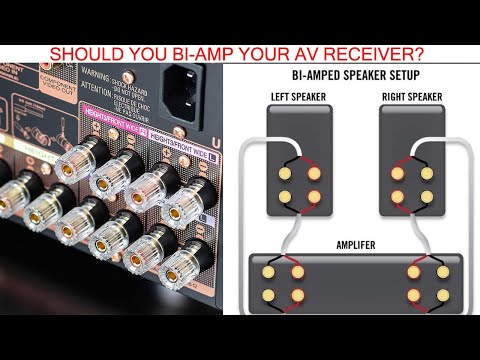 https://youtu.be/BD4irDk10WI?si=m1T4AoemLeqmtjQV