Does high quality digital cables matter?
Comments
-
And yet you still hold to the mantra that because *you* can't hear a difference between 2 sets of cables, that someone else can't either? It is a very narrow minded attitude to have on one specific topic when you are willing to admit that it doesn't apply evenly across the spectrum...
That's not even close to what I said. I hold the belief I do because NO ONE had been able to demonstrate THEY can hear it. I don't have to be able to run a 4 minute mile, to believe someone else can.
Your claims are about as credible as dowsing rods. And you will find plenty of people with experience and training who believe in those as well. It's still bunk. -
That's not even close to what I said. I hold the belief I do because NO ONE had been able to demonstrate THEY can hear it. I don't have to be able to run a 4 minute mile, to believe someone else can.
More correctly, no one has been able to demonstrate they can hear it using a test methodology YOU believe in. The scientific literature is full of audiophiles demonstrating their ability to hear differences in audio gear and you have dismissed them all for one reason or another because, like most conspiracy theorists, you hold to your belief with religious fervor.
The following information was provided to you in 2010:DarqueKnight wrote:I will share with you one paper that I found fascinating. The title of the paper is "Psychoacoustic Detection Threshold of Transient Intermodulation Distortion, by M. Petri-Larmi, M. Otala and J. Lammasniemi. It was published in the March 1980 issue of the Journal of the Audio Engineering Society. The abstract is as follows:
"The audible threshold of transient intermodulation distortion (TIM) was determined for the six most sensitive subjects of the previously reported test series of 68 listeners. Improved equipment, carefully controlled listening environment, a digital TIM generator, and five recorded stereophonic music samples were used. The results show that in certain types of passages of music, a trained and sensitive listener can reliably detect extremely low values of distortion. Low distortion values were perceived only as changes in sound character, and not as distortion."
Some excerpts:
"The thresholds reported are for experienced, well-rehearsed subjects, and are therefore believed to be conservative. Further improvements in equipment and records may, however, yield lower thresholds in the future."
"The test records were selected on the basis of the experience gained from the previous investigation to represent technically excellent and audibly "clean" recordings."
"The subject was allowed to play the record for 15-30 minutes."
"Comprehensive auditory tests were performed for all the subjects."
"At the end of the learning period the subject was asked to indicate the distortion level he thought he could perceive in a blind A/B test."
Thread: Further-Thoughts-On-ABX-Testing-Of-Stereophonic-Audio-Systems
Discussed again in this thread from 2012: Dumb-things-you've-heard-from"audiophiles"
You have never offered any scientific justification for why people should use blind tests in stereophonic audio. Why should anyone believe anything you say?
You remind me of the conspiracy theorists who insist that NASA's claim of putting men on the moon's surface was a big Cold War propaganda hoax, yet they never provide any scientifically credible explanation and data to support their claims and accusations.Proud and loyal citizen of the Digital Domain and Solid State Country! -
So things like RTA plots and Oscilloscope plots that show definitive changes when the same passage of music is played via the same gear with only the cables changing are the equivalent of dowsing rods?
Now I am certain that you are nuttier than a pecan tree. Thank you for proving beyond a shadow of a doubt that your opinion on the matter holds exactly no weight whatsoever.
(Reference any one of DK's plethora of cable threads along with any Stereophile article showing actual testing of cable comparisons to see why you are unequivocally wrong.)
Funny that there are countless simple noise floor comparisons between cables out there that show a noise floor difference in real, actual and measurable levels and yet you hold on to the belief. Sad really.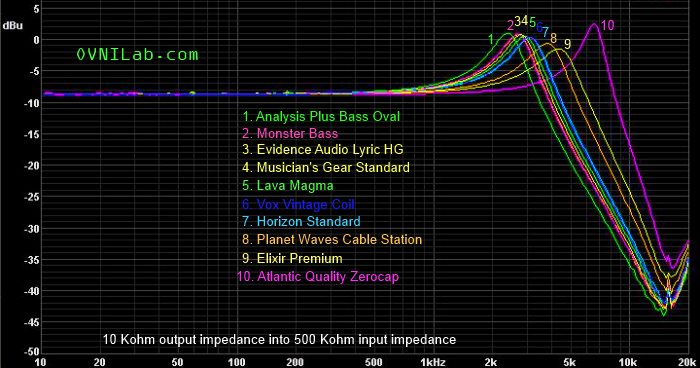
Since the graphic didn't display:
Is that the scope measurement taken in dBv where it can't be converted to dBu?
Did the transfer function of this get shown on the output side of an amp?
And how many dBu down is even the worst noise floor?
Also why spend that kind of $$ on cables when you could get a fully balanced power supply +60/0/-60?
If you have jitter suppression that is -113dB down and another that is twice as good at -116dB down. Who cares? Measurable absolutely, meaningful? No. If you could spend just a few percentage points more to go -116dB down Sure? 300% more? -
Now I am certain that you are nuttier than a pecan tree. Thank you for proving beyond a shadow of a doubt that your opinion on the matter holds exactly no weight whatsoever.
Yeah, I'm the nutty one imagining things that can't be demonstrated.
I'll just wait for you to prove us all wrong in your upcoming demonstration. That is, if you don't back out first... -
I think a major reason why some people are reluctant to admit that power cables, interconnects, speaker cables, vibration isolation devices, and other audio related items actually work is because then they will have to admit they are wrong. While we all want to be right, for some people it is an obsession. They will go to the grave trying to justify and rationalize their stubbornness. On the other hand, more mentally stable individuals will consider the possibility their belief just might be flawed, and then take steps to prove to themselves they are correct. Then if they discover that they were wrong in their belief they will admit it, and move on.
Since the hard-core close minded individuals will never change, and cling to their belief until they die, it is a waste of time trying to engage in a rationale discussion with them. The benefit of threads along this line is that the lurkers who are reading this might start thinking, and then try something for themselves.
For example, I used to think that the idea of a power cord making a difference was ridiculous. If 120V came out of the cord then how could one be different from the other? But after reading so many of these threads, I started to think about it, and decided to try it. I was fortunate because by that point I had built a nice entry level system, and even my first Pangea power cord was able to demonstrate to me that a power cord can improve the sound. After I added two Shunyata entry level cords to my amps, the debate was over. Power cords matter. End of story. However, if it had not been for threads like this I would still be in a state of ignorance. While I would be enjoying my stereo, I would not be enjoying it at its max potential. Ignorance is bliss, as the saying goes.Lumin X1 file player, Westminster Labs interconnect cable
Sony XA-5400ES SACD; Pass XP-22 pre; X600.5 amps
Magico S5 MKII Mcast Rose speakers; SPOD spikes
Shunyata Triton v3/Typhon QR on source, Denali 2000 (2) on amps
Shunyata Sigma XLR analog ICs, Sigma speaker cables
Shunyata Sigma HC (2), Sigma Analog, Sigma Digital, Z Anaconda (3) power cables
Mapleshade Samson V.3 four shelf solid maple rack, Micropoint brass footers
Three 20 amp circuits. -
At least I am willing to put up or shut up...can't say the same thing for you there cupcake. But you keep on not contributing in any way shape or form.
What a waste of bandwidth.
I already participated in blind testing, many years ago. Your a little late.
And where have I commented on DK's jumper thread? -
My biggest concern in all of this, Monk is that you aren't being even remotely open minded. You have this preconceived notion that seems to be insurmountable and no amount of evidence or proof is going to sway you in any way.
What's to say you show up, I meet or exceed the criteria of your challenge and you dismiss it as simply extraordinary luck?
I'm taking an adequate amount of care and due diligence to make sure the testing setup is transparent in it's approach. Level playing field for you and I so the data can speak for itself.
What are you going to say if you can't hit 26 out of 30? What happens if you simply hit the coin flip medium?
I'm not being open or closed minded. If I was I wouldn't be coming out. I have a few more items yet to come in. Getting a mainboard with enough PCIe slots is next because the one I had needed one of the three for a video card. -
Case in point, going from Audioquest FLX 12/2 with cheap brass plated bananas to factory terminated MIT Terminator SCs was a cosmic leap forward. No placebo effect and no need for some double or single blind study to tell me that I was hearing differences.
The same goes for my network cables. The old cables met spec. They did their job. But when upgrading (want to know what's silly...I bought the new network cables primarily because of their appearance since they would be more visible on my rack and I wanted them to match.) from CAT5E to CAT6 cables, the new cables not only made a marginal difference in performance (two way traffic from my NAS to my computer improved noticeably) but music played from the NAS to the BDP was noticeably improved. Airier highs and a more defined midrange were 2 things I noticed right away.
I would like to hear your MIT/AQ FLX.
On the CAT5E to CAT6. They should both behave optimally for a GB network since both standards are meant for it.
Again the cables need to be certified. I am going to order a ~12ft BJC CAT6. Let me know if you want me to also get a CAT5e cable from them. -
What length is your premium cable? If the entire setup is going to be on a wall with line level cables from the DAC passing through.
Just trying to visualize the space for the ergonomics of it all.
That is:
Can I have a computer with the three NIC's, switch next to it, server appliance, DAC all situated on one side together and feeding your system through wall?
Or would the DAC be on the other side and the USB cable pass through? -
For this test to be valid it has to be performed with ZLTFUL's old and new cables. Adding unknown cables into the mix can result in different results. First do the test with his old cables and establish a baseline, then try new cables and note the deviation.Lumin X1 file player, Westminster Labs interconnect cable
Sony XA-5400ES SACD; Pass XP-22 pre; X600.5 amps
Magico S5 MKII Mcast Rose speakers; SPOD spikes
Shunyata Triton v3/Typhon QR on source, Denali 2000 (2) on amps
Shunyata Sigma XLR analog ICs, Sigma speaker cables
Shunyata Sigma HC (2), Sigma Analog, Sigma Digital, Z Anaconda (3) power cables
Mapleshade Samson V.3 four shelf solid maple rack, Micropoint brass footers
Three 20 amp circuits. -
I think a major reason why some people are reluctant to admit that power cables, interconnects, speaker cables, vibration isolation devices, and other audio related items actually work is because then they will have to admit they are wrong. While we all want to be right, for some people it is an obsession. They will go to the grave trying to justify and rationalize their stubbornness. On the other hand, more mentally stable individuals will consider the possibility their belief just might be flawed, and then take steps to prove to themselves they are correct. Then if they discover that they were wrong in their belief they will admit it, and move on.
Since the hard-core close minded individuals will never change, and cling to their belief until they die, it is a waste of time trying to engage in a rationale discussion with them. The benefit of threads along this line is that the lurkers who are reading this might start thinking, and then try something for themselves.
For example, I used to think that the idea of a power cord making a difference was ridiculous. If 120V came out of the cord then how could one be different from the other? But after reading so many of these threads, I started to think about it, and decided to try it. I was fortunate because by that point I had built a nice entry level system, and even my first Pangea power cord was able to demonstrate to me that a power cord can improve the sound. After I added two Shunyata entry level cords to my amps, the debate was over. Power cords matter. End of story. However, if it had not been for threads like this I would still be in a state of ignorance. While I would be enjoying my stereo, I would not be enjoying it at its max potential. Ignorance is bliss, as the saying goes.
Yep, yep and yep.Political Correctness'.........defined
"A doctrine fostered by a delusional, illogical minority and rabidly promoted by an unscrupulous mainstream media, which holds forth the proposition that it is entirely possible to pick up a t-u-r-d by the clean end."
President of Club Polk -
So things like RTA plots and Oscilloscope plots that show definitive changes when the same passage of music is played via the same gear with only the cables changing are the equivalent of dowsing rods?
Yeah. Every thing outside of some fundamentalist extremist believers religion is voodoo.(Reference any one of DK's plethora of cable threads along with any Stereophile article showing actual testing of cable comparisons to see why you are unequivocally wrong.)
Sorry. Stereophile doesn't count. They accept audio equipment company ads, so their test reports are "suspect".Funny that there are countless simple noise floor comparisons between cables out there that show a noise floor difference in real, actual and measurable levels and yet you hold on to the belief. Sad really.
But it wasn't tested and blessed by a blind testing high priest.:sad:Habanero Monk wrote: »Since the graphic didn't display:
It's showing up now. Maybe the host site went down for a while.Habanero Monk wrote: »
Also why spend that kind of $$ on cables when you could get a fully balanced power supply +60/0/-60?
1. Because I can.
2. Because of the sadistic trill I get knowing other people are loosing sleep over how much I spent on cables.
To seriously answer your question, cables are another component in the signal transport chain. It has been well established by my reports on this forum, and in peer-reviewed scientific journal articles, that signal integrity is audibly affected by the noise characteristics of cables. Telecommunications companies would not and would not have spent billions of dollars on cable and connector research if wire quality didn't matter a lot.
It does not make sense to spend the money on low noise power supplies, low noise electronics, and then connect everything together with cables that do not match the noise performance of the connected components.I think a major reason why some people are reluctant to admit that power cables, interconnects, speaker cables, vibration isolation devices, and other audio related items actually work is because then they will have to admit they are wrong. While we all want to be right, for some people it is an obsession. They will go to the grave trying to justify and rationalize their stubbornness.
They are no different from any other religious fanatic.Since the hard-core close minded individuals will never change, and cling to their belief until they die, it is a waste of time trying to engage in a rationale discussion with them.
You are not entertained by people worrying about how you spend your discretionary income?The benefit of threads along this line is that the lurkers who are reading this might start thinking, and then try something for themselves.
Agreed.I already participated in blind testing, many years ago. Your a little late.
I recall you mentioning this, but I don't recall seeing a detailed report of the event. What cables (and/or electronics) were tested, what stereo system equipment was used, what musical selections were used and what was the format and methodology of the test?Proud and loyal citizen of the Digital Domain and Solid State Country! -
DarqueKnight wrote: »Because of the sadistic trill I get knowing other people are loosing sleep over how much I spent on cables.
Signature material right there!
Can I borrow that:biggrin: -
For this test to be valid it has to be performed with ZLTFUL's old and new cables. Adding unknown cables into the mix can result in different results. First do the test with his old cables and establish a baseline, then try new cables and note the deviation.
Any cable he brings has to be certified. I understand your point. -
DarqueKnight wrote: »
To seriously answer your question, cables are another component in the signal transport chain. It has been well established by my reports on this forum, and in peer-reviewed scientific journal articles, that signal integrity is audibly affected by the noise characteristics of cables. Telecommunications companies would not and would not have spent billions of dollars on cable and connector research if wire quality didn't matter a lot.
It does not make sense to spend the money on low noise power supplies, low noise electronics, and then connect everything together with cables that do not match the noise performance of the connected components.
Do you have any cable that shows a -3dBu drop in the signal. Balanced power certainly meets that criteria. I would encourage money spend on that prior to re-cabling.
Because it doesn't matter what you spent on cables you are running them on a bit of a lower tide so to speak. It's on my list of eventual equipment purchases. -
DK will still stand by blinds being overly complicated and not at all conducive with objective auditory evaluation.
I want to clarify that I have no problem with blind tests for certain kinds of audio, such as simple narrow bandwidth monophonic signals. As I stated in my A-Historical-Overview-of-Stereophonic-Blind-Testing thread, blind tests were routinely used by Bell Labs researchers for telephone line and equipment tests. It must be noted that the end users for such equipment were untrained listeners (the general public).
When Bell Labs began developing home stereo systems, the consumer segment was sophisticated trained listeners who were (or who would become) proficient at sound localization and characterization of complex, multi-dimensional sound fields. Simple discrimination tests are not adequate or appropriate for evaluating multi-dimensional stimuli. There are too many distractive elements in a stereo sound field. If a listener, whether trained or not, is asked to simply tell if there is a difference, it is very likely that a distractive element noticed in one trial, but not noticed in a subsequent trial, might be erroneously labeled as a "difference". That is why it is important to learn to catalog, categorize, and quantify all the sonic elements in sound stage. I often do not become aware of differences until I compare notes and sound stage maps among listening trials. I don't listen for differences. I listen to hear and document everything in the sound stage.
I have nothing against blind tests when they are appropriately used. My position, which is based on standard principles of sensory science and Bell Labs technical specifications for stereo, is that blind tests are unnecessary and inappropriate for the kinds of stimuli generated by stereophonic sound fields and they are unnecessary and inappropriate for the trained and experienced listeners required to evaluate stereophonic system and equipment performance.
Regards,
Darque "Certified Golden Ears" KnightProud and loyal citizen of the Digital Domain and Solid State Country! -
Signature material right there!
Can I borrow that:biggrin:
I'll lease it to you. Paypal me some $$$$:razz:Habanero Monk wrote: »Do you have any cable that shows a -3dBu drop in the signal. Balanced power certainly meets that criteria.
I don't know. I've never tested for such. Please relate your question above to one or more stereophonic performance parameters.Habanero Monk wrote: »I would encourage money spend on that prior to re-cabling.
Explain which aspects of stereophonic performance will be improved by following your advice.Habanero Monk wrote: »Because it doesn't matter what you spent on cables you are running them on a bit of a lower tide so to speak.
I need you to be more specific. Something along the lines of "the cost of cables is irrelevant because it has been scientifically demonstrated that cable changes do not affect any aspects of stereophonic performance". With this clarification in mind, can you be specific?Proud and loyal citizen of the Digital Domain and Solid State Country! -
Signature material right there!
Can I borrow that:biggrin:
Unlikely, even if it was actually written by him. I don't remember a time I've ever seen two typos in one DK sentence before. ;-) -
On a side note, I sensed a modicum of sarcasm in your previous post... :redface:
I will neither confirm nor deny any intended sarcasm in post #351. I will leave that to personal interpretation.:biggrin:
I will say that I was dead serious about wanting to know the details of WilliamM2's blind test.teekay0007 wrote: »Unlikely, even if it was actually written by him. I don't remember a time I've ever seen two typos in one DK sentence before. ;-)
Well, maybe not in any of my serious posts/threads. I sometimes get careless in cable "debate" threads because they aren't meant to be taken seriously.:twisted:Proud and loyal citizen of the Digital Domain and Solid State Country! -
DarqueKnight wrote: »
I need you to be more specific. Something along the lines of "the cost of cables is irrelevant because it has been scientifically demonstrated that cable changes do not affect any aspects of stereophonic performance". With this clarification in mind, can you be specific?
You did a test of power cables and you measured noise correct? -
Habanero Monk wrote: »You did a test of power cables and you measured noise correct?
I sure did. I also explained the relationship between noise characteristics and stereophonic performance.
Back to the questions I asked, you made some equipment recommendations and comments and I asked you to justify their relevance to stereophonic performance improvement. Can you do that?Proud and loyal citizen of the Digital Domain and Solid State Country! -
DarqueKnight wrote: »I sure did. I also explained the relationship between noise characteristics and stereophonic performance.
Back to the questions I asked, you made some equipment recommendations and comments and I asked you to justify their relevance to stereophonic performance improvement. Can you do that?
Ok. I have heard the noise floor of a system drop with a balanced power supply. Yes I could tell blind and easily. The stereo field opened up in my perception of the change.
It was a really nice Furman ~$2500.
Did you do any measurements of the transfer function? Can you explain the difference of dBv vs dBu and how dBv constitutes unwanted noise if it shows in the transfer function? -
Habanero Monk wrote: »Ok. I have heard the noise floor of a system drop with a balanced power supply. Yes I could tell blind and easily. The stereo field opened up in my perception of the change.
The stereo field "opened up"? What does that mean? Was it "closed" before?
If you are going to discuss changes in spatial properties, I would expect something quantitative along the lines of "sound images at the left and right moved further out about 1 foot".Habanero Monk wrote: »Did you do any measurements of the transfer function?
No. My testing methodology and results are documented in my power cable analysis threads. A really smart person should be able to calculate transfer functions from my Fast Fourier Transform data.Habanero Monk wrote: »Can you explain the difference of dBv vs dBu and how dBv constitutes unwanted noise if it shows in the transfer function?
Difference? dBv and dBu mean the same thing: decibels referenced to a voltage less than one volt. I don't recall the exact value for the reference voltage. They started using dBu so that dBv (small v) would not get confused with dBV (capital V).
dBV (capital V) is decibels referenced to 1 volt. dBV is the measurement I used in my power cable analysis studies.
You may want to rephrase your question since you had some confusion about dBv and dBu. I want to be sure that I answer what you intended to ask.
Your term "unwanted noise" does not make sense to me. Within the context of home audio electronics, any and all noise is "unwanted". With respect to the 60 Hz power signal, any other signal accompanying it are "noise" and are therefore "unwanted". That is why we use things like power filters and conditioners, isolation transformers, filtering power cords and AC regenerators to remove line noise.
With regard to things like transfer functions, I will caution you that gross measurements like transfer functions (and Ohms Law) do not fully characterize all the performance aspects of an electronic/electrical component. I will refer you to Bob Carver's amplifier transfer function exercises where he duplicated the transfer functions of expensive amplifiers, but his cheaper amps didn't in any way sound like the more expensive amps he copied. He was able to copy the sound of a more expensive amp using a zillion additional parts, but that configuration could not be economically reproduced in mass.Proud and loyal citizen of the Digital Domain and Solid State Country! -
I've got a new name for this thread...
"An electrical engineer, a pharmacologist and a network engineer walk into a bar..."
But the engineer is the only one with Phillips Certified "Golden Ears". :razz: Proud and loyal citizen of the Digital Domain and Solid State Country!
 -
I've got a new name for this thread...
"An electrical engineer, a pharmacologist and a network engineer walk into a bar..."
Don't forget the technician with the network certification.Lumin X1 file player, Westminster Labs interconnect cable
Sony XA-5400ES SACD; Pass XP-22 pre; X600.5 amps
Magico S5 MKII Mcast Rose speakers; SPOD spikes
Shunyata Triton v3/Typhon QR on source, Denali 2000 (2) on amps
Shunyata Sigma XLR analog ICs, Sigma speaker cables
Shunyata Sigma HC (2), Sigma Analog, Sigma Digital, Z Anaconda (3) power cables
Mapleshade Samson V.3 four shelf solid maple rack, Micropoint brass footers
Three 20 amp circuits. -
DarqueKnight wrote: »The stereo field "opened up"? What does that mean? Was it "closed" before?
If you are going to discuss changes in spatial properties, I would expect something quantitative along the lines of "sound images at the left and right moved further out about 1 foot".
As I recall it was a Symphony of Mahlers' that I was listening to and it brought the piano forward.DarqueKnight wrote: »Difference? dBv and dBu mean the same thing: decibels referenced to a voltage less than one volt. I don't recall the exact value for the reference voltage. They started using dBu so that dBv (small v) would not get confused with dBV (capital V).
dBV (capital V) is decibels referenced to 1 volt. dBV is the measurement I used in my power cable analysis studies.
Just asking. Thanks for the answer. -
So what can I expect as far as physical layout when I come?
-
DarqueKnight wrote: »You are not entertained by people worrying about how you spend your discretionary income?
Slightly, but I am more entertained when deniers spout nonsense without understanding what they are talking about. However, I do get slightly irritated when they imply I am psychotic because I am able to hear a difference when I upgrade a cable. So far I have not had the experience of things getting worse after an upgrade. Of course, I do my research, even if it is only Google searches, to get an idea of what others experience with the same gear.
If instead of implying I, and others, are crazy they said something along the line of "While the cable does make a difference you are crazy to spend that much money for that level of improvement" then I can respect that, since I have spent a ton of money now on power conditioners and the various cable types. I might not agree with it, since, for me, I enjoy the result, but I can respect that position.
In so far as being psychotic, I don't think so, since most of my stereo has been bought with bonuses and stock options given to me for doing a good job. My current bonus paid for my Magico S5s, which is nice since they cost more than I paid for my new car (Mazda 3S) in 2005.Lumin X1 file player, Westminster Labs interconnect cable
Sony XA-5400ES SACD; Pass XP-22 pre; X600.5 amps
Magico S5 MKII Mcast Rose speakers; SPOD spikes
Shunyata Triton v3/Typhon QR on source, Denali 2000 (2) on amps
Shunyata Sigma XLR analog ICs, Sigma speaker cables
Shunyata Sigma HC (2), Sigma Analog, Sigma Digital, Z Anaconda (3) power cables
Mapleshade Samson V.3 four shelf solid maple rack, Micropoint brass footers
Three 20 amp circuits. -
I will refer you to Bob Carver's amplifier transfer function exercises where he duplicated the transfer functions of expensive amplifiers, but his cheaper amps didn't in any way sound like the more expensive amps he copied. He was able to copy the sound of a more expensive amp using a zillion additional parts, but that configuration could not be economically reproduced in mass.
More on that subject. The Carver amp in question was so unstable it had to be constantly tweaked while in use. Bob Carver later admitted it would have been impossible to make a production version.
While it was conceded that he was successful in copying the sound of the CJ tube amp, the facts above say to me that it was an epic fail.
As noted, the TFM production amps sound nothing like a tube amp, not even close.Political Correctness'.........defined
"A doctrine fostered by a delusional, illogical minority and rabidly promoted by an unscrupulous mainstream media, which holds forth the proposition that it is entirely possible to pick up a t-u-r-d by the clean end."
President of Club Polk -
teekay0007 wrote: »Yes, headrott, please tell me about your training. You're the same one that not too long ago said he was afraid to try blinded studies with their equipment because they probably couldn't tell the difference between it and much cheaper gear. Yes, I'm paraphrasing, but the point is the same. And no, I can't find the post or I would certainly link it.
You cannot find and link the post where I said that I was afraid of trying blind studies because people probably couldn't tell the differences between it and cheap gear, because I never said anything like that, in any fashion. Paraphrased or not; what you are stating was never said, nor implied. What you posted is from your imagination. Or, you completely misinterpreted what I actually said.teekay0007 wrote: »I would actually gain much more experience and considerably more valid experience from not knowing which cables were connected in the scenario I laid out above. If I were told, "OK, now we're putting in the MIT (Shunyata, etc.) cables, let us know what you think", oh, I'd be hearing subtleties the BJCs could never dream of producing. It's human nature to do this. So, yes again, I trust my ears, but not yet my brain when it throws its two cents (consciously and subconsciously) into the mix.
Right, if you noticed that I defined "ears" in my previous post as:IF you trust your "ears" ("ears"; including your brain and consciousness), one would not need to blinded to what equipment is being used.
So again, you don't trust your "ears".teekay0007 wrote: »So, from all of this discussion, I've learned that we cannot make valid evaluations of gear or cables unless we are trained how to properly do so. This training is largely self-administered - meaning what we think is right and best is just that since we have nothing else to compare our concept of "right" with. Then, once we deem ourselves "trained" we can evaluate one pair of cables against another, but only if we know which ones are connected when we're evaluating. To not know which cables were being used would make our observations non-valid. Any biases that can be eliminated by not even letting them enter the equation should not be of concern to us since we were (self-) trained to not let any bias enter into our evaluation process. Got it!.
Yes, you are correct that training and experience in listening to stereophonic audio is self taught. A person can learn the different aspects of stereophonic audio by learning about the concepts of soundstage height, width, and depth, imaging, detail, transparency, tone(s), image weight, etc. etc. etc. by reading about them, but actual training and experience by DOING are what is necessary. Why do so many on this forum ask "what cables have you tried?" Because that shows what level of experience you have. It however does not show what amount of training you have. Both are necessary to properly hear the differences between pieces of gear. If one already doesn't believe that there are differences between cables, etc., then I can see why one would feel that one is biased and cannot trust one's "ears"; this is because this person is biased. Got it?teekay0007 wrote: »Again, headrott, your "training" in this area consists of what? And parroting DK doesn't count.
Ok, you asked for it, so here it goes (I will go through both my experience AND training as both can be and are acquired at the same time):
I started listening to stereophonic audio when I was about 7. My dad would put on reel-to-reel tapes and records of Led Zeppelin, Paul McCartney, The Beatles, etc. (most of the music I listen to today) and my older brother and I would listen for hours at times. My dad was into hi-fidelity music even before I was born. He would set his system up and listen quite regularly. He passed this love of music and love of stereophonic audio on to my brother and I (and the rest of my siblings).
At about the age of 14, I purchased my own stereophonic audio system. It consisted of a Sansui receiver, Denon tape deck, and Pioneer speakers. Compared to what I own now, this stuff was vey low fidelity, and low resolution. I enjoyed that for a number of years (as I didn't know there was anything better out there). It was also in grade school where I learned how to play the trumpet and by high school I had learned how to play the trumpet very competently taking part in honor band and touring the US in our band. Through this experience, I was able to pick up on tones and pitches where I was able to learn and identify different keys and modes which would later allow me to listen to music in a very analytical manner. I could (of course) also listen to music in a less, or non-analytical fashion, but that has little to do with what this reply is about.
At the age of 17, I purchased my first set of Polk speakers (Monitor 10A's with the peerless tweeters) as well as upgraded my Sansui receiver to a newer (what I thought was much better) Denon receiver (which I also used for A/V) a newer Denon tape deck, and a new at the time Denon CD player. I heard an immediate improvement in the audio produced by this system (from a tonal, detail, and clarity perspective). I still had absolutely no clue about how to properly set up the Monitor 10A's to have them image correctly or produce a soundstage properly, however. In fact, I had no idea what those terms even meant.
At age 20, I heard my brothers Harmon Kardon linear tracking turn table, hooked up to his Mcintosh solid state amplifier and using my Monitor 10A's as speakers. My brother was the one who showed me how to correctly angle the Monitor 10A's to get the correct timing and imaging with them. This was my first lesson in what a difference in HOW the gear was set up made. I also leaned that having a powerful, well designed amplifier can drastically increase the clarity and detail of the audio from your speakers. I had also began experimenting with some Radio-Shack speaker cables (where previously I had been using some inexpensive (hardware store) copper cables) as well as upgraded, Monster cable interconnects (previously I had used the IC cables that came with components). I noticed a definite difference when used with the rest of the equipment. The music was more refined, with greater detail, and sounded "more pleasing". At this time, I didn't know anything about taking notes to distinguish differences in pieces of audio gear so it was all done in my head. I can still remember what that system sounded like, vaguely however.
Taken from a recent Audioholics reply regarding "Club Polk" and Polk speakers:
"I'm yet to hear a Polk speaker that merits more than a sentence and 60 seconds discussion."
My response is: If you need 60 seconds to respond in one sentence, you probably should't be evaluating Polk speakers.....
"Green leaves reveal the heart spoken Khatru"- Jon Anderson
"Have A Little Faith! And Everything You'll Face, Will Jump From Out Right On Into Place! Yeah! Take A Little Time! And Everything You'll Find, Will Move From Gloom Right On Into Shine!"- Arthur Lee







This discussion has been closed.