Does high quality digital cables matter?
Comments
-
I've told people on here before that the best way to learn is to sit down with fellow hobbyists and talk about what you listen for. I've learned so much just from passing guests in rooms at LSAF and sitting down at another Polkie's room while they talk about what they like or don't like, or what now is apparent or has disappeared. Stereophony is hard to train yourself in - even when you think you understand all it has to offer, something else presents itself out of the blue.
Yes, DSkip (one in the "handful" I mentioned in my prior post), that makes sense. However, if we don't hang out with audiophiles or have any access to the circles they tend to be in in our current lifestyle circumstances, doing so is much easier said than done. Additionally, discussing through phone conversations or emails with those that we know are into the audio hobby what each other hears or experiences from their gear does little to further our training in this arena. I've also found that talking to salesmen is out since I've never even heard one of them offer so much as one positive word about any item that they weren't selling. -
Because economics professors are concerned with the study of economics and sales. These aren't often done blinded.
Right. So you are not aware that home stereo systems are merchandise subject to the same laws of economics as other merchandise?In one of your reviews you described bass articulation as "severely diminished", "more weight" etc. Those are subjective descriptions. Your use of an oscilloscope is objective (e.g., not subject to interpretation).
It becomes objective when I can describe the sonic effects that accompanied the changes in bass articulation. People with a framework of experience in this type of evaluation know full well what I mean. You, and others, who have no real interest in stereophonic audio are on the outside looking in. Concepts that are trivial to trained and experienced practitioners are huge stumbling blocks for you.In science "blinding" usually refers to a subject (or investigator, or both) not knowing his/her treatment.
According to the lady conducting the "blind" test with blindfolds and the fellow over at the AK forum advocating cable trials while blindfolded, and the scores of blind tests done with curtains and screens, "blinding" in stereo audio trials usually refers to visual obstruction as well as hiding product identity.For example, if I give you a drug without telling you what it is, you are "blinded" to the treatment. While it CAN refer to visual obstruction or a blind-fold, it often does not.
I have already thoroughly explained why the use of blind trials in medicine is in no way related to the use of blind trials in stereo audio evaluation. There is no scientific basis for it. All you are doing is spouting your beliefs which you have not provided one shred of scientific evidence for.The goal of Bell labs is to sell products.
Because their goal is "sales" and not knowledge per se. Another plausible reason is that the under blinded conditions, their products failed
I see. Therefore, since Bell Labs was a commercial enterprise, we should not believe anything they say? Did you come to this conclusion by credible research or is this just your opinion according to your religious devotion to blind tests? You obviously don't know anything about Bell Labs (one of my previous employers).
Since Bell Laboratories specifications pertaining to the evaluation of home stereo systems was/is in perfect agreement with principles in the field of sensory science. Are you going to similarly "discredit" the field of sensory science? What would be sensory scientist's economic incentive for scientifically demonstrating that multi-dimensional stimuli, such as a stereo sound field, should be evaluated with nonblind descriptive methods?Proud and loyal citizen of the Digital Domain and Solid State Country! -
DarqueKnight wrote: »Use blind tests, beads and rattles, Tarot cards or whatever else, if you believe you can't trust your ears.
That's exactly my point. I do trust my ears. That's why I'm asking (Yes, in all seriousness!) what would be wrong with my evaluating speaker cables by using a blinded trial method? It sounds like you're saying that because I did it under blinded conditions, that the results are not valid. Let me give an example:
I have my stereo setup using a fantastic pair of fully hot-rodded SDA-1Cs connected to my power amp using BJC 10-Gauge Belden cables. I'd be very interested in trying some cables higher up the food chain if they were going to make a significant improvement in what enjoyment I could get from my system from using them. If I put a $300 - $500 (most likely used) pair of cables into my system to try out, how could I know if it was actually the cable making the difference, or if it was my preconceived notion of how much better the "new" cable was supposed to sound?
I'd have the cables (both pairs) running from behind my power amp to behind my speakers. I would be able to see both cable pair runs, but I wouldn't be able to see which ones were hooked up. No, I would not be wearing a blindfold. I'd have another person making and changing connections while I'd listen to several familiar pieces of music from a variety of sources. I'd make notes from each sampling as to what I heard and what I preferred, categorizing further with clarity, soundstage placement and dimensions, noise level, detail, etc. When all trials were done, I could compare the results and evaluate whether the difference in the enjoyment from the "new" cables justified the investment over just sticking with the "old" ones.
From what I've gathered from what you're saying and the research you're citing, I would have non-valid results because I didn't know which cables were in play during each sampling. However, in my evaluation process, I would have eliminated any biases introduced during the process and therefore, would not have had to have been trained to eliminate any biases or preconceptions I might have had. Further, the trials would have been conducted in a real world space where my actual listening would be taking place after the testing was completed. -
teekay, I believe you totally missed Ray's point. IF you trust your "ears" ("ears"; including your brain and consciousness), one would not need to blinded to what equipment is being used. How does one gain trust their "ears"? Through training and experience. THAT is what isnecessary to evaluate stereophonic audio equipment, NOT being blinded. Since you feel you need to be blinded to evaluate stereophonic audio equipment, you already admitted that you aren't trained, and you put yourself in the "very early experienced listener" category; you don't need to blind yourself to evaluate setreophonic audio equipment, you need to **train** yourself and gain more **experience**. So in short, you in fact **DON'T** trust your ears. I am not sure how you cannot realise this? I found it to be pretty straight forward in Ray's posts.

Taken from a recent Audioholics reply regarding "Club Polk" and Polk speakers:
"I'm yet to hear a Polk speaker that merits more than a sentence and 60 seconds discussion."
My response is: If you need 60 seconds to respond in one sentence, you probably should't be evaluating Polk speakers.....
"Green leaves reveal the heart spoken Khatru"- Jon Anderson
"Have A Little Faith! And Everything You'll Face, Will Jump From Out Right On Into Place! Yeah! Take A Little Time! And Everything You'll Find, Will Move From Gloom Right On Into Shine!"- Arthur Lee -
DarqueKnight wrote: »Right. So you are not aware that home stereo systems are merchandise subject to the same laws of economics as other merchandise?
Studying human behavior and perception is a very different thing than studying consumer and buying habits. Often, in the study of economics the end goal is increasing sales. This is not the case in science.DarqueKnight wrote: »It becomes objective when I can describe the sonic effects that accompanied the changes in bass articulation. People with a framework of experience in this type of evaluation know full well what I mean.
Simply stating that something is objective does not make it so. Your idea of "tight bass", may not be the same as mine. It is not quantitative. On the other hand we all have a universally agreed upon measure of what "1 liter" is.DarqueKnight wrote: »You, and others, who have no real interest in stereophonic audio are on the outside looking in. Concepts that are trivial to trained and experienced practitioners are huge stumbling blocks for you.
Cute. You certainly have me pegged. Must be an ultra-exclusive club you're a part of.DarqueKnight wrote: »I see. Therefore, since Bell Labs was a commercial enterprise, we should not believe anything they say? Did you come to this conclusion by credible research or is this just your opinion according to your religious devotion to blind tests? You obviously don't know anything about Bell Labs (one of my previous employers).
Since Bell Laboratories specifications pertaining to the evaluation of home stereo systems was/is in perfect agreement with principles in the field of sensory science. Are you going to similarly "discredit" the field of sensory science? What would be sensory scientist's economic incentive for scientifically demonstrating that multi-dimensional stimuli, such as a stereo sound field, should be evaluated with nonblind descriptive methods?
Or, you could have just told me. Why did they discontinue blinded testing?
Let me ask an alternative question (and humor me here).
Lets design an experiment. We have the following:
1. "Trained", experienced listeners.
2. A comfortable room (naturalized environment).
3. Really high fidelity equipment (whatever that means to you)
4. An overall, "optimal" listening environment with a great setup.
5. The listeners have full view of the setup so all their tactile senses are intact EXCEPT the variable of interest.
6. The listeners "bias" has been removed through whatever means you deem acceptable.
We want to know whether a single set of ICs,or jumpers, etc. makes a "difference" in the sound quality (whether the trained experienced listeners think its better). Based on this, I have two questions:
1. Do you see any problem or bias when telling subjects: "Good morning, in this test, you will be evaluating one SUPER DELUXE cable made of diamonds, and one piece of junk from Walmart. Your task is to rate each cable. Let's start with the Super Deluxe...." (and you show the the cable and let them know).
2. Do you see any superiority with the alternative, double-blind trial where you simply instruct the subjects to rate two different cables? You don't tell them any other information (e.g. that one is better or worse etc.)
Just curious of your thoughts on the (above) hypothetical example. Apparently you're an expert in these types of testing, so I'm curious of your thoughts (not necessarily a copy paste from a book).Polk Fronts: RTi A7's
Polk Center: CSi A6
Polk Surrounds: FXi A6's
Polk Rear Surround: RTi4
Sub: HSU VTF-3 (MK1)
AVR: Yamaha RX-A2010
B&K Reference 200.7
TV: Sharp LC-70LE847U
Oppo BDP-103 -
Studying human behavior and perception is a very different thing than studying consumer and buying habits. Often, in the study of economics the end goal is increasing sales. This is not the case in science.
Economics is a branch of social science. Social science is science just like physics and chemistry. Look it up if you don't believe me. I have provided several excellent references from the field of economics regarding debiasing customers. Yet, you come back and say that economists do not study human behavior and perception. Inducing people to buy something is directly related to influencing human behavior and perception. I find it incredible that a purportedly educated person would declare that advertising, sales and marketing is a very different thing than studying human behavior and perception.Simply stating that something is objective does not make it so. Your idea of "tight bass", may not be the same as mine. It is not quantitative. On the other hand we all have a universally agreed upon measure of what "1 liter" is.
It depends on the relevant experience of the receiver of the information. A race car driver mentioning his car has the tightest possible cornering" will have a different quantitative meaning depending on whether the hearer is another experienced race car driver or a sports spectator.Cute. You certainly have me pegged.
You pegged yourself when you made the bizarre comment that "studying human behavior and perception is a very different thing than studying consumer and buying habits".Must be an ultra-exclusive club you're a part of.
It's small, but its not exclusive.Or, you could have just told me.
I have already given you much valuable information which you dismissed without investigation because it did not fit into your belief system.Why did they discontinue blinded testing?
I gave you many excellent references that discuss the issue. I and others have also answered that question in this thread.Let me ask an alternative question (and humor me here).
Lets design an experiment. We have the following:
1. "Trained", experienced listeners.
2. A comfortable room (naturalized environment).
3. Really high fidelity equipment (whatever that means to you)
4. An overall, "optimal" listening environment with a great setup.
5. The listeners have full view of the setup so all their tactile senses are intact EXCEPT the variable of interest.
6. The listeners "bias" has been removed through whatever means you deem acceptable.
We want to know whether a single set of ICs,or jumpers, etc. makes a "difference" in the sound quality (whether the trained experienced listeners think its better). Based on this, I have two questions:
1. Do you see any problem or bias when telling subjects: "Good morning, in this test, you will be evaluating one SUPER DELUXE cable made of diamonds, and one piece of junk from Walmart. Your task is to rate each cable. Let's start with the Super Deluxe...." (and you show the the cable and let them know).
2. Do you see any superiority with the alternative, double-blind trial where you simply instruct the subjects to rate two different cables? You don't tell them any other information (e.g. that one is better or worse etc.)
Just curious of your thoughts on the (above) hypothetical example. Apparently you're an expert in these types of testing, so I'm curious of your thoughts (not necessarily a copy paste from a book).
My thoughts are that your hypothetical example is ridiculous and has no semblance to reality. Why would trained listeners in an acoustically treated room with a high resolution system be evaluating "junk" anyway? You are not making sense. Go read some of the sensory science literature and learn when blind tests are appropriate and when they are not. You will then learn that your hypothetical above is just as devoid of knowledge as your comment that blind test advocates really don't use blindfolds.
You obviously cannot get past the fact that a trained listener, or any trained consumer, is not going to let factors unrelated to performance influence a performance evaluation. This fact has been well established in the economics literature and in audio science literature, both of which you have dismissed. Perhaps you are projecting the limitations of your thinking on others. Just because you are swayed by appearance, price, and brand name, you should not assume that others are.
As I said before, it is perfectly fine with me if people want to grab one or more other people to help them evaluate audio gear. It's easier for me, and others, to just use our ears and other sense organs.
As with anything, some people "get it" and others don't.Proud and loyal citizen of the Digital Domain and Solid State Country! -
DarqueKnight wrote: »[/B] I find it incredible that a purportedly educated person would declare that advertising, sales and marketing is a very different thing than studying human behavior and perception.
You can study perception in and of itself, without it having anything to do with economics or buying habits. This is basic science. For example, you could study how an instructional set affects perception. http://www.sciencedirect.com/science/article/pii/S0195666309000166
Sure, you could use the results for anything you want (including marketing). But that isn't the ultimate goal of many types of these investigations.DarqueKnight wrote: »It depends on the relevant experience of the receiver of the information. A race car driver mentioning his car has the tightest possible cornering" will have a different quantitative meaning depending on whether the hearer is another experienced race car driver or a sports spectator.
You still don't understand the basic definitions of "objective" versus "subjective". By the way, what numerical value would you assign to a descriptor of "tightest possible cornering"? "Quantitative" means number.DarqueKnight wrote: »You pegged yourself when you made the bizarre comment that "studying human behavior and perception is a very different thing than studying consumer and buying habits".
Human perception and what they buy are two different things. I can do a study asking people all sorts of things about how they feel. For example, I can ask a group of women how they feel after heart surgery. This will determine their (internal) perception of mood states etc. Has nothing to do with what they buy.
http://www.sciencedirect.com/science/article/pii/S1053249802006526DarqueKnight wrote: »My thoughts are that your hypothetical example is ridiculous and has no semblance to reality. Why would trained listeners in an acoustically treated room with a high resolution system be evaluating "junk" anyway? You are not making sense.
To determine whether they can discriminate your magic cables, and to determine if the performance of the cables influences their perference for them. We've been discussing this for a few pages now. I'll take your non-response to my question as "I don't know".DarqueKnight wrote: »Go read some of the sensory science literature and learn when blind tests are appropriate and when they are not. You will then learn that your hypothetical above is just as devoid of knowledge as your comment that blind test advocates really don't use blindfolds.
I'm glad I could educate you on basic science vocabulary.DarqueKnight wrote: »You obviously cannot get past the fact that a trained listener, or any trained consumer, is not going to let factors unrelated to performance influence a performance evaluation. This fact has been well established in the economics literature and in audio science literature, both of which you have dismissed. Perhaps you are projecting the limitations of your thinking on others. Just because you are swayed by appearance, price, and brand name, you should not assume that others are.
I commented several times on your "bias" training. Sure, it can be done. I never dismissed it.
Let me know when your paper is accepted for publication. I'd love to read it.Polk Fronts: RTi A7's
Polk Center: CSi A6
Polk Surrounds: FXi A6's
Polk Rear Surround: RTi4
Sub: HSU VTF-3 (MK1)
AVR: Yamaha RX-A2010
B&K Reference 200.7
TV: Sharp LC-70LE847U
Oppo BDP-103 -
DarqueKnight wrote: »Why would trained listeners in an acoustically treated room with a high resolution system be evaluating "junk" anyway?
They aren't evaluating junk in the 2nd scenario. They are evaluating their ability to discern two unknown quality of cable. It could even be the same cable.
Instead you cherry picked his first scenario and I think you also made his point:
In the 1st scenario he mentioned one piece of junk from Walmart and you picked it right up and made it the point of your response.
That's a form bias right there. -
I think what is really important here is the title of the thread should be "Do high quality digital cables matter?", not "Does high quality digital cables matter?"Polk Lsi9
N.E.W. A-20 class A 20W
NAD 1020 completely refurbished
Keces DA-131 mk.II
Analysis Plus Copper Oval, Douglass, Morrow SUB3, Huffman Digital
Paradigm DSP-3100 v.2 -
I think what is really important here is the title of the thread should be "Do high quality digital cables matter?", not "Does high quality digital cables matter?"
lol.
A simpler question would be; "Why must you know the identity/brand of a cable, in order to properly evaluate it?". Couldn't you evaluate a cable without knowing what it is? (blinded).Polk Fronts: RTi A7's
Polk Center: CSi A6
Polk Surrounds: FXi A6's
Polk Rear Surround: RTi4
Sub: HSU VTF-3 (MK1)
AVR: Yamaha RX-A2010
B&K Reference 200.7
TV: Sharp LC-70LE847U
Oppo BDP-103 -
Let me know when your paper is accepted for publication. I'd love to read it.
People are laughing at you because you ask this when I have already given you the citation to one of my stereo system evaluation papers that was published in a peer-reviewed journal several years ago.
You probably think that I am just another guy on the Internet running off at the mouth about things he knows nothing about ... like you.Proud and loyal citizen of the Digital Domain and Solid State Country! -
Habanero Monk wrote: »They aren't evaluating junk in the 2nd scenario. They are evaluating their ability to discern two unknown quality of cable. It could even be the same cable.
I have quoted badchad's original hypothetical below. Notice he said the evaluators are trained, experienced listeners. Since they are trained and experienced listeners, one would assume that their evaluation skills would not be on trial.
Since I have quoted the sensory science literature many times regarding the suitability of blind tests for multi-dimensional stimuli and given many credible citations to the peer-reviewed literature, I must assume that your clinging to the notion of using blind tests for situations they are not suited for is similar to religious faith. In that regard, no amount of reasoned argument, documentation, or scientific proof will be acceptable to you. It would be like asking someone to stop worshipping their god.Habanero Monk wrote: »Instead you cherry picked his first scenario and I think you also made his point:
In the 1st scenario he mentioned one piece of junk from Walmart and you picked it right up and made it the point of your response.
That's a form bias right there.
No, this is an example of your special kind of bias where you always want to put audiophiles on trial and evaluate them rather than evaluate gear.
Your mindset is bent on proving whether or not someone can hear what they say they hear, rather than whether one piece of gear outperforms another.
Outside of training scenarios, stereo equipment evaluations are for evaluating equipment, not for evaluating evaluators.Lets design an experiment. We have the following:
1. "Trained", experienced listeners.
2. A comfortable room (naturalized environment).
3. Really high fidelity equipment (whatever that means to you)
4. An overall, "optimal" listening environment with a great setup.
5. The listeners have full view of the setup so all their tactile senses are intact EXCEPT the variable of interest.
6. The listeners "bias" has been removed through whatever means you deem acceptable.
We want to know whether a single set of ICs,or jumpers, etc. makes a "difference" in the sound quality (whether the trained experienced listeners think its better). Based on this, I have two questions:
1. Do you see any problem or bias when telling subjects: "Good morning, in this test, you will be evaluating one SUPER DELUXE cable made of diamonds, and one piece of junk from Walmart. Your task is to rate each cable. Let's start with the Super Deluxe...." (and you show the the cable and let them know).
2. Do you see any superiority with the alternative, double-blind trial where you simply instruct the subjects to rate two different cables? You don't tell them any other information (e.g. that one is better or worse etc.)
Just curious of your thoughts on the (above) hypothetical example. Apparently you're an expert in these types of testing, so I'm curious of your thoughts (not necessarily a copy paste from a book).
Do you guys keep asking the same questions over and over again expecting that one day you will get the answer you desperately want to hear? In my case, you do not have to ask me. You can just go to the peer-reviewed science journal articles I have continually referenced for years.Proud and loyal citizen of the Digital Domain and Solid State Country! -
DarqueKnight wrote: »I have quoted badchad's original hypothetical below. Notice he said the evaluators are trained, experienced listeners. Since they are trained and experienced listeners, one would assume that their evaluation skills would not be on trial.
The evaluators aren't. The cable is.
Using the scenario/setup for evaluation outlined in your JOSS paper, why MUST the evaluators know the identity of the equipment they are evaluating? (the paper is on order from institution, so I don't know if you commented on this in the full text).Polk Fronts: RTi A7's
Polk Center: CSi A6
Polk Surrounds: FXi A6's
Polk Rear Surround: RTi4
Sub: HSU VTF-3 (MK1)
AVR: Yamaha RX-A2010
B&K Reference 200.7
TV: Sharp LC-70LE847U
Oppo BDP-103 -
DarqueKnight wrote: »Your mindset is bent on proving whether or not someone can hear what they say they hear, rather than whether one piece of gear outperforms another.
I think you finally understand what blind testing is used for, and the whole point of Monk's challenge. To see if there is a difference at all. Not sure why it took so long. -
The definition of insanity is doing the same thing over and over and expecting a different result.
Fairly certain that I will always go with the PhD vs the internet evangelist who is trying to save the virtual world from perceived wrong doing.
Even more important than the degree is he has tried different cables, and has based his opinion on that experience. Not on some nitwit spouting nonsense of how he thinks things should work.Lumin X1 file player, Westminster Labs interconnect cable
Sony XA-5400ES SACD; Pass XP-22 pre; X600.5 amps
Magico S5 MKII Mcast Rose speakers; SPOD spikes
Shunyata Triton v3/Typhon QR on source, Denali 2000 (2) on amps
Shunyata Sigma XLR analog ICs, Sigma speaker cables
Shunyata Sigma HC (2), Sigma Analog, Sigma Digital, Z Anaconda (3) power cables
Mapleshade Samson V.3 four shelf solid maple rack, Micropoint brass footers
Three 20 amp circuits. -
I think you finally understand what blind testing is used for, and the whole point of Monk's challenge. To see if there is a difference at all. Not sure why it took so long.
I fully understand the audio blind test religion and the irrational, unscientific basis of the faith.
The only difference that matters is the difference made in your own audio system. If someone is tone deaf and insensitive to the point that every cable, CD player, amp, etc. sounds the same to them, their hearing is not going to improve if everyone in the world proves that they can hear a difference, is it?
I find it all very amusing, otherwise I wouldn't participate every once in a while. Since the same questions get asked over and over again, by different people who come in thinking they are sharing some "great new discovery", my effort is minimal since I can just quote myself from years old threads.
Most hobbies that people are serious about have a peripheral naysayer fringe element. The ones in photography are much worse. There is no amount of optical science that will convince them that their 99 cent lenses and $24.95 cameras don't take pictures every bit as good as pro quality glass and cameras. The debates between film enthusiasts and digital enthusiasts make audio cable "debates" look like a family picnic.Proud and loyal citizen of the Digital Domain and Solid State Country! -
teekay, I believe you totally missed Ray's point. IF you trust your "ears" ("ears"; including your brain and consciousness), one would not need to blinded to what equipment is being used. How does one gain trust their "ears"? Through training and experience. THAT is what isnecessary to evaluate stereophonic audio equipment, NOT being blinded. Since you feel you need to be blinded to evaluate stereophonic audio equipment, you already admitted that you aren't trained, and you put yourself in the "very early experienced listener" category; you don't need to blind yourself to evaluate setreophonic audio equipment, you need to **train** yourself and gain more **experience**. So in short, you in fact **DON'T** trust your ears. I am not sure how you cannot realise this? I found it to be pretty straight forward in Ray's posts.
Yes, headrott, please tell me about your training. You're the same one that not too long ago said he was afraid to try blinded studies with their equipment because they probably couldn't tell the difference between it and much cheaper gear. Yes, I'm paraphrasing, but the point is the same. And no, I can't find the post or I would certainly link it.
I would actually gain much more experience and considerably more valid experience from not knowing which cables were connected in the scenario I laid out above. If I were told, "OK, now we're putting in the MIT (Shunyata, etc.) cables, let us know what you think", oh, I'd be hearing subtleties the BJCs could never dream of producing. It's human nature to do this. So, yes again, I trust my ears, but not yet my brain when it throws its two cents (consciously and subconsciously) into the mix.
So, from all of this discussion, I've learned that we cannot make valid evaluations of gear or cables unless we are trained how to properly do so. This training is largely self-administered - meaning what we think is right and best is just that since we have nothing else to compare our concept of "right" with. Then, once we deem ourselves "trained" we can evaluate one pair of cables against another, but only if we know which ones are connected when we're evaluating. To not know which cables were being used would make our observations non-valid. Any biases that can be eliminated by not even letting them enter the equation should not be of concern to us since we were (self-) trained to not let any bias enter into our evaluation process. Got it!
Again, headrott, your "training" in this area consists of what? And parroting DK doesn't count. -
The evaluators aren't. The cable is.
Using the scenario/setup for evaluation outlined in your JOSS paper, why MUST the evaluators know the identity of the equipment they are evaluating? (the paper is on order from institution, so I don't know if you commented on this in the full text).
If you ever progress to the point of reading the paper, you will see that I blind tested a minimally trained, biased, and disinterested subject. Therefore, I think it is obvious that my methodology can be used in either a blind or nonblind scenario. However, blinding is as unnecessary as Superman buying a plane ticket.
The point you and others seem not to be able to grasp is that blinding adds an unnecessary layer of complexity. When misused, as it often is, it can lead to erroneous results, the nature of which I have discussed in the JOSS paper and in many discussions on this and other audio forums. However, as I said before, if you can't trust your ears, if you are so scared, terrified, and rattled by the thought that one of those bad old audio snake oil purveyors will take advantage of you, by all means follow the tenets of your blind testing religion. I think you should go even further and blind test everything you buy, even FDA approved medicines. After all, there is no guarantee that what worked years ago for the test subjects will work for you. Medicine that helps to heal one person can kill another. It amazes me that people are so scared about being taken advantage of by audio companies, yet they will swallow any and every pill that a doctor prescribes without knowing whether he is taking under the table payments from drug companies for pushing certain drugs.
I'm not sure the following concepts will be accessible to you, as it goes against your faith, but I'm going to take a chance here and "humor you" as you put it.
1. Home stereo systems were designed for home-based consumers. When a consumer buys a piece of audio equipment, they don't do so in a blind fashion. Since people don't buy things in a blind fashion, it does not make sense to insist that they test what is bought in a blind fashion. Bell Labs scientists, whose integrity you have impugned, meant for people to learn to evaluate recorded media and stereo equipment on their own, as they do with any other merchandise.
2. When said piece of audio equipment placed in the consumer's stereo system, it cannot be blind tested without the assistance of one or more persons. Dragging someone else away from what they were doing in order to help you evaluate your audio purchase is not a good plan. What if no one is interested in helping? What do you do then? Please tell me.
3. There is a scientific principle that says a thing should be evaluated in the manner in which it will be used. People don't buy and use things in a blind fashion, so why should the methodology used to test them be blind? Before you pull out the tired old mantra about blind tests being the "gold standard" in medicine, please review my comments on the reasons why medical test scenarios are not similar to consumer product evaluation scenarios.
4. Why can't manufacturers do the blind testing and relieve the consumer of that responsibility? In medical trials, the results from a very small population can be extended to a very large population. This is because human beings have relatively few physiological differences. That is why the same medicine can be safely taken by millions and billions of people. You claim to be a pharmacist, so you understand this. In audio, there are exponential differences in equipment, listening rooms, and hearing ability. There is no way an audio manufacturer can guarantee that a piece of equipment will perform as claimed and specified in all the audio systems and rooms in which it might be used. All the manufacturer can guarantee is that the item will perform up to specification. Final testing, therefore, must be done by individual consumers.
In summary, calm down and understand that no one is trying to take your totem from you. Blind test to your hearts content till the end of time.
Enjoy your music.Proud and loyal citizen of the Digital Domain and Solid State Country! -
Habanero Monk wrote: »In the instance of audio, using Philips GoldenEar web site tools as example, the purpose of training is to increase the awareness of what to listen for.
You self administer and it's blind.
https://www.goldenears.philips.com/en/introduction.html
I'd like to thank Habanero Monk for the tip about the Philips Golden Ear challenge web site. I make a few general comments here and will provide more details about my experience with the test in a separate thread.
I completed 93% of the test, comprising the first three levels (Basic, Bronze, and Silver ears), plus over 60% of the Golden ear level in 2.5 hours: 1/2 hour each for the Basic and Bronze levels and 45 minutes for the Silver level and 45 minutes for four sections of the Gold level. I completed the remaining two sections of the Gold level tests in 2 hours the next day. An hour and fifteen minutes of the second day was spent in study and 45 minutes in test taking, for a total of 4.5 hours.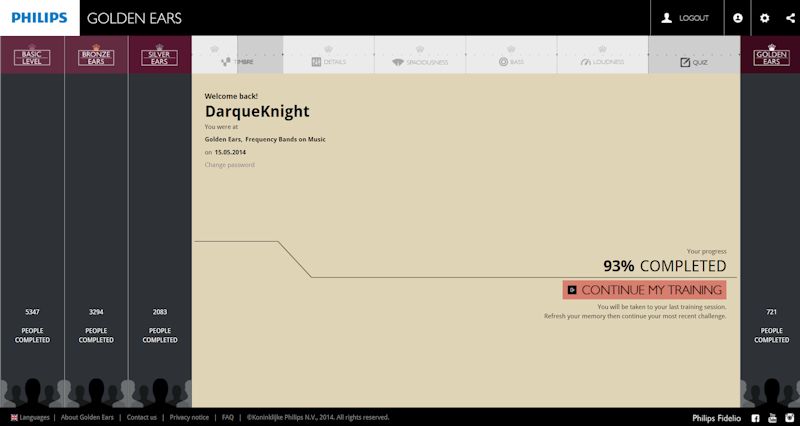
The first day's progress.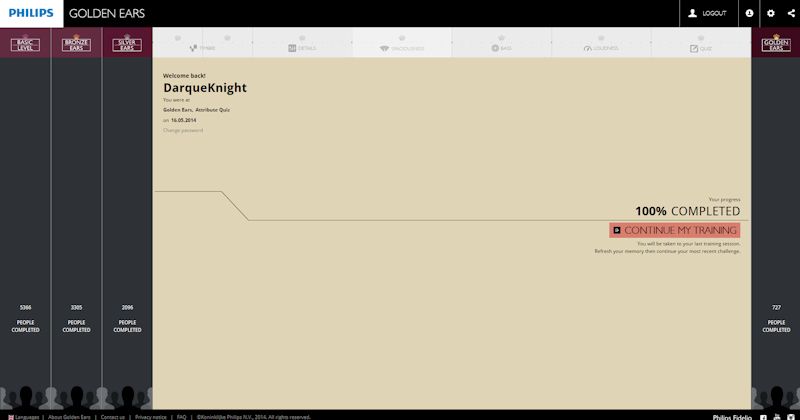
Finished on the second day.
For quite a while some people have derisively referred to my "golden ears". Now I have certification from a real audio company that meant it in a nice way.:cool:
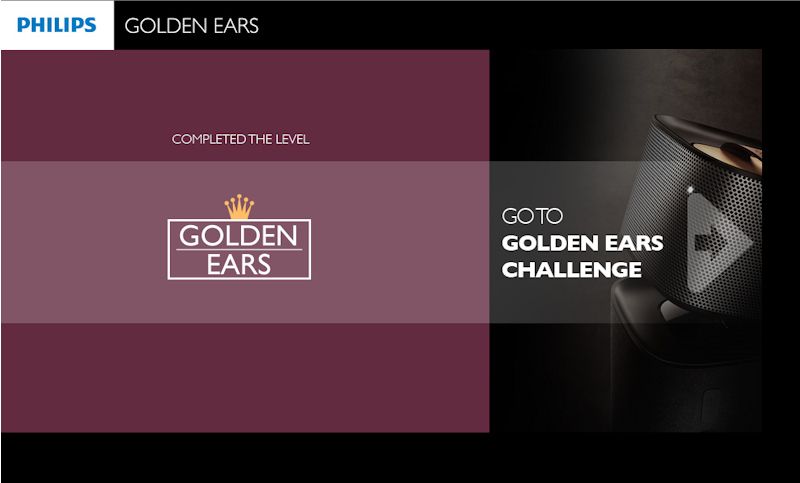
Awww man .... we fight our way though that aggravating test and can't get our names on our certificates?:evil:
Parts of the test were easy (for me) and some were very difficult. It was a great ear workout.
At the time I completed the test:
5366 people had completed the Basic Ear level.
3305 people had completed the Bronze Ear level.
2096 people had completed the Silver Ear level.
727 people had completed the Golden Ear level.Proud and loyal citizen of the Digital Domain and Solid State Country! -
DarqueKnight wrote: »No, this is an example of your special kind of bias where you always want to put audiophiles on trial and evaluate them rather than evaluate gear.
Your mindset is bent on proving whether or not someone can hear what they say they hear, rather than whether one piece of gear outperforms another.
Ok, so lets use the trained listeners to evaluate Product X/Y/Z. We'll let everyone know what Make and Model X/Y/Z after the evaluation.
They don't need to know before. You've just established that the trained listener is the control and the product is the variable. -
DarqueKnight wrote: »
The point you and others seem not to be able to grasp is that blinding adds an unnecessary layer of complexity. When misused, as it often is, it can lead to erroneous results, the nature of which I have discussed in the JOSS paper and in many discussions on this and other audio forums.
So this is primarily what I'm interested in. I'll try and withhold further comment until I read the paper.DarqueKnight wrote: »4. Why can't manufacturers do the blind testing and relieve the consumer of that responsibility? In medical trials, the results from a very small population can be extended to a very large population. This is because human beings have relatively few physiological differences. That is why the same medicine can be safely taken by millions and billions of people. You claim to be a pharmacist, so you understand this.
To be clear, this is what I had intended (manufacturer testing).
To expand briefly on the prior points you made, I completely agree that lab-based test may not be always be representative of actual, consumer behavior. For example, most of us don't drive our cars into concrete wall at high speed. I haven't gotten up and sat down on my Ikea chair 4,000 times a day, and I'd think its rare in medicine for someone to take a drug then close their eyes and stand on one foot, but we do these tests to provide us with different information.
In any event, I'll keep an eye out for some nice cables on my local CL. Polk Fronts: RTi A7's
Polk Center: CSi A6
Polk Surrounds: FXi A6's
Polk Rear Surround: RTi4
Sub: HSU VTF-3 (MK1)
AVR: Yamaha RX-A2010
B&K Reference 200.7
TV: Sharp LC-70LE847U
Oppo BDP-103 -
DarqueKnight wrote: »The only difference that matters is the difference made in your own audio system. If someone is tone deaf and insensitive to the point that every cable, CD player, amp, etc. sounds the same to them, their hearing is not going to improve if everyone in the world proves that they can hear a difference, is it?
No, but if someone, anyone, would demonstrate the ability to hear the difference, we might believe that there really is a difference in silly things like fuses.Most hobbies that people are serious about have a peripheral naysayer fringe element. The ones in photography are much worse. There is no amount of optical science that will convince them that their 99 cent lenses and $24.95 cameras don't take pictures every bit as good as pro quality glass and cameras. The debates between film enthusiasts and digital enthusiasts make audio cable "debates" look like a family picnic.
And many hobbies have a fringe element that imagine differences where none exist. And most are afraid to have their claims put to the test. -
Why is it silly? And if it were demonstrated to any degree, someone...ANYone would find a way to discredit the findings. Sound familiar yet?No, but if someone, anyone, would demonstrate the ability to hear the difference, we might believe that there really is a difference in silly things like fuses.
And many hobbies have a fringe element that imagine differences where none exist. And most are afraid to have their claims put to the test.
And I have never found DK to be afraid of anything, nor do I believe that he advocates that everyone try, or accept, his findings or opinions on the many items/upgrades he's done. Rather, he just likes to offer his opinions on tests he's performed in his system, if for no other reason than to encourage people to think outside the box.
I can admit I've spent many eye-rubbing hours poring over his informative posts here, not because I feel I HAVE to try anything and everything new and different, but because it's pretty cool to see someone so committed to audio, video, testing, etc. who is willing to share what he's learned without wondering if it's simply marketing hype?
For myself, I do know that I've tried many different things in my own systems over the years, and found the journey to be most rewarding because of what I've discovered for myself; hobbies are supposed to be fun after all...So, are you willing to put forth a little effort or are you happy sitting in your skeptical poo pile?
http://audiomilitia.proboards.com/ -
For myself, I do know that I've tried many different things in my own systems over the years, and found the journey to be most rewarding because of what I've discovered for myself; hobbies are supposed to be fun after all...
Bingo....give this man a cookie.HT SYSTEM-
Sony 850c 4k
Pioneer elite vhx 21
Sony 4k BRP
SVS SB-2000
Polk Sig. 20's
Polk FX500 surrounds
Cables-
Acoustic zen Satori speaker cables
Acoustic zen Matrix 2 IC's
Wireworld eclipse 7 ic's
Audio metallurgy ga-o digital cable
Kitchen
Sonos zp90
Grant Fidelity tube dac
B&k 1420
lsi 9's -
No, but if someone, anyone, would demonstrate the ability to hear the difference, we might believe that there really is a difference in silly things like fuses.
And many hobbies have a fringe element that imagine differences where none exist. And most are afraid to have their claims put to the test.
Think about how utterly ridiculous this statement is.
You asking someone to prove to another what they hear, even though it has been established we all hear differently. Like snowflakes, no two sets of ears will be identical. To properly demonstrate you need 2 identical sets of ears, which is why the ONLY set of ears that matters is yours.HT SYSTEM-
Sony 850c 4k
Pioneer elite vhx 21
Sony 4k BRP
SVS SB-2000
Polk Sig. 20's
Polk FX500 surrounds
Cables-
Acoustic zen Satori speaker cables
Acoustic zen Matrix 2 IC's
Wireworld eclipse 7 ic's
Audio metallurgy ga-o digital cable
Kitchen
Sonos zp90
Grant Fidelity tube dac
B&k 1420
lsi 9's -
Think about how utterly ridiculous this statement is.
You asking someone to prove to another what they hear, even though it has been established we all hear differently. Like snowflakes, no two sets of ears will be identical. To properly demonstrate you need 2 identical sets of ears, which is why the ONLY set of ears that matters is yours.
Think about how utterly ridiculous this statement is.
We all hear differently, some claim to be able to discern things in the sound of wire/fuses/outlets that others can't. But after decades of debate, none of them have demonstrated these claims. -
Music is like art "The beauty is in the eye of the beholder" in this case "the ear"
Same follows suit with trained wine tasters, to many it's just a glass of wine others can pick out every little nuance of the makers intentions.2-channel: Modwright KWI-200 Integrated, Dynaudio C1-II Signatures
Desktop rig: LSi7, Polk 110sub, Dayens Ampino amp, W4S DAC/pre, Sonos, JRiver
Gear on standby: Melody 101 tube pre, Unison Research Simply Italy Integrated
Gone to new homes: (Matt Polk's)Threshold Stasis SA12e monoblocks, Pass XA30.5 amp, Usher MD2 speakers, Dynaudio C4 platinum speakers, Modwright LS100 (voltz), Simaudio 780D DAC
erat interfectorem cesar et **** dictatorem dicere a -
I suppose you are also the sort that thinks that there is no differences to the electrical properties of various metals too? One who believes that either it passes a signal or it doesn't? That it has no effect one way or the other?
You should think long and hard about your answer because if you say yes, you discredit about 85% of all of your derisive and derogatory posts.
Of course there are different electrical properties. The question is, are they audible?And you are trying to tell me that the professional who spends their LIFE doing whatever this thing may be is no better than the hobbyist who just started learning about the subject?
I have no doubt some people can do things better than other, they demonstrate it everyday. -
Music is like art "The beauty is in the eye of the beholder" in this case "the ear"
Same follows suit with trained wine tasters, to many it's just a glass of wine others can pick out every little nuance of the makers intentions.
As for your statement William I have seen examples of where people have picked up on subtle differences in music while swapping cables. Those differences were later revealed on spectra graphs...some heard it some didn't2-channel: Modwright KWI-200 Integrated, Dynaudio C1-II Signatures
Desktop rig: LSi7, Polk 110sub, Dayens Ampino amp, W4S DAC/pre, Sonos, JRiver
Gear on standby: Melody 101 tube pre, Unison Research Simply Italy Integrated
Gone to new homes: (Matt Polk's)Threshold Stasis SA12e monoblocks, Pass XA30.5 amp, Usher MD2 speakers, Dynaudio C4 platinum speakers, Modwright LS100 (voltz), Simaudio 780D DAC
erat interfectorem cesar et **** dictatorem dicere a -
txcoastal1 wrote: »Music is like art "The beauty is in the eye of the beholder" in this case "the ear"
Same follows suit with trained wine tasters, to many it's just a glass of wine others can pick out every little nuance of the makers intentions.
And the wine tasters can demonstrate this ability, even blind. Good point.








This discussion has been closed.