SDA Cable
Options

Kwikfinger
Posts: 1
I have a pair of SDA 1C Polk Audio Speakers that I picked up for $50 on OfferUp, but they are missing the interconnect cable, is there anyone out there who knows where I can find this ? Or does anyone have information about the cable itself ? I'm curious about if it can be replicated, if I could make one myself ? I've been searching everywhere for 6 months now & finding zilch ! Please help !🤪
Answers
-
Sure, just use an rca cable to the pin slot....the blade slot is irrelevant.
It works and is 100% safe....I assure you.
Enjoy!I plan for the future. - F1Nut -
Early 1C's used a blade/blade cable. Both blades carried a signal.
-
-
This content has been removed.
-
I could be corrected on that one.
-
For the OP....IF it has a pin/blade connection....use the RCA cable.
Blade/Blade.....ebay probably best bet.I plan for the future. - F1Nut -
A typical RCA interconnect will likely have a tiny conductor. The RCA pin may be approximately the right size to plug into the speaker, but the cable it's attached to is probably insufficient. (Unless you're custom-making an SDA interconnect cable using "speaker wire" connected to RCA plugs.)Sure, just use an rca cable to the pin slot....the blade slot is irrelevant.
It works and is 100% safe....I assure you.
I don't think so. At least, not until you use the isolation transformer. One blade socket on those wasn't connected to anything. That's the big "fix" for those--to add a foot of wire between one of the blade connectors and the negative terminal so both the blades are electrically active.Early 1C's used a blade/blade cable. Both blades carried a signal.
https://forum.polkaudio.com/discussion/131691/2b-and-early-1c-ai-1-modifications#latest
The 1B had blade/blade, and both conductors carried signal. There were major differences in the way the SDA signal was transferred between the two speaker cabinets between the 1B and earlier speakers, and the 1C and later speakers.
-
Well, in the case of a pin/blade connection......and your choices are
A. Connect the with an RCA cable (you might have to shave the collar)
Or
B. Listen to the speakers with no cable
I’ll take what’s behind door number one, Monty.
I’ve done it. Many others have done it.....I’m pretty sure Polk Audio suggested it as a work around.....and nobody has suffered any ill effectsI plan for the future. - F1Nut -
I don't think so. At least, not until you use the isolation transformer. One blade socket on those wasn't connected to anything. That's the big "fix" for those--to add a foot of wire between one of the blade connectors and the negative terminal so both the blades are electrically active.
Yep, I think you're right. Thanks! -
The "ill effects" would be a reduction in SDA volume (and clarity?) due to excess resistance in the RCA cable conductor. It'd "work" but not be "right". I'm thinking that Polk used 16- or 18-gauge wire in the SDA cable; while the center conductor in typical RCA-terminated interconnects are thinner than that.Well, in the case of a pin/blade connection......and your choices are
A. Connect the with an RCA cable (you might have to shave the collar)
Or
B. Listen to the speakers with no cable
I’ll take what’s behind door number one, Monty.
I’ve done it. Many others have done it.....I’m pretty sure Polk Audio suggested it as a work around.....and nobody has suffered any ill effects
I'd suggest
C. Build a custom cable using speaker wire and modified RCA ends
D. Remove or bypass the OEM connector socket, install an aftermarket connection point--banana plugs, the fancy Neutrik air-tight audiophile connector body, or some other connector. This "works" no matter which style of connector Polk originally supplied on the 1C.
E. in the case of those 1Cs built with blade/blade connector sockets, spend the rest of your life looking for the "Adapter Plugs" that were once provided by Polk, but which are probably decades out-of-production. But God bless eBay, you might get lucky. (I doubt it.) Then use Option C. -
And you know this for a fact because?
Perhaps, I am just that dumb, but I ran SDA’s for a long time and found no loss of anything....nor has anyone else reported such....
YMMV.I plan for the future. - F1Nut -

Just moved into what I hope will be
my last house. Broke out my SDA-SRS’s (circa 1985) and went into a panic. No IC cable! Then big sigh of relief when I found it in a box with component cables. Now I’m ready to unbox my SDA-1C’s. . . Will there be an IC cable there? They have been in their boxes for a few years. Saw pin/blade cables on ebay $65. What would be a good cable to use for building a new one? Bought both sets new. -
Whatever speaker wire you prefer, along with cable ends/connectors to suit.What would be a good cable to use for building a new one?
It's the ends on the cable, and the matching connector bodies on the cabinets that's the problem. Far as I know, the OEM connections are no longer available. Perhaps I'm wrong.
As said, the "hot" set-up as I understand it is the airtight/sealed versions of the Neutrik connectors. Just remember that your "original" SDA-SRS is wired differently than the newer generations.
You only need one dedicated "SDA" connector terminal on each cabinet, the input for the SDA drivers via the big capacitors and inductor. The two conductors in the SDA cable carry full-range, full-volume signal to the opposite speaker cabinet. You could piggyback the SDA cable output conductor onto the regular positive speaker terminal. So from each speaker, you have a conductor leading from the positive terminal to the opposite speaker's SDA input terminal.
It also works for the SDA 1B, SRS 2 blade/blade, SDA 2A, and maybe some older generation speakers. This SDA wiring is NOT correct for the newer generations.
-
I used the neutrik sealed connectors on my 2A,s they work great. They also have a twist lock.
-
I used the neutrik sealed connectors on my 2A,s they work great. They also have a twist lock.
That is the best way to go. -
Hi Everyone. I hope this forum is still monitored. Despite my wife's protests, I am reviving my SDA-1Cs. But I cannot find my interconnection cable. I have seen the workarounds presented in the forums, but I have an additional problem that my two speakers have different interconnection cable sockets - one has the two blades and the other has the pin/blade (photos attached ignore the inadequate speaker wire, I will be upgrading it before its final set up). I bought these as floor models from the PX at Pearl Harbor in 1988 and did not realize the issue until later. To their credit, Polk sent me an entirely new cable with an adapter which, in the ensuing 38 years, I have lost. If anyone can give me advice as to how to fabricate and fit a new cable, I would be grateful
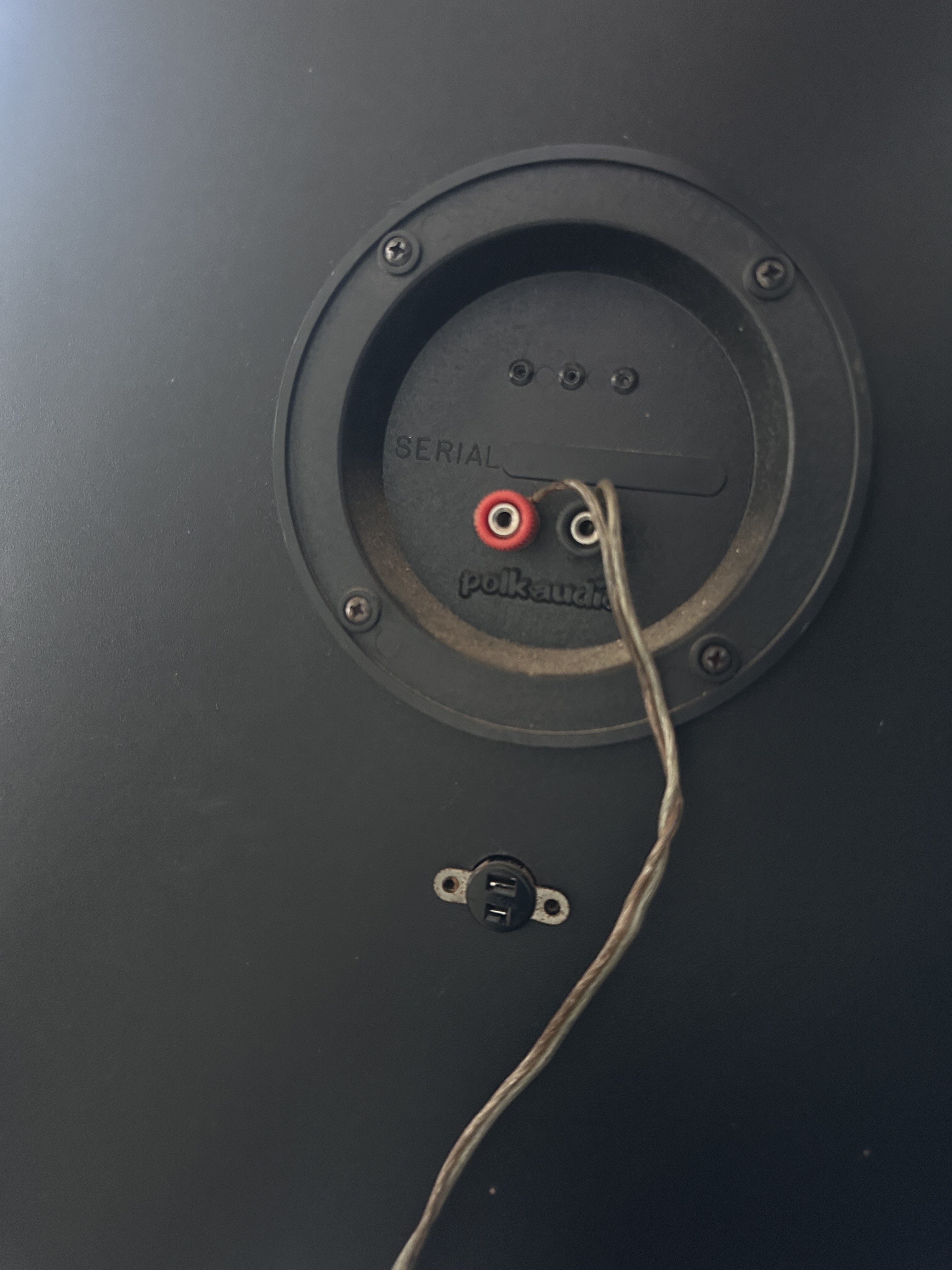
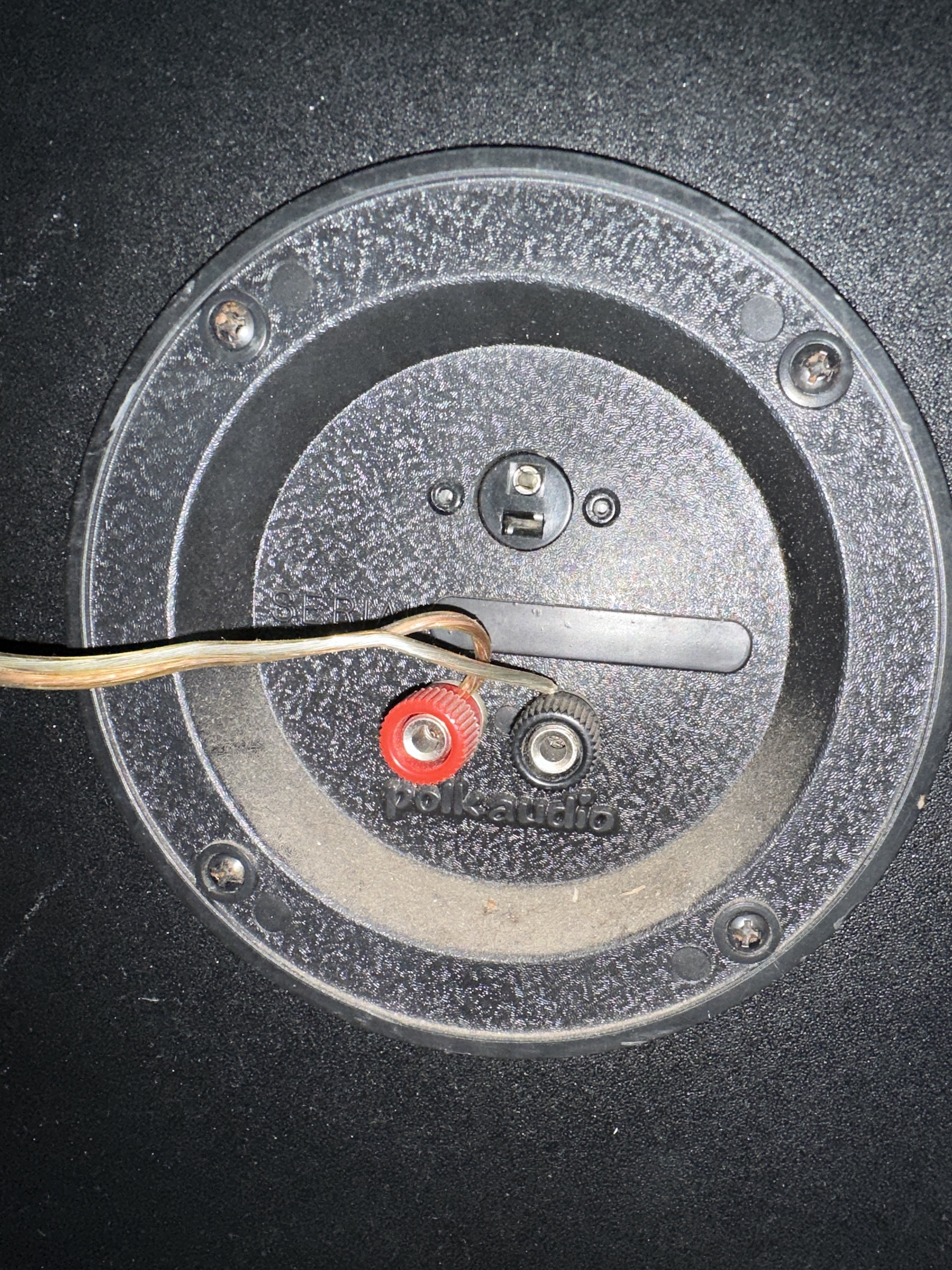
-
This content has been removed.
-
ASSUMING that these speakers really are a pair of 1Cs, and not a 1C and a 1B, for example:
At minimum, you need to connect the pin of the pin/blade connector to one or the other of the blades on the Blade/blade connector. I can't remember which blade is active on those. In their original configuration, one blade will not be connected to anything else, so you could connect the pin end, and then touch the other end of the cable to each blade on the other cabinet--the one that changes the sound is the correct one.
The factory recommended--but user-installed--fix was to connect the "dead" blade of the Blade/blade cabinet terminal to speaker-cable negative terminal. Kinda guessing that has not been done to your speakers, but all you'd have to do is connect an ohmmeter between the negative speaker terminal of that cabinet, and each of the two blades in the Blade/blade connector. If neither of them have continuity, the speaker has not been given the "factory-recommended" fix.
It's a matter of finding wire-end connectors that mate with the speaker-cabinet connectors--pin on one end of your SDA cable, blade on the other end.
The better fix is to bypass the OEM connectors, install and wire-in aftermarket connectors--the air-tight Neutriks heavily favored. Then you build an SDA cable of appropriate length with the matching Neutrik connectors. -
This content has been removed.
-
Thank you both for taking the time to respond. You both seem to hint at the possibility that they are mis-matched speakers, one 1C and one 1B. Is there a definitive way I can determine this? I was definitely sold them as a pair of 1Cs.
@pitdogg2 : How do I determine what drivers are in the speakers?
@Schurkey I like your idea of using Neuriks and bypassing the OEM connectors. Is there any post, or can you provide me some guidance, on how I might do this? Also could you provide me with a link directing me to the exact Neuriks connectors you recommend? -
This content has been removed.
-
Early 1C's used a blade/blade cable. Both blades carried a signal.
My question to that is....
What then were the difference between the early C and the previous B model?
Drivers and caps?
I had known early C had B/b socket BUT I clearly was wrong to presume that the connection was both blades were NOT active.
I read somewhere years ago that some very early C's came in B cabinets. I have a pair of C's my Dad bought brand new. But they are in B cabinets. So they are "supposedly" C's. I'm not sure how to tell exactly if they are C's in B cabinets though.--Gary--
Onkyo Integra M504, Bottlehead Foreplay III, Denon SACD, Thiel CS2.3, NHT VT-2, VT-3 and Evolution T6, Infinity RSIIIa, SDA1C and a few dozen other speakers around the house I change in and out. -
Neutrik
-
Here's a link, https://www.neutrik.us/en-us/products/audio/speakon
The current offerings have different model numbers than the last time I ordered. For the panel socket make sure the version is air tight as not all are. That is very important.
Edit: another thing, the 4 pole versions, especially the metal versions with the higher amperage ratings are a lot more robust than the 2 pole versions, IME. -
This content has been removed.
-
Thanks again to everyone who has responded. The drivers were a combination of 6510/6511 so they are a pair of SDA-1Cs, as I thought I'd purchased. But I still have the problem of the mismatched interconnection sockets. I took some photos while I had the speakers open. The right speaker with the blade/blade socket seems to have a single wire that is terminated at a large coil (crossover?). The left speaker (pin/blade) joins the blade with the -ve speaker terminal. The interconnection pin wire, -ve and +ve speaker terminals are joined into a single plug and inserted into a socket on the circuit board (the blue, black and white wires). So I guess my question is: how do I configure my the cable I need to fabricate?
My guess is to join the single cable from the right speaker to the blue wire on the left?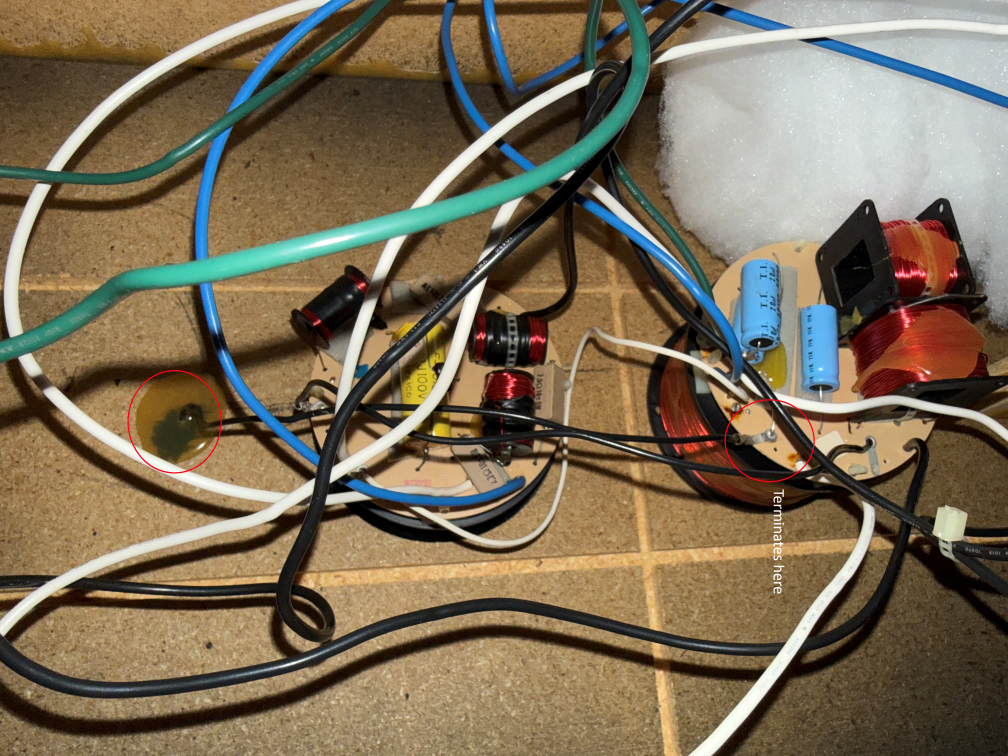
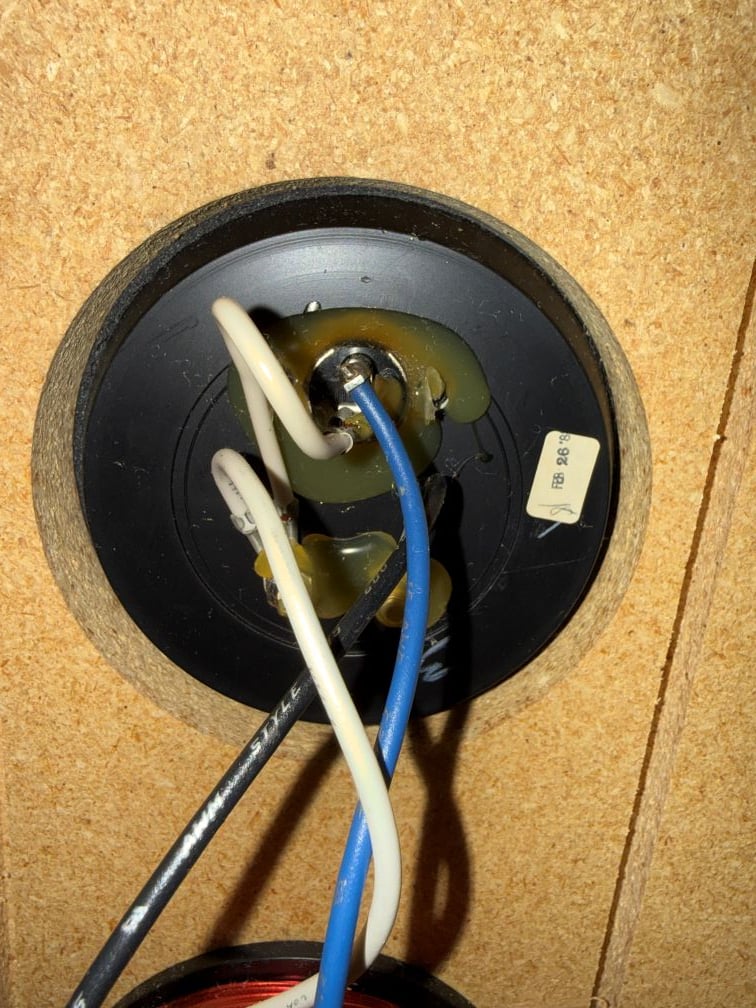
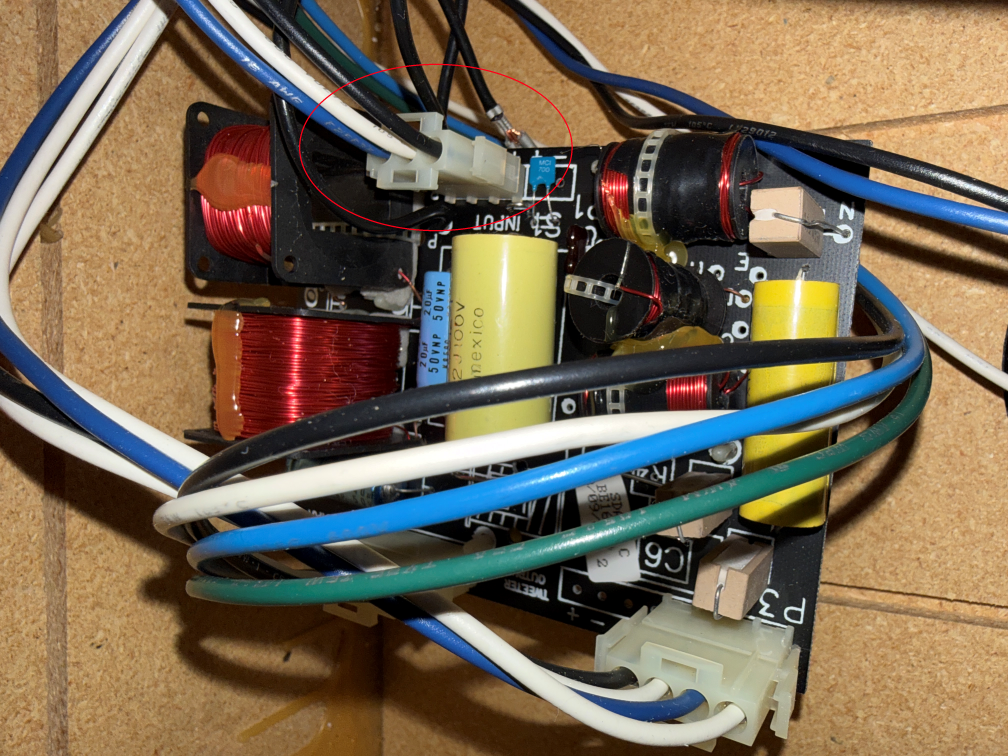
-
Yup.The pin of one cabinet goes to whichever blade is actually connected to something on the other cabinet.Homersapian wrote: »My guess is to join the single cable from the right speaker to the blue wire on the left?
IF (big IF) you ever would want to use an isolation transformer in the SDA cable, you'll have to connect the "non-connected" blade terminal to the negative speaker-cable connection. (No time like the present...) -
This content has been removed.