Time to replace the old Yamaha avr
Comments
-
It occurred to me that she should upgrade her lampcord speaker wires while doing this. She needs a total of 20' non terminated. Anybody ever satisfied with some from Amazon, or would a trip to Best Buy do the same?
I was going to recommend the wire I used last time I built a set of cables, but it seems like Monoprice discontinued the wire.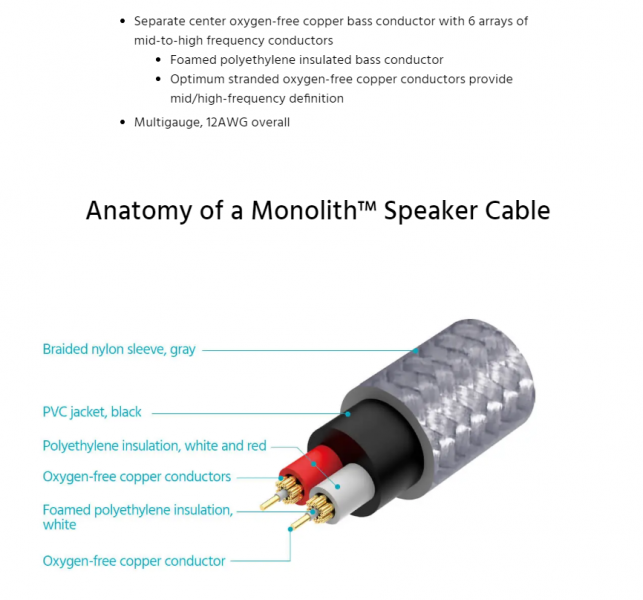
It was a pretty good deal at $39 for a 25' spool. Now they just sell terminated versions and they are advertising them as 14AWG and not 12AWG like the stuff I bought.
https://www.amazon.com/Monolith-Multi-Strand-Conductors-Speaker-Wire/dp/B07Q8WDF1K?
At this point, I think the Canare 4S11 (or 4S11G) is a better recommendation, especially if you want un-terminated. In fact, I may just buy a length and do another set since I have exactly 8 Audioquest silver coated copper spades left from a bulk purchase about 18 years ago.
-
"Does this amp have PFFB? I am guessing no." Actually the WiiM Ultra does have it.Yep, my name really is Bob.
Parasound HCA1500A(indoor sound) and HCA1000(outdoor sound), Dynaco PAS4, Denon DP1200 w/Shure V15 Type V and Jico SAS stylus, Marantz UD7007, Polk L600, Rythmik L12 sub. -
You might also consider WiiM's earlier WiiM Amp or WiiM Amp Pro, which are priced a fair bit lower ($300-$380), but those models might have all she needs. They are about half as powerful as the Ultra, and don't have the fancy touchscreen, but both were well reviewed a few years ago.
https://www.wiimhome.com/wiimamp/overview
https://www.amazon.com/dp/B0DFPJ91ZX?th=1
Question is, will 60wpc into 8ohm or 120w into 4ohm be enough power? I think the difference between the Amp and Amp Pro is an improved DAC in the Amp Pro along with better cooling and the addition of PFFB in the Pro.
Post edited by billbillw on -
The WiiM Vibelink and Amp Ultra both have post filter feedback. For what they are I've been impressed with the amps and I think they'd suit most casual music listeners. The Vibelink is primarily for someone who already has a digital source component with a coaxial or optical output.
-
"Does this amp have PFFB? I am guessing no." Actually the WiiM Ultra does have it.
OK, so there you go! It should be reasonably load-independent, then.
-
"Question is, will 60wpc into 8ohm or 120w into 4ohm be enough power? '
That is indeed the question of the day. Time will tell once she orders the amp probably using Amazon for ease of return. First we'll wait for the speaker cables to arrive & see if that makes much of a difference with the AVR....I'm not optimistic about this but she needs better wires anyhow.
What does PFFB do? What would be the audible difference betwenn one unit having it and the other not?Yep, my name really is Bob.
Parasound HCA1500A(indoor sound) and HCA1000(outdoor sound), Dynaco PAS4, Denon DP1200 w/Shure V15 Type V and Jico SAS stylus, Marantz UD7007, Polk L600, Rythmik L12 sub. -
PFFB seems to keep distortion and frequency response more consistent across a wider dynamic load. Class D is more load dependent than A/B or A.
-
"Question is, will 60wpc into 8ohm or 120w into 4ohm be enough power? '
That is indeed the question of the day. Time will tell once she orders the amp probably using Amazon for ease of return. First we'll wait for the speaker cables to arrive & see if that makes much of a difference with the AVR....I'm not optimistic about this but she needs better wires anyhow.
What does PFFB do? What would be the audible difference betwenn one unit having it and the other not?
Post-Filter FeedBack. Broadly similar to the feedback loop used in Class AB amplifiers (and/or also the specific feedback employed in PP Ultralinear vacuum tube amplifiers) to broaden frequency response, reduce distortion, and lower amplifier output impedance. The goals are essentially the same... but mostly (I think) to remove the load-dependency that is a hallmark of PWM (Class D) amplification.
Amusingly, I think that the load-dependent changes in frequency response might be (have been) one of the primary reasons that some "early"* Class D amplifiers (e.g., those using the Tripath "Class T" chipset) found a fanbase some years back with their "tube-like" sound.
_____________
* Not that early! Commercially-available Class D amplifiers date back to the 1960s and the famous/infamous Sir Clive Sinclair... the Class T amps were a late-90s/early 21st Century thing.
EDIT: The "filter" in PFFB, in case it isn't obvious, is the low-pass filter that's required on the output side of all class D amplifiers to remove the ultrasonic crud from the amplified output signal fed to loudspeakers. It needs to be removed for the same reasons as the HF 'hash' that is filtered out in a DAC. In and of itself, the ultrasonic noise is inaudible by definition, but it can wreak havoc with tweeters and/or result in audible artifacts by 'heterodyning' with other signal components, producing artifacts ("beat products") in the audible range. -
My Vibelink amp performs as well as a Pioneer Elite SC57 in stereo mode I was using even with the analog inputs being used on the Vibelink. Got it to reduce the system footprint. Actually, bass is a bit better from the R100s.
The WiiM amp products should perform at least as well as most AVRs for stereo use and in many cases better with 4 ohm speaker loads. -
They get lots of good reviews from owners and the price of the WiiM products is certainly reasonable.
-
PFFB seems to keep distortion and frequency response more consistent across a wider dynamic load. Class D is more load dependent than A/B or A.
Not all class D amplifiers are load dependent, many apogee scintilla owners were using Henry Ho's H2O amplifier with better results than many class A amplifiers.