bridging NAD amplifiers
Comments
-
............"Appreciation of audio is a completely subjective human experience. Measurements can provide a measure of insight, but are no substitute for human judgment. Why are we looking to reduce a subjective experience to objective criteria anyway? The subtleties of music and audio reproduction are for those who appreciate it. Differentiation by numbers is for those who do not".--Nelson Pass Pass Labs XA25 | EE Avant Pre | EE Mini Max Supreme DAC | MIT Shotgun S1 | Puritan Audio PSM136 Pwr Condtioner & Classic PC's | Legend L600 | Roon Nucleus 1 w/LPS - Tubes add soul!
-
Dual mono is completely different than bridging two stereo amps.
-
"Appreciation of audio is a completely subjective human experience. Measurements can provide a measure of insight, but are no substitute for human judgment. Why are we looking to reduce a subjective experience to objective criteria anyway? The subtleties of music and audio reproduction are for those who appreciate it. Differentiation by numbers is for those who do not".--Nelson Pass Pass Labs XA25 | EE Avant Pre | EE Mini Max Supreme DAC | MIT Shotgun S1 | Puritan Audio PSM136 Pwr Condtioner & Classic PC's | Legend L600 | Roon Nucleus 1 w/LPS - Tubes add soul!
-
I just can't help it - might be genetic...
Once bridged aren't the "stereo" amps mono?
From the manual:
"This switch "bridges" the two power amplifier channels to form a monophonic amplifier"
You can only drive the left channel with the 7400 at that time and must use another amp- hopefully the 2400 - to drive the right channel. You then use the Pre-out of the 7400 right channel to supply signal to the 2400. The only change up here is that the 7400 supplies the left channel, sans cable, to the power amplifier section of the integrated amp.
I'm not sure how dual mono is completely different? My dual mono amp has separate power, boards, caps and transformer. One for each channel. It's just a space saver, I don't need two chassis'. Just to be clear I'm not bi-amping. In the classic dual mono situation (assuming I had two fully separate physical amps) I would use one amp (in this case the bridged 7400) for the left channel and left only. I would use the other amp (in this case the bridged 2400) for the right channel and right only. No more stereo from either amp. One speaker wire comes from the 7400, the other from the 2400.
I understand they weren't born as mono amps but they certainly had the surgery to become mono amps.Aaron
Enabler Extraordinaire -
Qualitive questions aside by definition those amps bridged would become mono blocs.
-
That is true, however my point is that there is no longer a stereo amp after bridging. Whether housed in a single chassis or multiple they are mono. Therefore they are not "completely different" - see post #35 and #36.
Because of that...blah blah blah reference post #33.Aaron
Enabler Extraordinaire -
CertainlyIt's semantics
True which is really what you end up with when bridging a pair of like amplifiers since the two ch. within each now function as one.. Monoblock by its very definition is a single channel amplifier in a single chassis. -
There are notable differences between bridged amps and a purpose built dual mono amp or mono blocks. Two examples off the top of my head are that a dual mono amp or mono blocks have lower distortion and the ability to drive low ohm loads.Political Correctness'.........defined
"A doctrine fostered by a delusional, illogical minority and rabidly promoted by an unscrupulous mainstream media, which holds forth the proposition that it is entirely possible to pick up a t-u-r-d by the clean end."
President of Club Polk -
Absolutely. Many of the higher powered monoblocks(ie.Pass,Bryston)actually use balanced /bridged output stages but the two halves of the circuit have been closely gain matched so that common mode distortion is cancelled or reduced.Everything has been optimised for mono operation.While I have seen test results on well designed stereo amps that actually have lower THD when bridged it certainly won't be the case with ones that have poor matching between it's two channels.There are notable differences between bridged amps and a purpose built dual mono amp or mono blocks. -
Therefore they are not "completely different" - see post #35 and #36.
Because of that...blah blah blah reference post #33.
If you're looking at it as a stereo amp becoming a mono amp, yes, it's the same as a mono block because the stereo amp just turned to a mono amp when bridged.
However, the circuitry and result will be completely different.
Say we buy two different amps from the same manufacturer. One is a stereo amp in a single chassis. The other is the exact same amp built into seperate chassis (mono blocks). Both output 120w/ch.
Get another one of the stereo amp and bridge them for 240w/ch.
Driving the same speakers, the 240w bridged amps won't be able to handle low impedance like the 120w mono block. When you bridge a stereo amp, it will cut your speaker impedance by half and increase THD. -
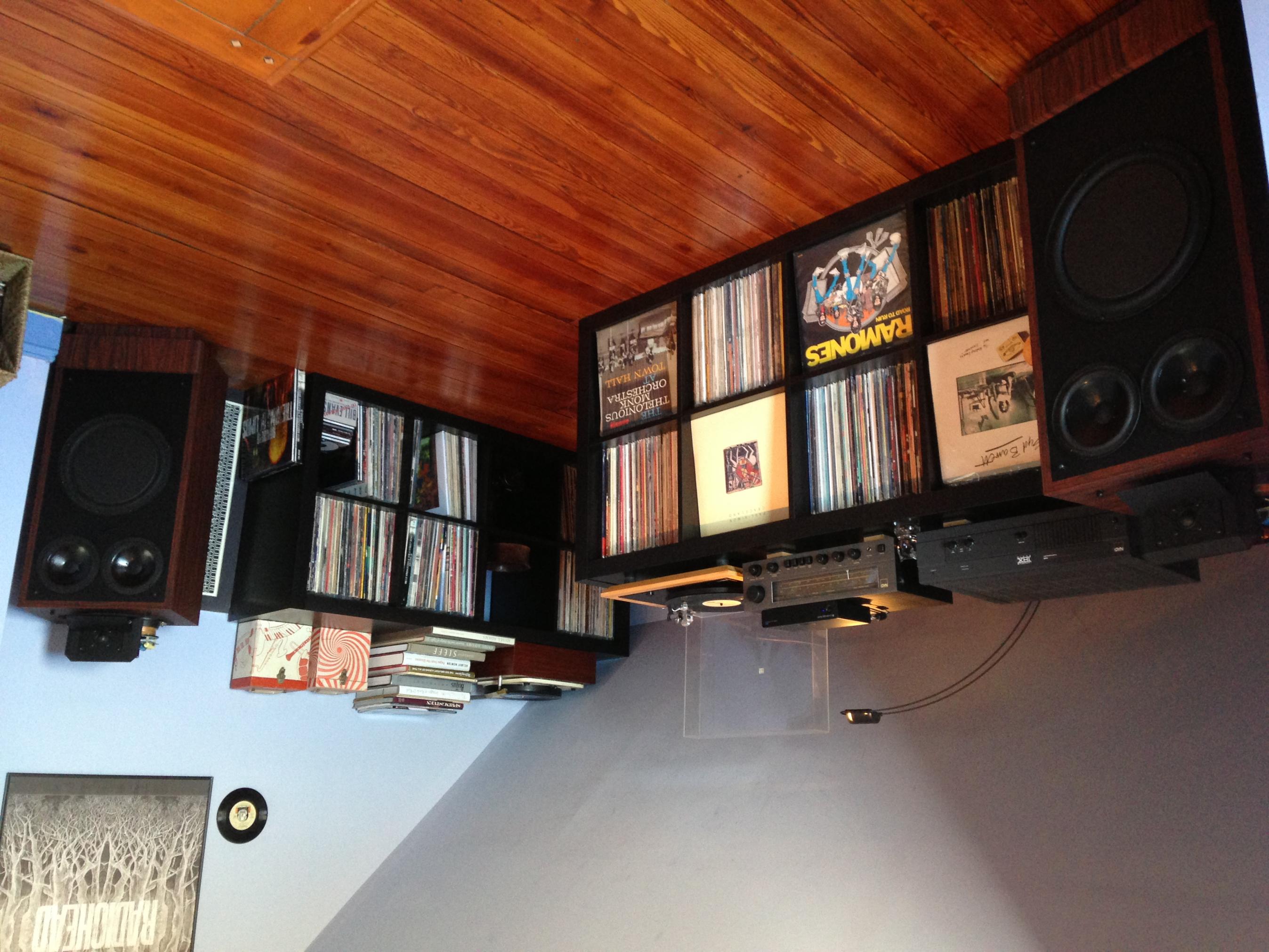
So I bought the NAD 7020 integrated amp and am currently using it as a preamp in conjunction with the NAD 2400THX power amp. There is more than enough power to drive my Polk Audio RTA 12C speakers! Very rarely do have the volume knob up past 1/4. Any higher and the neighbors might have the cops at my front door. I'm very happy with the quality of the sound. Thanks again to everyone in this forum!
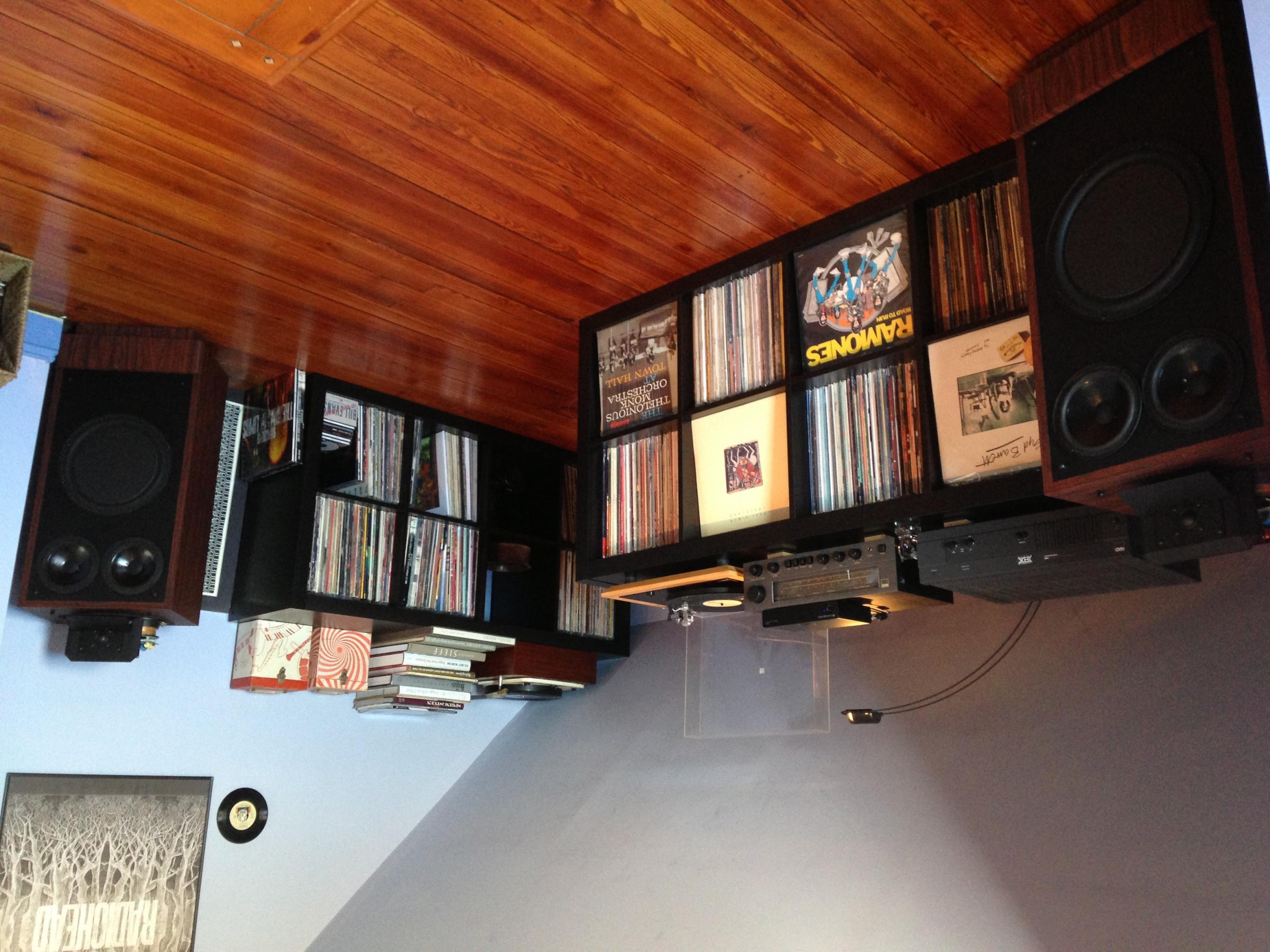
-
Not sure why my photo was inverted while uploading from my iPhone. Lets try that again...
-
The 7400 has the same specs as the 2400. Ditch the 2400 amp. If you need more "safe" power, get a NAD 7600 (150x2, 500 wpc tone burst). There is a *huge* difference between the 7400 and 7600 when i tested them on my rti10's.
Sorry, just saw your post stating you got the 7020. Do you hear a difference between the 7020+2400 as opposed to using the 7400 alone? -
I started this thread because I was considering purchasing a NAD 7400. However, after all of the feedback I decided against buying one. So I'm afraid I can't tell you if that would sound much different than my current setup.
-
Update: I've replaced our NAD 2400THX power amp with a NAD 2600 power amp, which has had speaker relays and caps replaced. I'm quite happy with the sound quality it provides in tandem with our NAD 1300 pre amp. The 2400 will be our backup amp.