Can you do an Ohm test with tweeter plugged in?
Options

NewToAudio
Posts: 23
I have a really used CS1 Series 2 center speaker that someone for work gave me. Something sounds really off with this and Im not confident fully pulling this apart to test internals. Anyhow I undid the Tweeter (leads still connected) and got an ohm reading of .5-.7 so obviously this doesn't seem right. But not fully sure if you can get a reading this way
One lead was glued on so I didnt mess with it
One lead was glued on so I didnt mess with it
Comments
-
You have to disconnect the leads.
-
As @F1nut says, the tweeter (i.e., the voice coil of the tweeter) must be isolated from the crossover to measure its DC resistance.
"glued"???NewToAudio wrote: »...One lead was glued on so I didnt mess with it
Soldered, maybe?
If you cannot (or don't know how to) desolder, you can snip the lead going to the tweeter ("downstream" of the crossover), measure the resistance, and then reconnect afterwards. That may be easiest to do by adding a small piece of wire and connecting both ends. Ideally the splices would be soldered, but it's possible to twist the leads together and use "butt connectors"*. Otherwise, you'll just have to not worry about it, or take it to someone who knows what they're doing.
_______________
* No, this is not dirty. These things:
https://www.parts-express.com/search?keywords=butt connector&order=relevance:desc
-
In what way does it sound "off"? Why have you focused on the tweeter?NewToAudio wrote: »I have a really used CS1 Series 2 center speaker that someone for work gave me. Something sounds really off with this and I'm not confident fully pulling this apart to test internals...
-
mhardy6647 wrote: »
In what way does it sound "off"? Why have you focused on the tweeter?NewToAudio wrote: »I have a really used CS1 Series 2 center speaker that someone for work gave me. Something sounds really off with this and I'm not confident fully pulling this apart to test internals...
I actually just re ran audyssey not to long ago and it sounds better now. Not sure if it was my placement of the center on my last audyysey test made it sound off. Had the center back port almost up to my tv stand. Moved the center all the way forward and gave it about 8 of clearance from the port
Before it was like all voice were muffled. No aliveness to the voice as if someone was speaking with a mask on. Made it sound really off putting -
mhardy6647 wrote: »As @F1nut says, the tweeter (i.e., the voice coil of the tweeter) must be isolated from the crossover to measure its DC resistance.
"glued"???NewToAudio wrote: »...One lead was glued on so I didnt mess with it
Soldered, maybe?
If you cannot (or don't know how to) desolder, you can snip the lead going to the tweeter ("downstream" of the crossover), measure the resistance, and then reconnect afterwards. That may be easiest to do by adding a small piece of wire and connecting both ends. Ideally the splices would be soldered, but it's possible to twist the leads together and use "butt connectors"*. Otherwise, you'll just have to not worry about it, or take it to someone who knows what they're doing.
_______________
* No, this is not dirty. These things:
https://www.parts-express.com/search?keywords=butt connector&order=relevance:desc
Had to be hot melt glue. Unless theres a clearish looking solder idk about. It just had it on the - terminal. Would unplugging the + lead be enough to test it?
-
Depends on the crossover topology, but no, probably not.NewToAudio wrote: »
Had to be hot melt glue. Unless theres a clearish looking solder idk about. It just had it on the - terminal. Would unplugging the + lead be enough to test it?
-
NewToAudio wrote: »mhardy6647 wrote: »As @F1nut says, the tweeter (i.e., the voice coil of the tweeter) must be isolated from the crossover to measure its DC resistance.
"glued"???NewToAudio wrote: »...One lead was glued on so I didnt mess with it
Soldered, maybe?
If you cannot (or don't know how to) desolder, you can snip the lead going to the tweeter ("downstream" of the crossover), measure the resistance, and then reconnect afterwards. That may be easiest to do by adding a small piece of wire and connecting both ends. Ideally the splices would be soldered, but it's possible to twist the leads together and use "butt connectors"*. Otherwise, you'll just have to not worry about it, or take it to someone who knows what they're doing.
_______________
* No, this is not dirty. These things:
https://www.parts-express.com/search?keywords=butt connector&order=relevance:desc
Had to be hot melt glue. Unless theres a clearish looking solder idk about. It just had it on the - terminal. Would unplugging the + lead be enough to test it?
Post a photo of that please. -
As above... you may be able to get away with testing by just pulling one leg, either + or -.
This was a way to test a resistor in a circuit to be in spec.
Pull the easiest one and try, report back please. -
NewToAudio wrote: »mhardy6647 wrote: »As @F1nut says, the tweeter (i.e., the voice coil of the tweeter) must be isolated from the crossover to measure its DC resistance.
"glued"???NewToAudio wrote: »...One lead was glued on so I didnt mess with it
Soldered, maybe?
If you cannot (or don't know how to) desolder, you can snip the lead going to the tweeter ("downstream" of the crossover), measure the resistance, and then reconnect afterwards. That may be easiest to do by adding a small piece of wire and connecting both ends. Ideally the splices would be soldered, but it's possible to twist the leads together and use "butt connectors"*. Otherwise, you'll just have to not worry about it, or take it to someone who knows what they're doing.
_______________
* No, this is not dirty. These things:
https://www.parts-express.com/search?keywords=butt connector&order=relevance:desc
Had to be hot melt glue. Unless theres a clearish looking solder idk about. It just had it on the - terminal. Would unplugging the + lead be enough to test it?
Post a photo of that please.
Way later on today I can after im off work and have the energy 👍🏼
-
NewToAudio wrote: »mhardy6647 wrote: »As @F1nut says, the tweeter (i.e., the voice coil of the tweeter) must be isolated from the crossover to measure its DC resistance.
"glued"???NewToAudio wrote: »...One lead was glued on so I didnt mess with it
Soldered, maybe?
If you cannot (or don't know how to) desolder, you can snip the lead going to the tweeter ("downstream" of the crossover), measure the resistance, and then reconnect afterwards. That may be easiest to do by adding a small piece of wire and connecting both ends. Ideally the splices would be soldered, but it's possible to twist the leads together and use "butt connectors"*. Otherwise, you'll just have to not worry about it, or take it to someone who knows what they're doing.
_______________
* No, this is not dirty. These things:
https://www.parts-express.com/search?keywords=butt connector&order=relevance:desc
Had to be hot melt glue. Unless theres a clearish looking solder idk about. It just had it on the - terminal. Would unplugging the + lead be enough to test it?
Post a photo of that please.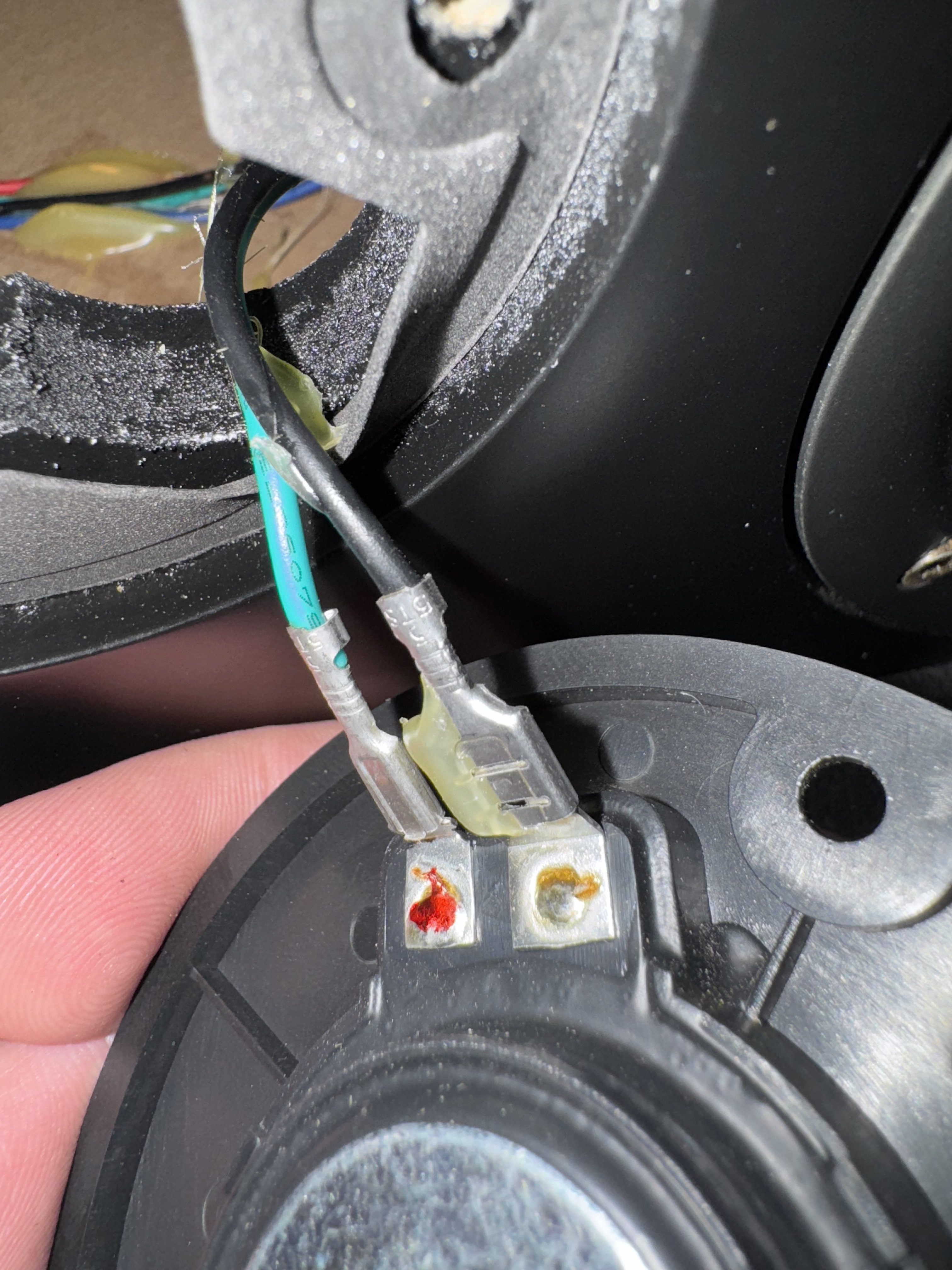
-
Those are not soldered together. They are held together by the clip itself (mechanical compression connection), and you simply slide them off. You can't mess up putting them back in the right spot for correct polarity, because they are different sizes.
Tom~ In search of accurate reproduction of music. Real sound is my reference and while perfection may not be attainable? If I chase it, I might just catch excellence. ~ -
This content has been removed.
-
FWIW, I like to use relatively subtle tools to dislodge slide-on quick connectors like those (especially examples that have been "together" for decades) - hemostats and/or a dental pick can come in very handy.
One common trick used by installers to cinch the quick connectors firmly onto their terminals is to crimp them a bit with pliers. Carefully (!) sliding the tip of a small/slim screwdriver 'twixt connector and terminal can usually loosen 'em up enough to worry the quick connector off of the terminal. Employing a pair of 'stats to do the worrying can (usually) do this gently enough not to break anything mission-critical on the driver. 
-
NewToAudio wrote: »NewToAudio wrote: »mhardy6647 wrote: »As @F1nut says, the tweeter (i.e., the voice coil of the tweeter) must be isolated from the crossover to measure its DC resistance.
"glued"???NewToAudio wrote: »...One lead was glued on so I didnt mess with it
Soldered, maybe?
If you cannot (or don't know how to) desolder, you can snip the lead going to the tweeter ("downstream" of the crossover), measure the resistance, and then reconnect afterwards. That may be easiest to do by adding a small piece of wire and connecting both ends. Ideally the splices would be soldered, but it's possible to twist the leads together and use "butt connectors"*. Otherwise, you'll just have to not worry about it, or take it to someone who knows what they're doing.
_______________
* No, this is not dirty. These things:
https://www.parts-express.com/search?keywords=butt connector&order=relevance:desc
Had to be hot melt glue. Unless theres a clearish looking solder idk about. It just had it on the - terminal. Would unplugging the + lead be enough to test it?
Post a photo of that please.
That's an accidental drop of hot glue, but I doubt that is what is holding the faston to the tab. The faston or the tab has a tiny clip that locks them together. You have to pop the tiny clip free while gently pulling the faston off the tab. -
Faston! Derp. I forgot.

-
mhardy6647 wrote: »Faston! Derp. I forgot.
Maybe Ill tinker with it this weekend. Amazon had a sale on the ES30 for $205! Bought that to go with my ES15’s. Should be a big upgrade.
-
Well got my new center in and got that tweeter pulled out. Ohm meter read OL
So I wasn't crazy and the tweeter is damaged! -
Good job