You’re doing it wrong…
Comments
-
Crappy wire and crappy connections equals crappy sound.Political Correctness'.........defined
"A doctrine fostered by a delusional, illogical minority and rabidly promoted by an unscrupulous mainstream media, which holds forth the proposition that it is entirely possible to pick up a t-u-r-d by the clean end."
President of Club Polk -
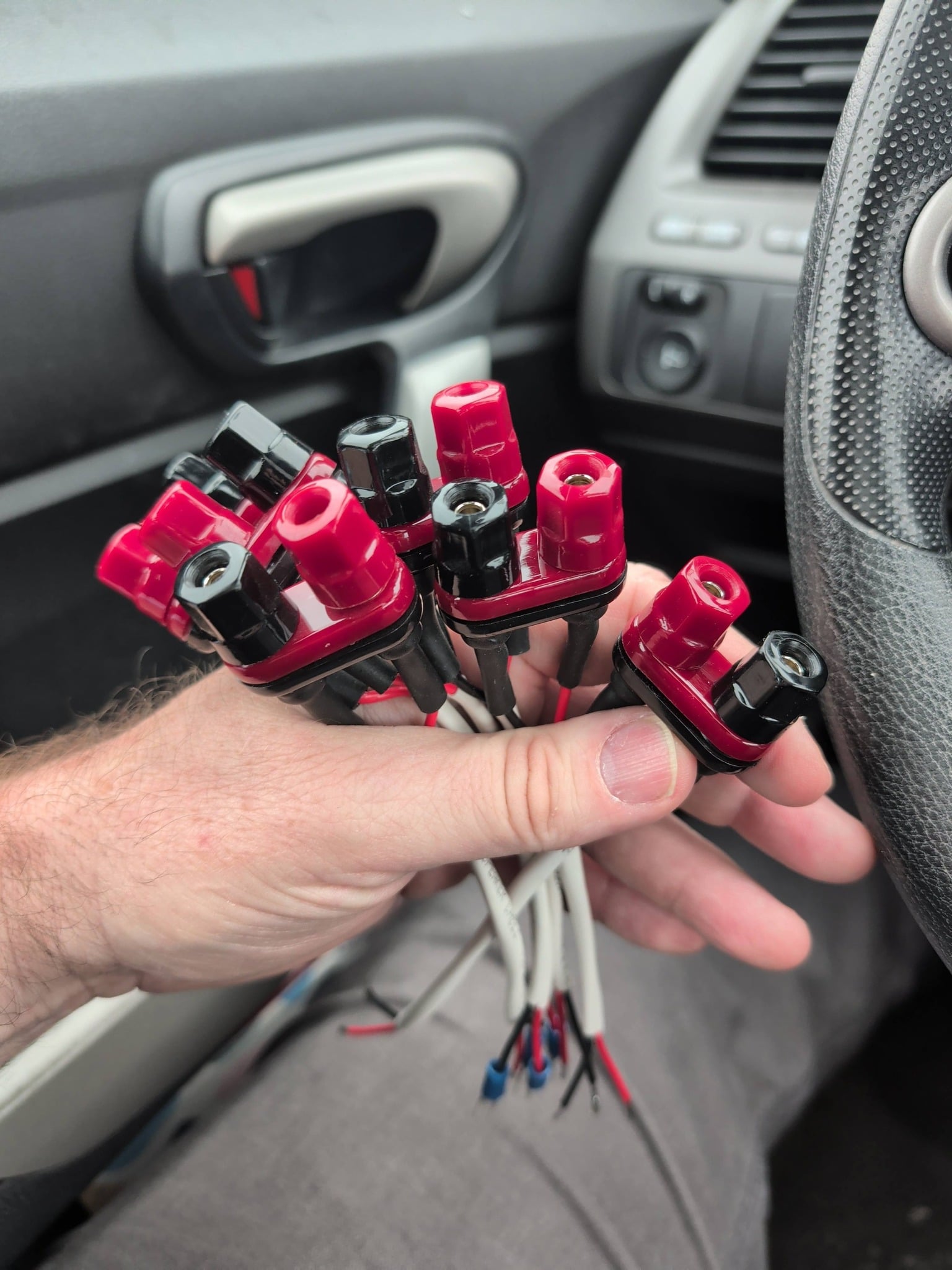
Should I be embarrased to say that I've made a few of these for testing purposes. They are very convenient when you have 'nanners on your cables and spring terminals on the speakers or amp.Stan
Main 2ch:
Polk LSi15 (DB840 upgrade), Parasound: P/LD-1100, HCA-1000A; Denon: DVD-2910, DRM-800A; Benchmark DAC1, Monster HTS3600-MKII, Grado SR-225i; Technics SL-J2, Parasound PPH-100.
HT:
Marantz SR7010, Polk: RTA11TL (RDO198-1, XO and Damping Upgrades), S4, CS250, PSW110 , Marantz UD5005, Pioneer PL-530, Panasonic TC-P42S60
Other stuff:
Denon: DRA-835R, AVR-888, DCD-660, DRM-700A, DRR-780; Polk: S8, Monitor 5A, 5B, TSi100, RM7, PSW10 (DXi104 upgrade); Pioneer: CT-6R; Onkyo CP-1046F; Ortofon OM5E, Marantz: PM5004, CD5004, CDR-615; Parasound C/PT-600, HCA-800ii, Sony CDP-650ESD, Technics SA 5070, B&W DM601 -
Absolutely not - test cable combinations are a complete free-for-all…. I’ve made some crazy bench adapters in my time, and they are essential:-)“Human beings are born with different capacities. If they are free, they are not equal. And if they are equal, they are not free.”
― Aleksandr Solzhenitsyn -
I have loved this thread since @daddyjt started it in 2023. During the last several days, my mind was wondering and I thought of the times in life when I was personally involved in a "You’re doing it wrong…" happening.
My wondering took me back to the 1950's and early 1960's. when one of my favorite TV shows was "Watch Mr. Wizard".
About 74 years ago, March 3, 1951, Watch Mr. Wizard debuted. The long-running children's science show stared Don Herbert as Mr. Wizard.
Mr. Wizard always had some kind of laboratory experiment going that taught something about science. The experiments, many of which seemed impossible at first glance, were usually simple enough to be re-created by viewers.
The show was very successful; by 1954 it was broadcast live by 14 stations, and by kinescope (a film made from the television monitor of the original live broadcast) by an additional 77. Mr. Wizard Science Clubs were started throughout North America, numbering 5,000 by 1955 and 50,000 by 1965.
The show moved from Chicago to New York on September 5, 1955, and had produced 547 live broadcasts by the time the show was canceled in 1965. The show was cited by the National Science Foundation and American Chemical Society for increasing interest in science and won a 1953 Peabody Award.
Don Herbert continued producing variations of his show, including Mr. Wizard's World in the 1980s. No episode of Mr. Wizard’s World ever reused 1950s footage as Nickelodeon executives required: all content to be newly shot, no black‑and‑white archival inserts, and no reused kinescope material .
My BRIEF FORAY into chemical reactions was my contribution to "You’re doing it wrong…". at an early age.
Don Herbert demonstrated creating hydrogen gas to fill a balloon using aluminum foil (in my mom's kitchen cabinet), Drano (under my mom's kitchen sink) (sodium hydroxide), and water. The reaction is highly exothermic, creating a "nasty slurry" that produces hydrogen gas faster than air, making the balloon float. The experiment, often featured to demonstrate chemical reactions, warns that hydrogen is explosive
The original hydrogen‑balloon episode aired later in the 1951 - 1965 era of the show. The 1950s era hydrogen‑balloon experiment survives only as kinescope and exists only in film reels at the Library of Congress and UCLA. It was never digitized, was never released on DVD, was never uploaded by Mr. Wizard Studios.
________________________________________ ___________________________________________________
However, you can see the basics of the episode because Don Herbert created a new version of the experiment in the 1980's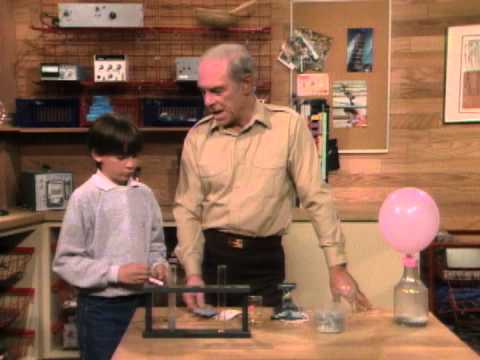 https://www.youtube.com/watch?v=5tiv-VNFrOQ
^^^ NOTE THE BALLOON IN THE PICTURE OR VIDEO OF THE EXPERIMENT
Reaction Components: The combination of aluminum foil (shredded for surface area), drain cleaner (sodium hydroxide crystals), and water generates heat and releases hydrogen gas,.
Demonstration: The gas is captured in a balloon, which is then often ignited with a sparkler or flame, demonstrating its explosive nature.
Safety Notice: This experiment generates significant heat and should only be conducted with appropriate safety gear and supervision, as it can shatter glass or release dangerous, hot liquids.
The experiment is often cited to show how hydrogen, being lighter than air, causes the balloon to rise, contrasting with heavier gases.
Note: there were no warnings in the original video as appears in the new version.
SUCCESS: At the age of about 15-16 the experiment was a great success on the covered porch of our house.
DOING IT WRONG...: Not realizing younger brother 9 years younger would come along behind me and put the balloon in his mouth to blow it up. Trip to the VIlla Rica Georgia hospital emergency room for Drano burns. Future experiments outlawed."Sometimes you have to look to the past to understand where you are going in the future"Harry / Marietta GA


