Review: Benchmark AHB2 Amp
Comments
-
Agree, I was just trying to convey that 3 clicks is pretty substantial. I think I've only ever tweaked mine one click for anything new, so far. I do sometimes wish the clicks were about half as impactful, though.
Brian -
I understand the number of gain detents (clicks) to be about the same with the T/5X and the S/812. Around 40 if I remember right but mine are usually somewhere between one quarter and one third only. I remember I had to drop the gain on mine quite a bit during the break in period which was a bit annoying when the system would sound slightly off every week for the first three months.
It is a nice feature to have on the AHB2 to provide for different gain and a professional recording studio focused feature. Parasound tends to have a continuous gain knob on their two channel amps with the best setting at full on. That's kind of a relic from their original custom installer focus. -
The next logical step is to get the Benchmark LA4 preamp and their cabling. And then one of their DACs.

That's what they're built for (long video from the source):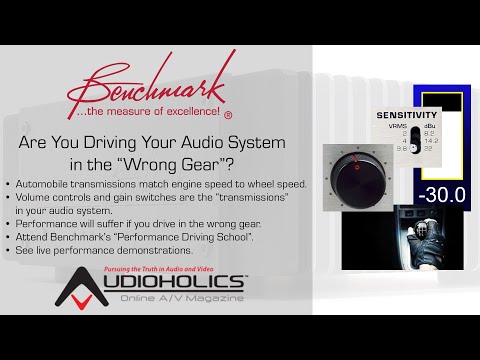 https://www.youtube.com/watch?v=vu9lHR9o-Mc
 -
I understand the number of gain detents (clicks) to be about the same with the T/5X and the S/812. Around 40 if I remember right but mine are usually somewhere between one quarter and one third only. I remember I had to drop the gain on mine quite a bit during the break in period which was a bit annoying when the system would sound slightly off every week for the first three months.
It is a nice feature to have on the AHB2 to provide for different gain and a professional recording studio focused feature. Parasound tends to have a continuous gain knob on their two channel amps with the best setting at full on. That's kind of a relic from their original custom installer focus.
You are correct about the Parasound, the A21+ has gain settings for both channels. I found that the highest setting was what I preferred. The AHB2 has 3 settings (low, med, hi). Benchmark recommends the low setting for RCA, med for XLR & hi for upstream pro gear. Talking with Rory at Benchmark he recommended the med setting for the best match with my pre & AVR. He also said to experiment with all 3 to see what worked best. The recommended med setting was spot on.
I know 3 clicks of volume decrease on a REL might seem like a lot but that decrease really dialed it in perfectly. I don't run it hot at all, just enough to fill in the bottom end without drawing attention to it's self.
-
You've got me taking another look at the latest Benchmark products!
It's great to see that the company is responsive to customer questions. -
Although I haven't asked Benchmark it appears the AHB2 is a fully balanced differential amp design, meaning not going to run Polk L800 speakers. The design is what makes it have such a good S/N ratio.
-
Although I haven't asked Benchmark it appears the AHB2 is a fully balanced differential amp design, meaning not going to run Polk L800 speakers. The design is what makes it have such a good S/N ratio.
Yes it is a fully balanced differential amp. Too bad it's not a good match for the L800's. That would have been awesome!
As far as the design goes I believe it was an 8yr project with THX & Benchmark engineers. All I can say is that they nailed it!!
-
Here is what I read so far , Blah Blah blah blah.
Phil, glad you're digging the amp not to mention the incredible weight savings. Also not to mention the space savings, I love how small it is.Dan
My personal quest is to save to world of bad audio, one thread at a time. -
Here is what I read so far , Blah Blah blah blah…
Well that’s kinda rude…. Are you upset that a group of adults are having a respectful, interesting conversation? To be clear, this is how people gather information, challenge norms, and grow their knowledge and experience. I have yet to comment in this thread, but I’m following it with interest. If you don’t like the read, tune out and go your own way - but there’s no need to wade in and label everyone else’s input as “blah blah blah blah”, - that’s just ignorant.“Human beings are born with different capacities. If they are free, they are not equal. And if they are equal, they are not free.”
― Aleksandr Solzhenitsyn -
Here is what I read so far , Blah Blah blah blah…
Well that’s kinda rude…. Are you upset that a group of adults are having a respectful, interesting conversation? To be clear, this is how people gather information, challenge norms, and grow their knowledge and experience. I have yet to comment in this thread, but I’m following it with interest. If you don’t like the read, tune out and go your own way - but there’s no need to wade in and label everyone else’s input as “blah blah blah blah”, - that’s just ignorant.
I agree. This is one of the few threads of recent times that hasn't turned to $hit with bias and close-mindedness. -
I think Dan's tended to be a home theater receiver kind of guy and not a super heavy separate amp kind of guy.

Different perspective from purchasers of different kinds of amps. I'm a class A, AB, D, G, H, tube, and hybrid guy. -
I think Dan's tended to be a home theater receiver kind of guy and not a super heavy separate amp kind of guy.
Different perspective from purchasers of different kinds of amps. I'm a class A, AB, D, G, H, tube, and hybrid guy.
You're right about that. I have amps just laying around and no need for any of them at this time.
Dan
My personal quest is to save to world of bad audio, one thread at a time. -
I think Dan's tended to be a home theater receiver kind of guy and not a super heavy separate amp kind of guy.
Different perspective from purchasers of different kinds of amps. I'm a class A, AB, D, G, H, tube, and hybrid guy.
Yeah I believe Dan's audio business is mostly custom HT installs for his clients.
Looks like you have all your bases covered when it comes to amps! -
The only audio gear I've ever regretted selling has been amplifiers. I think I have a dozen around currently. No pun intended.
-
Friends don't let friends listen to music thru home theater receivers- Not Tom ::::::: Any system can play Diana Krall. Only the best can play Limp Bizkit.
-
Friends don't let friends listen to music thru home theater receivers
Receivers (AVRs) are a big box of compromises. Fine for home theater duties (with external amplification), but a serious liability in a quality 2ch system.“Human beings are born with different capacities. If they are free, they are not equal. And if they are equal, they are not free.”
― Aleksandr Solzhenitsyn -
I've owned and heard many many high end AVRs and they all have a common trait that they suck the big one for 2 channel.
Home theater is fine but they just are unlistenable for 2 channel. Even just as a preamp- Not Tom ::::::: Any system can play Diana Krall. Only the best can play Limp Bizkit. -
I've owned and heard many many high end AVRs and they all have a common trait that they suck the big one for 2 channel.
Home theater is fine but they just are unlistenable for 2 channel. Even just as a preamp
I don't know what AVR's you heard that are unlistenable for music but I can tell you this is not true.
I'll start with B&K, they use the exact same preamp in their AVR's as they did in their separates. No difference. Companies like them back in the day like McIntosh, NAD, Anthem etc all use the same parts in their preamps as their AVR's.
Now lets move into the last so many years, some AVR's now have true bypass and you can make a AVR an actual stand alone Preamp. Pure disconnect pure signal path pure voltage to the amps if your driving external amps.
The measurements of AVR's vs Preamps are no difference anymore and haven't been in many years. Your statement was very true many decades ago but holds no water today and hasn't in quite sometime .
The reason you would want to go separates today is if you plan on using all external amps because you have a larger room and or demanding speakers that require more power than AVR's built today can supply.
Companies like Marantz , Denon , Integra all make high end AVR's that can power large theater rooms and sound amazingly playing music on higher end speakers. Again it's matching output power to need of SPL in room and requirements of given speaker package.
Dan
My personal quest is to save to world of bad audio, one thread at a time. -
^^^
Here is what I read so far , Blah Blah blah blah. "This may not matter to you, but it does to me for various reasons, many of them illogical or irrational, but the vinyl hobby is not really logical or rational..." - member on Vinyl Engine
"Sometimes I do what I want to do. The rest of the time, I do what I have to." - Cicero, in Gladiator
Regarding collectibles: "It's not who gets it. It's who gets stuck with it." - Jimmy Fallon -
I wouldn't be surprised if that B&k AVR uses a shared power supply for preamp and amp sections.
-
There's no argument here for me, we will just agree to disagree 😊- Not Tom ::::::: Any system can play Diana Krall. Only the best can play Limp Bizkit.
-
… Companies like Marantz , Denon , Integra all make high end AVR's that can power large theater rooms and sound amazingly playing music on higher end speakers. Again it's matching output power to need of SPL in room and requirements of given speaker package.
You might (and I stress might) have an argument for all the rest, but this claim is absurd. Even the largest and highest end AVR would struggle to power even a modest home theater to realistic sound levels. 9-11 channels of amplification from a single power supply just doesn’t provide any room for dynamics and/or the sustained SPLs required by modern films“Human beings are born with different capacities. If they are free, they are not equal. And if they are equal, they are not free.”
― Aleksandr Solzhenitsyn -
… Companies like Marantz , Denon , Integra all make high end AVR's that can power large theater rooms and sound amazingly playing music on higher end speakers. Again it's matching output power to need of SPL in room and requirements of given speaker package.
You might (and I stress might) have an argument for all the rest, but this claim is absurd. Even the largest and highest end AVR would struggle to power even a modest home theater to realistic sound levels. 9-11 channels of amplification from a single power supply just doesn’t provide any room for dynamics and/or the sustained SPLs required by modern films
Let me ask you a direct question,
How many Theater rooms have you setup , calibrated and failed to power a designed speaker system for that theater room? How many?
You say that even the highest end AVR's , lets make an example of a few , lets talk about the Integra DRX 8.4 , the Denon A1H , the Marantz Cinema 30 for starters, we can go up and down each of the big 3's offerings like the Integra DRX 5.4 , Denon AVR4800H and the Marantz Cinema 40. So by what you are saying NONE of these AVR's have NO chance to power a theater room correctly right? So I have to believe you are one of these guys who spec's , Installs , calibrates , Programs these rooms you claim none of this awesome equipment can't power?
Since this is a Polk Audio forum, lets build a Theater speaker system ok?
I'm gonna use the Reserve line and the Theater room dimensions will be 16x 24 which is nice size theater room, 9 foot ceilings Atmos Dual Subs.
Let's use the Reserve R350's as a floor level system in a 7 layer setup.
Lets now use Polk in ceilings 4 of them for Atmos Fronts and Atmos Rears we can use model number 900 LS .
Now for subwoofers, who cares the models as they are self powered and don't require the AVR to power them. But for the sheer hell of it lets use what's popular in SVS Pro 2000's by 2. They will be setup in the room to get the most even bass response.
Let's go further , we will have 2 rows of seats 4 seats in each row.
Also we have clean dedicated 20 amp circuits, 2 of them available to give us juice for whatever we need in the rack. We will also have high end Surge X power , a Branch circuit .
So now with this system layout , I have NO ability to power these speakers with any of the AVR's above to reference levels?
If you are right , what would I have to buy instead of a AVR to power this theater system correctly?
I wonder if I made a call to Tech support to Polk what would they suggest I use to power such system. If you didn't know, Polk is in the same family as Denon and Marantz and I guess the ONLY thing that could possibly power thier 7.2.4 theater system would be Marantz separates? Or am I reading you wrong?
Dan
My personal quest is to save to world of bad audio, one thread at a time. -
… Companies like Marantz , Denon , Integra all make high end AVR's that can power large theater rooms and sound amazingly playing music on higher end speakers. Again it's matching output power to need of SPL in room and requirements of given speaker package.
You might (and I stress might) have an argument for all the rest, but this claim is absurd. Even the largest and highest end AVR would struggle to power even a modest home theater to realistic sound levels. 9-11 channels of amplification from a single power supply just doesn’t provide any room for dynamics and/or the sustained SPLs required by modern films
It depends how sensitive your speakers are. Most of that required energy is for the sustained bass and that usually comes from a separate sub-amp anyway. I can say that my theater will blast you out of your seat with just the AVR and the SVS sub.
But, I totally agree that an AVR is substandard for critical 2-channel listening. It's one of those things where you might think music sounds good on the AVR, but when you switch over to the 2-ch system, the difference and improvement is obvious. An AVR may satisfy the average home music lover, but most of us here are not average listeners.
-
… Companies like Marantz , Denon , Integra all make high end AVR's that can power large theater rooms and sound amazingly playing music on higher end speakers. Again it's matching output power to need of SPL in room and requirements of given speaker package.
You might (and I stress might) have an argument for all the rest, but this claim is absurd. Even the largest and highest end AVR would struggle to power even a modest home theater to realistic sound levels. 9-11 channels of amplification from a single power supply just doesn’t provide any room for dynamics and/or the sustained SPLs required by modern films
Let me ask you a direct question,
How many Theater rooms have you setup , calibrated and failed to power a designed speaker system for that theater room? How many?
You say that even the highest end AVR's , lets make an example of a few , lets talk about the Integra DRX 8.4 , the Denon A1H , the Marantz Cinema 30 for starters, we can go up and down each of the big 3's offerings like the Integra DRX 5.4 , Denon AVR4800H and the Marantz Cinema 40. So by what you are saying NONE of these AVR's have NO chance to power a theater room correctly right? So I have to believe you are one of these guys who spec's , Installs , calibrates , Programs these rooms you claim none of this awesome equipment can't power?
Since this is a Polk Audio forum, lets build a Theater speaker system ok?
I'm gonna use the Reserve line and the Theater room dimensions will be 16x 24 which is nice size theater room, 9 foot ceilings Atmos Dual Subs.
Let's use the Reserve R350's as a floor level system in a 7 layer setup.
Lets now use Polk in ceilings 4 of them for Atmos Fronts and Atmos Rears we can use model number 900 LS .
Now for subwoofers, who cares the models as they are self powered and don't require the AVR to power them. But for the sheer hell of it lets use what's popular in SVS Pro 2000's by 2. They will be setup in the room to get the most even bass response.
Let's go further , we will have 2 rows of seats 4 seats in each row.
Also we have clean dedicated 20 amp circuits, 2 of them available to give us juice for whatever we need in the rack. We will also have high end Surge X power , a Branch circuit .
So now with this system layout , I have NO ability to power these speakers with any of the AVR's above to reference levels?
If you are right , what would I have to buy instead of a AVR to power this theater system correctly?
I wonder if I made a call to Tech support to Polk what would they suggest I use to power such system. If you didn't know, Polk is in the same family as Denon and Marantz and I guess the ONLY thing that could possibly power thier 7.2.4 theater system would be Marantz separates? Or am I reading you wrong?
Ok, first the answer to your ”direct question” - I’ve designed and built seven home theaters in my various homes - three of them literally from the ground-up (chose dimensions, built stud walls, wired, insulated, lighting, Sheetrock, trim, etc). I’ve helped countless coworkers and friends with gear selection, setup and calibration. I’m aware you have spent time in “the industry”, and that’s great. However, one does not to be an industry “insider” to utilize design software, a tape measure and calibration tools - no more than one needs to be an ASE mechanic to work on cars successfully.
Second - for being an “industry insider”, you don’t seem to understand how power supplies and amplifiers work together. Down below, I’ve posted the spec sheets for the Denon and Marantz receivers you mention. Notice how they spec at 150 & 140 watts 2 channels driven? Do you know why that is? Well, it’s because even though these are 15 & 11 channel receivers, the power supply has to provide the current for all those channels (and the preamp, processing, DAC, HDMI switching, etc). What these specs (2 channels driven) are clearly telling you is that the more channels you start driving, the less current the power supply can deliver to each channel.
Third - as to your question of whether or not a high-end AVR “can” drive a high quality HT system, of course it can - and a Honda Accord can also make a 1/4 mile run down a drag strip. Point being, just because a thing “can”, doesn’t mean it “should”. What I can tell you unequivocally is that EVERY TIME I’ve added external amplification to my personal (or a friend or coworker’s) system it has sounded SUBSTANTIALLY better.
And lastly, let’s talk about these high-end AVRs. SEVEN THOUSAND ($7,000) dollars?? For that same amount, you could buy a processor and any array of separate amplifiers. Then, if your processor dies, you only have to replace it with another $2,000ish processor - your amplifiers don’t go down with the new boat anchor. OR, if some new processor magic (Atmos II, Atmos X, or who knows what), you still have you amplifiers and just need to upgrade your processor. The down side of separates is more space, and a set of RCA cables - but if your processor dies have a dedicated HT, space for components really shouldn’t be an issue, now should it;-)
Marantz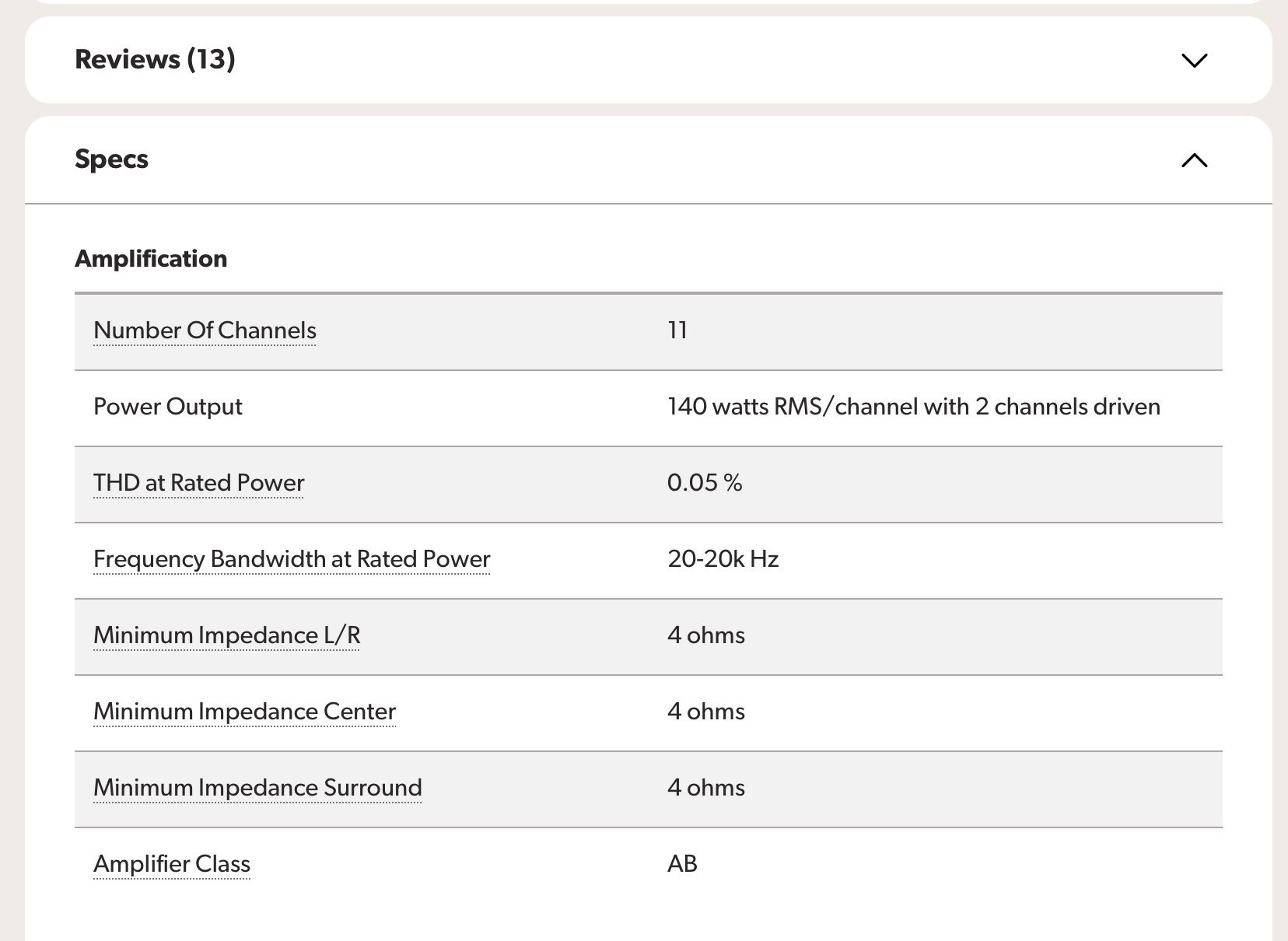
Denon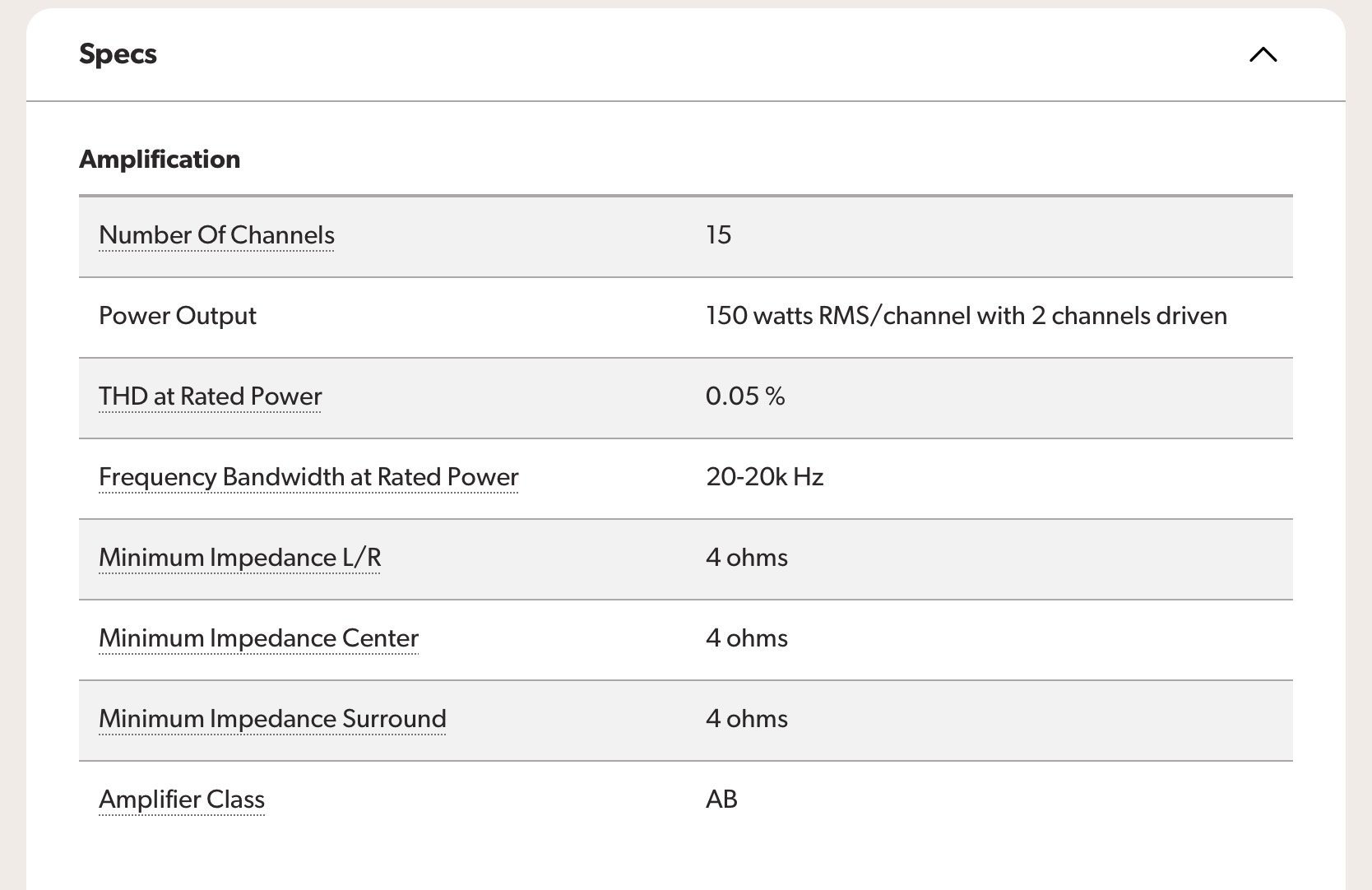
“Human beings are born with different capacities. If they are free, they are not equal. And if they are equal, they are not free.”
― Aleksandr Solzhenitsyn -
Polk has been recommending separate amplification since introducing the ring radiator tweeter on its LSi lineup more than a couple decades ago. It's mainly the tweeter that presents a difficult load. When that line was introduced there were a handful of home theater receivers rated as being 4 ohm stable. Now, most mid-grade and up receivers are capable of running Polk's speakers that have that type of tweeter. The whole Reserve line is rated as being compatible with amplifiers that are 8/6/or 4 ohm stable. But merely being compatible doesn't mean a relatively small power supply in a receiver shared across 7 or more speakers wouldn't benefit from some supporting power. The tweeters in the LSiM707s get hot even with high current amplification when driven hard.
A receiver won't get the best performance out of the speakers and in the hands of people who don't know any better and drive a system at too high a volume for too long warranty repairs eventually become necessary because of blown tweeters. This is also why all but the cheapest receivers have pre-amplifier outputs. If knowledgeable customers wouldn't benefit from having them they wouldn't be there, right?
I usually recommend that someone who's interested in home theater as a hobby at least get a separate amplifier like an Outlaw Audio Model 5000x or 7000x. I have both and both are way better than any receiver at powering 4 ohm load speakers in a multichannel home theater system. But they are not intended to be the highest quality two channel amps. I switch over to Parasound or something else for that. Marantz does also make separate and integrated amps!
Crutchfield recommends high current separate or integrated amps for all of the Reserve speakers, not just the big R700s which dip down to 3.6 ohms minimum. This is from their R200 listing.
"Recommended amplifier power: 30-200 watts
high-current amplification from a quality power amp or integrated amp is recommended for best performance"
-
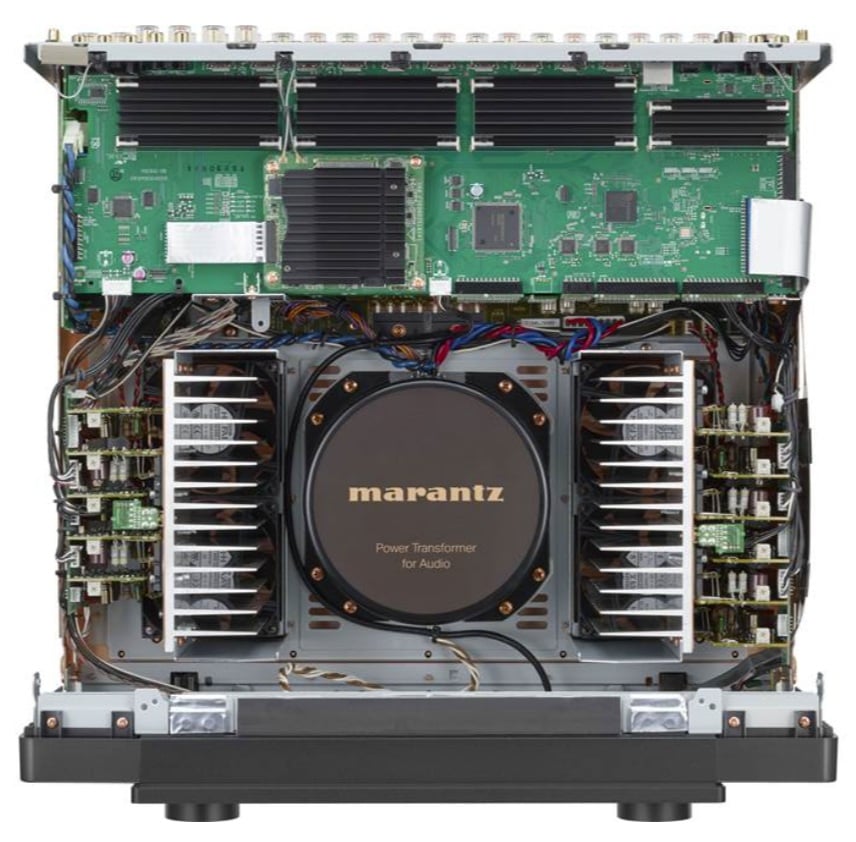
For reference, the innards of the $4800 Marantz Cinema 30 and the $3800 Marantz Cinema 40 below. Note the differences in the transformers and heat sinks but also note how tiny they are for AB amplification. Also note the processing chips with the big heat sinks, which is where a lot of the cost goes in these things. Somehow the prices on receivers like these doubled in price over the years without me noticing!

-
The innards of an Outlaw Model 7000x amplifier rated at 130 watts per channel into 8 ohms (but I suspect it's a little conservative). A bit of a difference.
And still only $1100.
-
Polk has been recommending separate amplification since introducing the ring radiator tweeter on its LSi lineup more than a couple decades ago. It's mainly the tweeter that presents a difficult load. When that line was introduced there were a handful of home theater receivers rated as being 4 ohm stable. Now, most mid-grade and up receivers are capable of running Polk's speakers that have that type of tweeter. The whole Reserve line is rated as being compatible with amplifiers that are 8/6/or 4 ohm stable. But merely being compatible doesn't mean a relatively small power supply in a receiver shared across 7 or more speakers wouldn't benefit from some supporting power. The tweeters in the LSiM707s get hot even with high current amplification when driven hard.
A receiver won't get the best performance out of the speakers and in the hands of people who don't know any better and drive a system at too high a volume for too long warranty repairs eventually become necessary because of blown tweeters. This is also why all but the cheapest receivers have pre-amplifier outputs. If knowledgeable customers wouldn't benefit from having them they wouldn't be there, right?
I usually recommend that someone who's interested in home theater as a hobby at least get a separate amplifier like an Outlaw Audio Model 5000x or 7000x. I have both and both are way better than any receiver at powering 4 ohm load speakers in a multichannel home theater system. But they are not intended to be the highest quality two channel amps. I switch over to Parasound or something else for that. Marantz does also make separate and integrated amps!
Crutchfield recommends high current separate or integrated amps for all of the Reserve speakers, not just the big R700s which dip down to 3.6 ohms minimum. This is from their R200 listing.
"Recommended amplifier power: 30-200 watts
high-current amplification from a quality power amp or integrated amp is recommended for best performance"
I'm glad you have some experience . You base your decesions to discount the ability of a AVR to power a theater system by spec, not by experience. My question to you is out of the 7 Theaters you spec'd and built or helped your friends do, how many had AVR's that just couldn't get the job done?
Yes I'm in the Industry , Yes I have built spec'd and installed Hundreds of Surround systems and Theater ranging from nice small family Room Bose systems to Million Dollar Wilson / Krell / Proceed etc stuff over my decades in this business. I'm not looking to measure that.
I completely disagree with you that you can't power a Theater system with a AVR because you're using internal amps. That is simply not true UNLESS you spec a AVR that does NOT have the ability to power a speaker package in a larger room that the AVR simply can't do. That my friend , we can agree. I have seen clients from companies that I have worked for in the past decide to purchase against the salesman recommended AVR and go with a less powerful unit and yes it was underwhelming and struggled to power their speaker package in their room at reference volumes.
Now under reference volumes , most AVR's will get the job done and satisfy most people. I've seen it hundreds of times. However I have also used AVR's in countless theater rooms and family lifestyle rooms where you couldn't run the AVR out of gas no matter how loud you play it.
So you again are looking at spec's and saying shared power and all that stuff matter , I can tell you, hardly never ever have I seen this happen in the real world. Powering a full Dynaudio Theater system or B&W or Monitor Audio or Klipsch or name a brand that has a line of theater speaker setups and I can match them with the room dimensions with a AVR that will power them.
So to support your point on spec's and amp shared power in a AVR, there are demands that an AVR simply can't support and you absolutely need to add external power amps or go separates , not so much today but in the past, preamps where more popular as the noise floor in older AVR's where not on the same level of dedicated preamps, that was true then not today. But again a Theater of the size 25 x 45 with all Martin Logan speakers no AVR I know of can power such a system in a 9. 2 configuration. So in this very case we can agree. I used all Proceed amps to power all these Martin Logan speakers.
Another example where you are right was a Wilson Audio Theater system I did. We used all Krell Monoblocks as a AVR was simply not going to power this system in a 20 x 31 room.
Blanket statements like yours and throwing spec's around hold NO water unless you put it into a room and speaker package. If you build a Klipsch Theater system, hardly never do you need external power amps. Marantz , Denon or Integra AVR's when again spec's correctly for the space and speaker package will absolutely drive that system into Reference with plenty of head room for dynamic passages.
The older LSI speakers from polk, yes they were power hungry and needed more current than the RT line which required much less to achieve a good theater experience. No power amps where not always necessary, I had a B&K AVR that powered the LSi's to breaking point with the internal 125 watt amp which by the way was the same exact power amp as the stand alone 125.7 you can buy. How do I know that? I watched them build it at the B&K factory in NY when I went there for training. I watched them hand build amps preamps and AVR's and all the parts they used where exactly the same in different chassis. The LSI system also responded very well to when I purchased a Pioneer Elite ICE AVR which was fantastic back in the day SC-07. It had plenty of power to drive my entire LSI 15 , LSI C , LSI 7's and LSI FX speakers to Reference levels with no issues overheated or Shut downs.
When power is needed , it's used , when power isn't needed , it's not used. You would be surprised on how many people use 1/8 of the power they have on a day to day basis to drive their speakers to levels satisfying to them. It's not always about Reference levels as not many people inlcuding everyone in this forum do not listen at Reference levels, If they did , their hearing would be damaged and then the joy of listening would be compromised.
So having this interesting conversation with you I'm not interested in Gotcha or your dumb or anything like that. But you made claims as other did on this thread about AVR's not being good enough to do the jobs they where built for. That is simply not true. Maybe many on here feel that way and that is perfectly fine. Add all the amps you want.
Phil the thread starter has very nice speakers , he changes them a lot but guess what? Ask Phil how loud he listens to he's system, I had to ask him many times to turn it up as he does NOT like it overly loud or anywhere near reference levels, it becomes uncomfortable for him and I do NOT judge him for that. He likes what he likes, he has WAY more power then he will ever use, He has REL subwoofers all over the place and they never crack a sweat. I have been to Phil's house a few times and got the pleasure of actually enjoying his company , his system and NEED all that power he has? No, his Yamaha AVR has more power than he will ever need or use but he enjoys this hobby like the rest of us as he sees fit and if he wants Parasound or whatever amp he desires and puts in his system because he likes it, I'm completely fine with that. But I'm also not going to tell him he needs it when he does not.Dan
My personal quest is to save to world of bad audio, one thread at a time. -
Polk has been recommending separate amplification since introducing the ring radiator tweeter on its LSi lineup more than a couple decades ago. It's mainly the tweeter that presents a difficult load. When that line was introduced there were a handful of home theater receivers rated as being 4 ohm stable. Now, most mid-grade and up receivers are capable of running Polk's speakers that have that type of tweeter. The whole Reserve line is rated as being compatible with amplifiers that are 8/6/or 4 ohm stable. But merely being compatible doesn't mean a relatively small power supply in a receiver shared across 7 or more speakers wouldn't benefit from some supporting power. The tweeters in the LSiM707s get hot even with high current amplification when driven hard.
A receiver won't get the best performance out of the speakers and in the hands of people who don't know any better and drive a system at too high a volume for too long warranty repairs eventually become necessary because of blown tweeters. This is also why all but the cheapest receivers have pre-amplifier outputs. If knowledgeable customers wouldn't benefit from having them they wouldn't be there, right?
I usually recommend that someone who's interested in home theater as a hobby at least get a separate amplifier like an Outlaw Audio Model 5000x or 7000x. I have both and both are way better than any receiver at powering 4 ohm load speakers in a multichannel home theater system. But they are not intended to be the highest quality two channel amps. I switch over to Parasound or something else for that. Marantz does also make separate and integrated amps!
Crutchfield recommends high current separate or integrated amps for all of the Reserve speakers, not just the big R700s which dip down to 3.6 ohms minimum. This is from their R200 listing.
"Recommended amplifier power: 30-200 watts
high-current amplification from a quality power amp or integrated amp is recommended for best performance"
You might want to call tech support to support your claims. Both Denon and Marantz make AVR's that can power a full Reserve system with or without the R700's as mains. Most Denon and Marantz AVR's can put out 30-140 Watts per channel , no not all at once but hardly never does content require that level of power all channels driven. They can however for short periods of time which is all that is required of a typical action movie. Both Denon and Marantz have a 70% rule they follow, you should learn about it.Dan
My personal quest is to save to world of bad audio, one thread at a time.