RTA 8T Upgrade Questions
Options

dapandaman88
Posts: 6
Hey everyone, making my first post and I apologize if it's a little rambly and I give too much info, but I like context, TLDR at the bottom.
I bought my pair of 8Ts from a record store about 5 years ago and love them. I'm driving them with a Yamaha A-S501 with a B&W AS300 sub. Theyre mostly used for casual TV watching and movies, or blasting music when Im doing housework. I usually only sit down to actively listen to music when spinning records or listening to mixes for my band through them. I think they sound great but I remember when buying them reading about the woes of the sl2000 and I enjoy tinkering so the last week I've been doing more research of replacing the tweeters and recapping the crossover for fun. I also don't have really any reference for nicer systems to im curious how my system can supposedly sound even better.
Now I was almost settled on the caps I was going to buy, cross referencing places to buy them and the humble homemade wifi guide, but then I started to dig into the TL and if I should go that route if I'm doing all this work anyways. I was able to find a good bit of info on doing the TL mods to the 7s and you all made it sound like the way to go, but I couldn't find much in an 8T to 8TL conversion.
So I priced out some parts, and depending on what caps I go with im expecting it to be up to $100 more to go the TL route. I am leaning towards that it is worth it, but honestly I'll probably be happy with the upgrade either way. My ears probably aren't good enough to tell the differences without A/B testing, it will be more just knowing I could've done more in the back of my head.
Now, I have some technical questions on doing the TL upgrade. Below I have the 8T crossover and I drew in red what I would considering doing to do the upgrade. The 8TL crossover is also shown for reference.
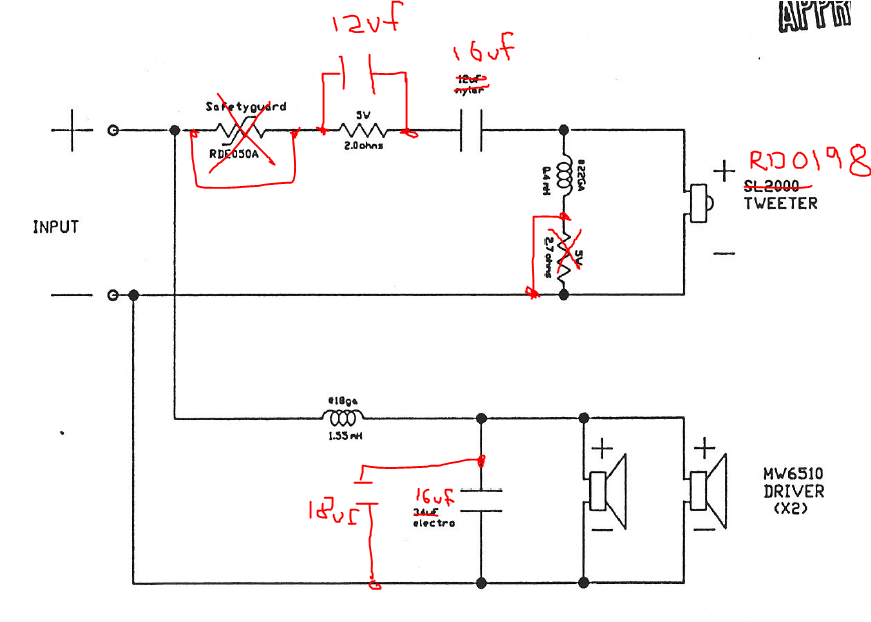
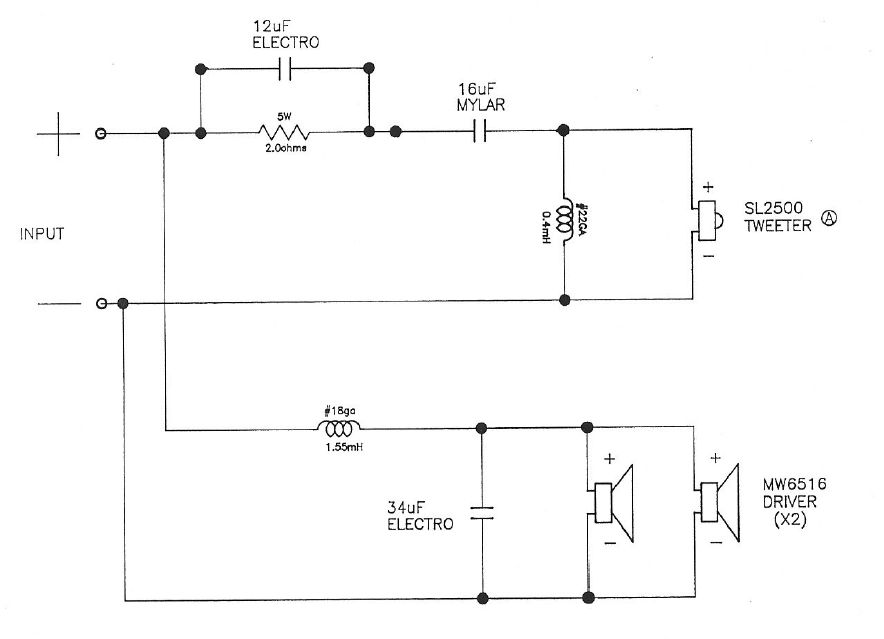
I couldn't really find and 34uf caps, so I was going to split between a 16 and 18 but maybe just a 33uf. I was also going to jump the safteyguard (I see people say to put a .5ohm resister instead, but the 8TL diagram doesn't have one so just jump?). Also jump the 2.7ohm resistor. I don't see why this wouldn't work besides the physical space of the caps possibly (potential reason for using a single 33uf, but these modifications seems very doable on the existing 8T board to me.
I could also buy 8TL crossovers, but thats more money for maybe a slightly easier time soldering and easier ability to convert back if I ever wanted, doesn't seem worth it to me at the moment.
I had the sillier thought for money and space saving to try and combine the 12 and 16 cap into a 6.8uf cap because 1/((1/12)+(1/16))=6.8 for caps in series (Maybe even buy a nicer cap cause its 1 at a lower value). However I don't know what I would do with the resistor if I would just omit it or still have it before the cap. I'm sure the resistor and cap in parallel have a function which this could mess up. I am going to ask some of my electrical engineer coworkers but we don't make anything audio related.
For caps, soniccaps seems to be the goto in this Polk forum, but I didn't see a ton of info for them elsewhere. Do they jsut pair with Polk tweeters specifically well? Cross shopping a bunch of them I didn't get the vibe they're the amazing value they've been claimed to be in older threads, I can get claritycaps CSA for less and Jantzens standards for less or superiors for a similar price. Before I dove into the TL I was considering using the Jantzen superiors or calritycap purs for the tweeter and Jantzen standard (as a 33uf instead of the 16+18) for the woofer. Now I was looking at CSAs for tweeter and still Jantzen standards for the woofer, going soniccaps is more expensive.
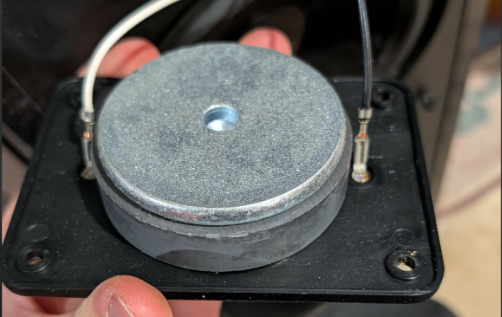
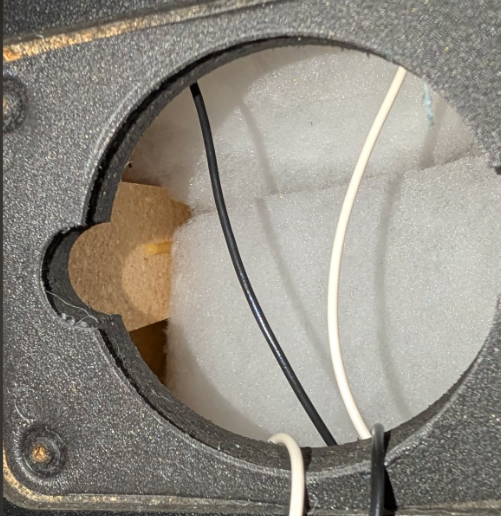
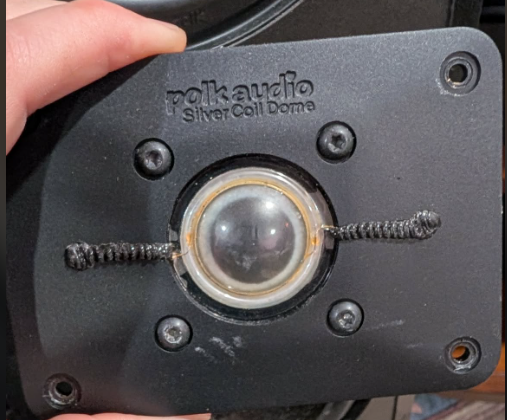
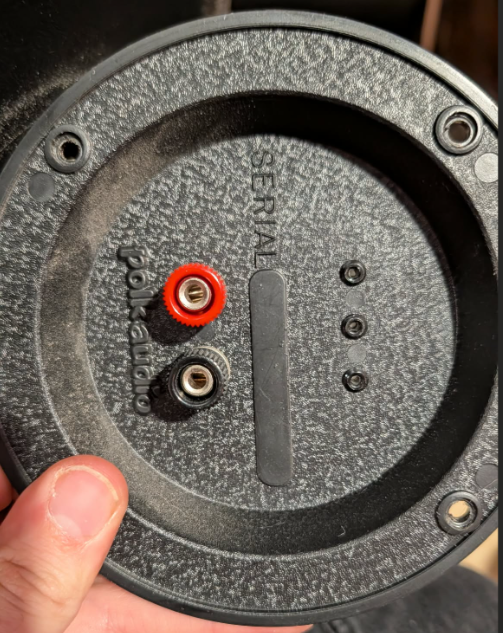
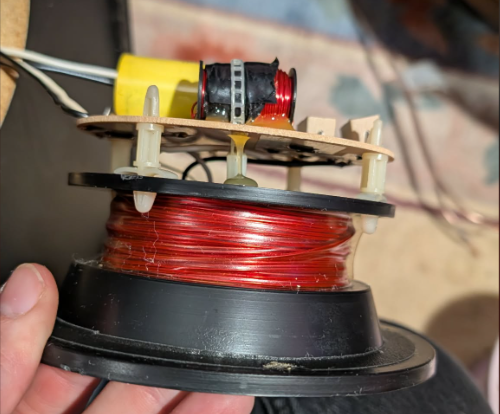
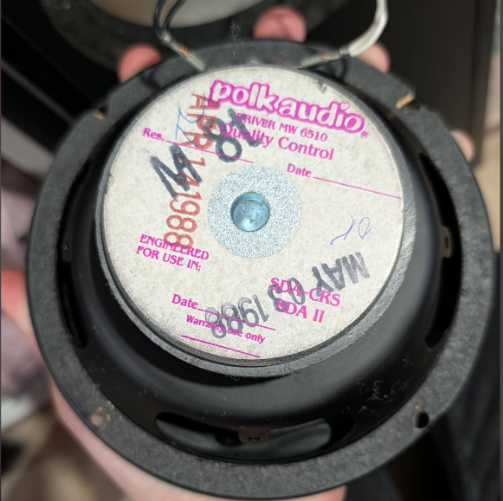
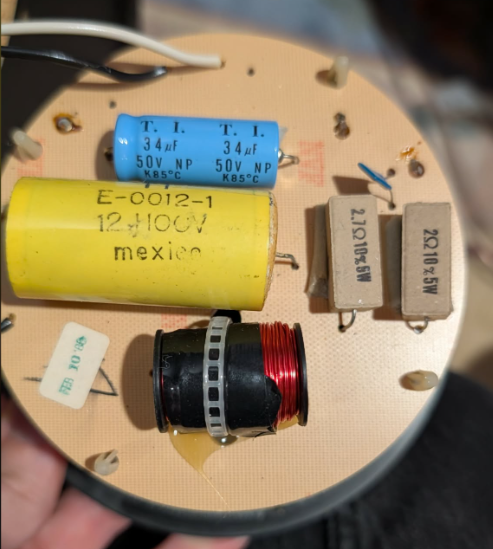
And finally, here are some pics of my speaker when I pulled the tweeter, woofer, and crossover for fun to check it out. There was a roll of white foam in the speaker which I didn't know or read about, is that normal or have these been opened?
TLDR:
I am upgrading my RTA 8Ts, is the little more money worth the TL mod and am I correct on how I would do the mod? Also, should I go for a 33uf or squeeze in an 18uf and 16uf in parallel for the woofer?
I appreciate any feedback and insight you can provide! I've done my best to research without being lazy expecting people to do the work for me.
I bought my pair of 8Ts from a record store about 5 years ago and love them. I'm driving them with a Yamaha A-S501 with a B&W AS300 sub. Theyre mostly used for casual TV watching and movies, or blasting music when Im doing housework. I usually only sit down to actively listen to music when spinning records or listening to mixes for my band through them. I think they sound great but I remember when buying them reading about the woes of the sl2000 and I enjoy tinkering so the last week I've been doing more research of replacing the tweeters and recapping the crossover for fun. I also don't have really any reference for nicer systems to im curious how my system can supposedly sound even better.
Now I was almost settled on the caps I was going to buy, cross referencing places to buy them and the humble homemade wifi guide, but then I started to dig into the TL and if I should go that route if I'm doing all this work anyways. I was able to find a good bit of info on doing the TL mods to the 7s and you all made it sound like the way to go, but I couldn't find much in an 8T to 8TL conversion.
So I priced out some parts, and depending on what caps I go with im expecting it to be up to $100 more to go the TL route. I am leaning towards that it is worth it, but honestly I'll probably be happy with the upgrade either way. My ears probably aren't good enough to tell the differences without A/B testing, it will be more just knowing I could've done more in the back of my head.
Now, I have some technical questions on doing the TL upgrade. Below I have the 8T crossover and I drew in red what I would considering doing to do the upgrade. The 8TL crossover is also shown for reference.
I couldn't really find and 34uf caps, so I was going to split between a 16 and 18 but maybe just a 33uf. I was also going to jump the safteyguard (I see people say to put a .5ohm resister instead, but the 8TL diagram doesn't have one so just jump?). Also jump the 2.7ohm resistor. I don't see why this wouldn't work besides the physical space of the caps possibly (potential reason for using a single 33uf, but these modifications seems very doable on the existing 8T board to me.
I could also buy 8TL crossovers, but thats more money for maybe a slightly easier time soldering and easier ability to convert back if I ever wanted, doesn't seem worth it to me at the moment.
I had the sillier thought for money and space saving to try and combine the 12 and 16 cap into a 6.8uf cap because 1/((1/12)+(1/16))=6.8 for caps in series (Maybe even buy a nicer cap cause its 1 at a lower value). However I don't know what I would do with the resistor if I would just omit it or still have it before the cap. I'm sure the resistor and cap in parallel have a function which this could mess up. I am going to ask some of my electrical engineer coworkers but we don't make anything audio related.
For caps, soniccaps seems to be the goto in this Polk forum, but I didn't see a ton of info for them elsewhere. Do they jsut pair with Polk tweeters specifically well? Cross shopping a bunch of them I didn't get the vibe they're the amazing value they've been claimed to be in older threads, I can get claritycaps CSA for less and Jantzens standards for less or superiors for a similar price. Before I dove into the TL I was considering using the Jantzen superiors or calritycap purs for the tweeter and Jantzen standard (as a 33uf instead of the 16+18) for the woofer. Now I was looking at CSAs for tweeter and still Jantzen standards for the woofer, going soniccaps is more expensive.
And finally, here are some pics of my speaker when I pulled the tweeter, woofer, and crossover for fun to check it out. There was a roll of white foam in the speaker which I didn't know or read about, is that normal or have these been opened?
TLDR:
I am upgrading my RTA 8Ts, is the little more money worth the TL mod and am I correct on how I would do the mod? Also, should I go for a 33uf or squeeze in an 18uf and 16uf in parallel for the woofer?
I appreciate any feedback and insight you can provide! I've done my best to research without being lazy expecting people to do the work for me.
Answers
-
I used 33uf caps from Erse. They have the C-Cap line in 33uf now. A little more refined than the Pulse-X I used. Your diagram looks correct for the TL/RDO upgrade. No need to buy the later crossovers.
I will add that you can also improve the midrange from those 6510's via @Gardenstater foam frame mod. It's more pronounced improvement in the 8T/Ls due to both drivers emitting midrange.
Welcome aboard.
Don't take experimental gene therapies from known eugenicists. -
Sonicap Gen 1 is available in a 34uF, but it is priced at $103 each. I would probably just use a more common 33uf. That is only 2.9% off from the original value and the original e-cap was probably only a 10% precision part and is likely further off by now. Keep in mind, that 34uF is a shunt cap for the woofers, so the improvement with better quality capacitors isn't quite as obvious as with in-line capacitors in the tweeter circuit. Personally, I wouldn't spend the high dollars for those. A Clarity Cap ESA series is about 1/3 the price and is equally regarded with approximately the same ranking by Humblehifi. Back when everyone here recommended Sonicaps, they were priced competitively. That has changed obviously. Honestly, you could probably even go cheaper and probably not hear a noticeable difference, because it is a shunt cap. Due to size and massive costs, I had to use four 48uF Jantzen non-polar e-caps in one of my projects because four poly film caps in that size would be massively large and expensive, and they are just shunt caps. They were still a nice improvement over the original 35 year old Bennic caps.
I see no reason why you can't do a TL mod, but do not try to save space by using a 6.8uf capacitor. It is not that simple since one cap is bypassed by a resistor. I am not a circuits expert, but Polk designed it that way to contour the response. Keep the original values from the TL schematic. For resistors, the MRA-12 series are generally regarded as a good standard. Good luck and let us know how things progress.
-
I didn't read the whole thing yet, just skimmed....
Are you planning to use your existing MW6510s and not worry about the 8tl schematic specifies MW6516s?
You probably aren't intending to keep the 16uf Electrolytic right? I wouldn't. Better to do what xschop did and use a 33uf film cap.George / NJ
Polk 7B main speakers, std. mods+ (1979, orig owner)
Martin Logan Dynamo sub w/6ft 14awg Power Cord
Onkyo A-8017 integrated
Logitech Squeezebox Touch Streamer w/EDO applet
iFi nano iDSD DAC
iPurifier3
iDefender w/ iPower PS
Custom Steve Wilson 1m UPOCC Interconnect
iFi Mercury 0.5m OFHC continuous cast copper USB cable
Custom Ribbon Speaker Cables, 5ft long, 4N Copper, 14awg, ultra low inductance
Custom Vibration Isolation Speaker Stands and Sub Platform -
Gardenstater wrote: »I didn't read the whole thing yet, just skimmed....
Are you planning to use your existing MW6510s and not worry about the 8tl schematic specifies MW6516s?
You probably aren't intending to keep the 16uf Electrolytic right? I wouldn't. Better to do what xschop did and use a 33uf film cap.
I don't think it matters because the woofer section schematic has the exact values and arrangement in the 8T and the 8TL. -
I think what @Gardenstater means is that the added 16uf cap in the later TL circuit contoured the frequency closer to the MW crossover point because Polk used MWs with tighter suspensions (I've taken apart and tested both 6510/6516s in the cabinets) in the TLs to improve midrange, although not changing their circuits.
They also redid the porting size and locations in the 8TLs to accommodate the 6516's new TS parameters.Don't take experimental gene therapies from known eugenicists. -
Thank you guys for the quick answers.
Yes, I am planning on using the existing MW6510s as there seems to be no difference in the crossover design for the low pass, so I was going to roll with it and can always change the woofers later pretty easily.Gardenstater wrote: »I didn't read the whole thing yet, just skimmed....
Are you planning to use your existing MW6510s and not worry about the 8tl schematic specifies MW6516s?
You probably aren't intending to keep the 16uf Electrolytic right? I wouldn't. Better to do what xschop did and use a 33uf film cap.
I was also going to change all the capacitors, and I am probably going to go with a 33uf film cap. That was my original plan, but I think I am now entering the territory of over thinking it by using 2 or with messing with a 6.8uf cap for the tweeter.
I agree that this probably won't work and probably isn't worth the effort researching and fully thinking through.I see no reason why you can't do a TL mod, but do not try to save space by using a 6.8uf capacitor. It is not that simple since one cap is bypassed by a resistor. I am not a circuits expert, but Polk designed it that way to contour the response. Keep the original values from the TL schematic.
I was getting the vibe that the quality doesn't matter as much for this side, nice to get some validation that I can go cheaper and also the 33uf value would be fine.Honestly, you could probably even go cheaper and probably not hear a noticeable difference, because it is a shunt cap.
This is the first I have come across this, so I will do some digging into this.I will add that you can also improve the midrange from those 6510's via @Gardenstater foam frame mod. It's more pronounced improvement in the 8T/Ls due to both drivers emitting midrange.
So after all that mess of my post, my current plan is to do the TL upgrade by doing what I drew in red except use a 33uf instead of the 2 caps. This leaves me at needing:
RD0198 tweeters
Decent 12uf and 16uf caps
Less decent 33uf cap
2ohm resitor
I will probably sit on it over the weekend to be sure this is what I am doing, but thank you all for the quick feedback!
-
I think what @Gardenstater means is that the added 16uf cap in the later TL circuit contoured the frequency closer to the MW crossover point because Polk used MWs with tighter suspensions (I've taken apart and tested both 6510/6516s in the cabinets) in the TLs to improve midrange, although not changing their circuits.
They also redid the porting size and locations in the 8TLs to accommodate the 6516's new TS parameters.
Interesting additional changes. Did you notice much of a difference practically with the woofers in the cabinet? I wouldn't have the same porting as I have no interest in modifying the cabinets themselves (since I use a sub I'm not as concerned with low end output, but maybe in a couple years Ill get that itch...). I would rather not have to buy the woofers, at least at the moment cause, but am curious if the difference is more subtle that trained ears would mostly only notice, or if it significantly muddies or unbalances the sound. -
Too bad we don't have Thiele/Small parameters for those MW6516. I can only imagine they were trying to get lower bass response or tighter bass response perhaps, along with the port change. Tighter is still a factor even when you add a sub layered on top of it because that would be additive.
On jumping the polyswitch vs. going with 0.5 ohm, kind of hard to say because maybe the sensitivity of the MW6516 is a bit more and they found that to keep balance they needed less resistance in the tweeter circuit.
PS: Also, I've never really felt on board with the sentiment that a shunt capacitor doesn't need to be high quality. I think anything that effects the signal transient response (etc.) at the terminals of the driver still matters. I think it is more of a matter of whether the driver is generating signals at a bandwidth that the ear/brain connection is highly sensitive to or not, and the MWs here most definitely are doing the critical midrange fundamentals and lower harmonics too.George / NJ
Polk 7B main speakers, std. mods+ (1979, orig owner)
Martin Logan Dynamo sub w/6ft 14awg Power Cord
Onkyo A-8017 integrated
Logitech Squeezebox Touch Streamer w/EDO applet
iFi nano iDSD DAC
iPurifier3
iDefender w/ iPower PS
Custom Steve Wilson 1m UPOCC Interconnect
iFi Mercury 0.5m OFHC continuous cast copper USB cable
Custom Ribbon Speaker Cables, 5ft long, 4N Copper, 14awg, ultra low inductance
Custom Vibration Isolation Speaker Stands and Sub Platform -
dapandaman88 wrote: »I think what @Gardenstater means is that the added 16uf cap in the later TL circuit contoured the frequency closer to the MW crossover point because Polk used MWs with tighter suspensions (I've taken apart and tested both 6510/6516s in the cabinets) in the TLs to improve midrange, although not changing their circuits.
They also redid the porting size and locations in the 8TLs to accommodate the 6516's new TS parameters.
Interesting additional changes. Did you notice much of a difference practically with the woofers in the cabinet? I wouldn't have the same porting as I have no interest in modifying the cabinets themselves (since I use a sub I'm not as concerned with low end output, but maybe in a couple years Ill get that itch...). I would rather not have to buy the woofers, at least at the moment cause, but am curious if the difference is more subtle that trained ears would mostly only notice, or if it significantly muddies or unbalances the sound.
I can only speak to trying a set of 6510's in the 8TL cabinets/x-overs I have. The 6516's have a tighter midbass and more coherent midrange than the 6510's.
I did extensive testing/experimenting a few summers back. I even converted them to SDA's. The soundstage is staggering on all my jazz collection.Don't take experimental gene therapies from known eugenicists. -
Like billbillw said, you absolutely can't look at it as a 12uf in series with a 16uf. That 12uf in parallel with the 2.0 Ohm resistor is an RC Contour Network to compensate for a rising response in the tweeter. There are also RL Contour Networks. One is for correcting a rising response with decreasing frequency (RC) and the other is the opposite (RL).
https://download.phoenixphorum.com/TechSupport/X-Over Chart.pdfGeorge / NJ
Polk 7B main speakers, std. mods+ (1979, orig owner)
Martin Logan Dynamo sub w/6ft 14awg Power Cord
Onkyo A-8017 integrated
Logitech Squeezebox Touch Streamer w/EDO applet
iFi nano iDSD DAC
iPurifier3
iDefender w/ iPower PS
Custom Steve Wilson 1m UPOCC Interconnect
iFi Mercury 0.5m OFHC continuous cast copper USB cable
Custom Ribbon Speaker Cables, 5ft long, 4N Copper, 14awg, ultra low inductance
Custom Vibration Isolation Speaker Stands and Sub Platform -
Gardenstater wrote: »Like billbillw said, you absolutely can't look at it as a 12uf in series with a 16uf. That 12uf in parallel with the 2.0 Ohm resistor is an RC Contour Network to compensate for a rising response in the tweeter. There are also RL Contour Networks. One is for correcting a rising response with decreasing frequency (RC) and the other is the opposite (RL).
https://download.phoenixphorum.com/TechSupport/X-Over Chart.pdf
Thanks for that information, it does a good job of explaining it in a basic way. Taking a step back from all the research I did its pretty obvious that isn't a good idea regardless.
Looking at the difference between the circuits, I was wondering about the removal of the 2.7ohm resistor and putting the cap in parrallel to the 2ohm purpose. The way im currently understanding it is, the 8T xover has those 2 resistors acting to damp the tweeter output overall, probably to bring it in line with the MW6510. The 8TL xover removes thats dampening and instead adds the RC contour to balance the SL2500, and based off what xschop has said, the MW6516 has more midrange output so either the SL2500 doesn't need to be damped, or the SL2500 had a little less output than the SL2000 and thats why it isn't needed.
Soooo what I'm expecting out of my mods based on that is that the tweeter may overpower the woofers a little bit, but if thats the case I can jsut change woofers pretty easily so it isn't too much risk. Or the levels may sound fine if those changes in the circuit are purely to accommodate the tweeter differences, and I can change the woofer to tighten it up a little which I may end up doing anyways later. -
I will add that you can also improve the midrange from those 6510's via @Gardenstater foam frame mod. It's more pronounced improvement in the 8T/Ls due to both drivers emitting midrange.
Welcome aboard.
This does look like a pretty simple mod, but will probably hold off at the moment. I want to upgrade in steps just to hear the difference it all makes as this is my first time messing with this stuff. So I will probably just do the tweeter first, listen, then do caps with old tweeter, then the new tweeter again just for my own experience. I was thinking of doing the foam first, but now that im thinking more about the woofers I think I will hold off until after so I can decide if I want to change the woofer in general, then do that. -
Right, it was all a matter of voicing and two different tweeter/MW combinations and maintaining desired Xover frequency. If the tweeter is too bright you can put a resistor in instead of the polyswitch jumper. You could also put a small resistor where you have jumpered out the tweeter shunt resistor if it is not loud enough or go with a smaller wire size shunt inductor to give it more DCR. Problem potentially with doing that is that may change the Xover frequency a bit.
Actually I think the proper way to pad down the tweeter is by adjusting both resistor values if you want to keep the impedance the same (L Pad circuit). Beyond my expertise but they talk about it on p. 4George / NJ
Polk 7B main speakers, std. mods+ (1979, orig owner)
Martin Logan Dynamo sub w/6ft 14awg Power Cord
Onkyo A-8017 integrated
Logitech Squeezebox Touch Streamer w/EDO applet
iFi nano iDSD DAC
iPurifier3
iDefender w/ iPower PS
Custom Steve Wilson 1m UPOCC Interconnect
iFi Mercury 0.5m OFHC continuous cast copper USB cable
Custom Ribbon Speaker Cables, 5ft long, 4N Copper, 14awg, ultra low inductance
Custom Vibration Isolation Speaker Stands and Sub Platform -
I am going to see if i can find a way to rig the xover to where I can easily swap in a jumper or a resistor to be able to experiment a little. Start with my initial plan but be able to swap out the jumpers for a resistor quickly without breaking out the solder iron. Ideally I don't want to mess with the inductor and Im banking I dont need to considering theyre the same across the board.
-
I am going to see if i can find a way to rig the xover to where I can easily swap in a jumper or a resistor to be able to experiment a little.
2 Alligator clips and 2 short pieces of wire. Get it where you want it and then remove all to solder in the final solution.


