Why does my amplifier cause one speaker to softly f@rt (puff sound) after I turn it off?
Options

Pekka72
Posts: 4
The right channel of my Perreaux PMF1850 amp, after I power it off, will cause the right speaker to make a series of five soft puffing sounds that get softer in intensity for the ten to twelve seconds they last. Preamp is turned on first and off last. The speakers are KEF 104/2 and this amp is the best match for them that I’ve found. Only the right channel does this phenomenon, the left speaker is silent. Amplifier does not have relay protection for the speaker terminals.
Best Answers
-
The orange are bypass caps.
Some manufacturers use a small film type cap as they think it gives them a preferred sound.
If the large cap is replaced with film caps the bypass is no longer needed.
Most of the time I've seen this on speaker crossovers. Doing it that way, bypass film cap, helps to keep costs down.
Didn't know this was done on amplifiers too.
One of the amp manufacturers I've always wanted to try. -
I’ve always referred to this sound as a “burp” - it’s caused by the positive/negative power supply rails collapsing at a different rate when the amplifier is powered off and the supply caps discharge. It is harmless at this stage, but it is indicative of future problems…“Human beings are born with different capacities. If they are free, they are not equal. And if they are equal, they are not free.”
― Aleksandr Solzhenitsyn


Answers
-
A failing power supply capacitor.
-
Perreaux used MOSFET design amps. Unless the powering down sound is also affecting the output sound with the amp powered up I'd ignore it, but the 1850 is old at this point and may need to be refreshed and adjusted by a repair shop. Perreaux is still in business. Recommend asking them for advice.
-
I guess I’ll go to Mouser for some caps and copy what I see here. Any idea what that additional orange drop type cap would be for on the 100v 15000uF Rubycon caps?
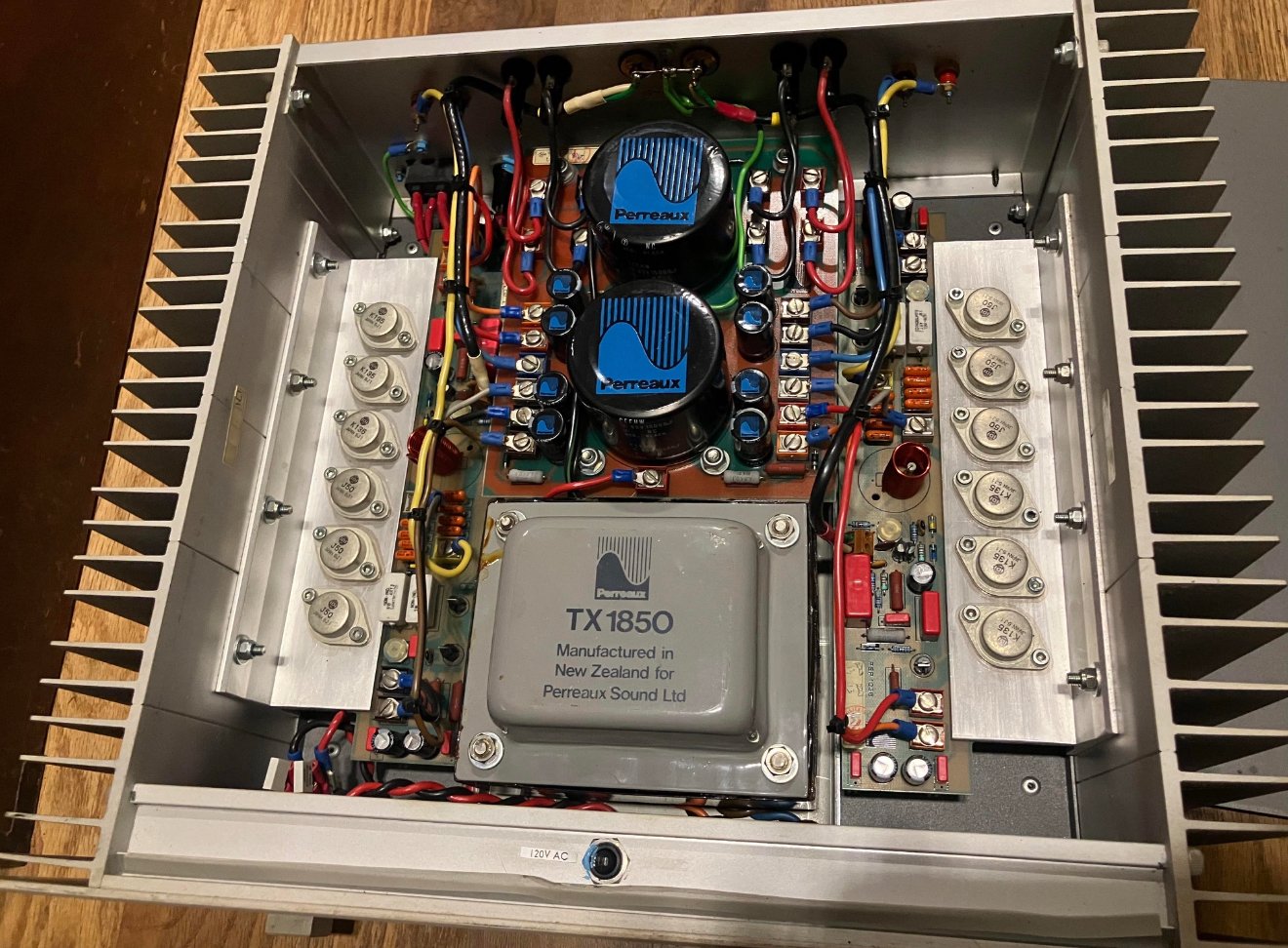
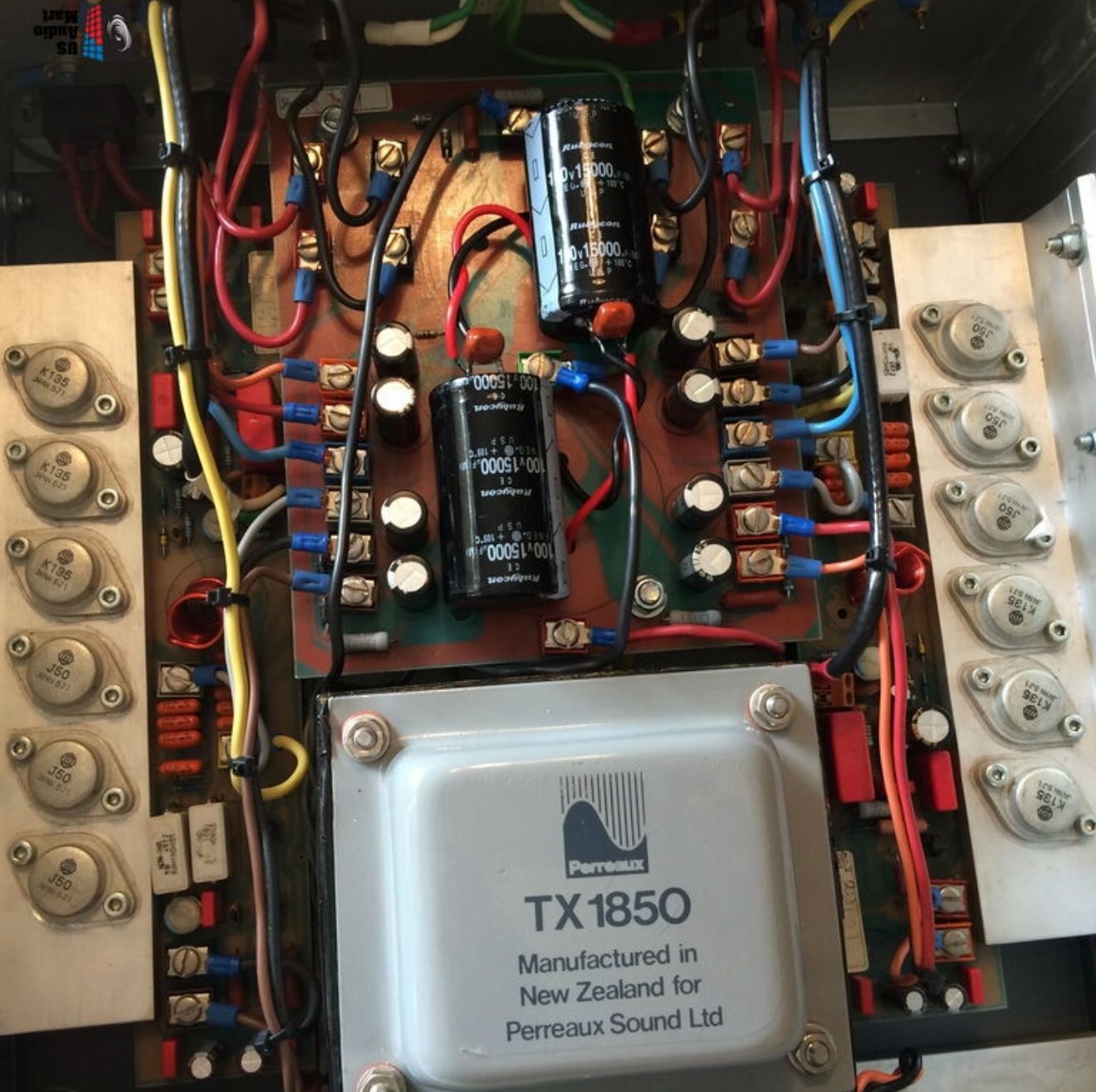
-
I don't know what's needed to refresh it, but that's one beautiful mid-1980s era amp internally!
I used to own one of their early 2000s integrated amps and a CD player. Solid smooth sounding equipment. -
This content has been removed.
-
I'm going to go out on a limb here and say, you cannot replace those electrolytic caps with a film cap. Those 15,000uf are storing energy, something a film cap doesn't do. Not to mention that the film cap IF possible would be gargantuan in that value.skipshot12 wrote: »The orange are bypass caps.
Some manufacturers use a small film type cap as they think it gives them a preferred sound.
If the large cap is replaced with film caps the bypass is no longer needed.
One can replace an electrolytic with a film capacitor. All capacitors 'store energy' (well, actually charge) but, yes, a 15,000 uF film capacitor (even at low working voltage) would be almost unimaginably immense.
Here's a 20 uF @ 750 VDC non-electrolytic for comparison (the white cylinder near the front-left).
-
So... let's see if we can imagine it!

The capacitance and volume of capacitors should be roughly proportional
That ECI 20 uF @ 750 VDC capacitor is about 2.5 inches in diameter (1.25 inch radius) and 2.5 inches long.
Volume = 3.9 cubic inches (= pi*r^2*h)
15,000 uF is 750 times more capacitance than 20 uF.
3.9 inch^3 * 750 = 2,925 cubic inches
According to google 1 gallon = 231 cubic inches, so a 17,500 uF film capacitor, to a reasonable approximation, would be a cylinder with a volume of 11.66 gallons.
Kind of kitchen trash can sized.
PS Don't make me translate that into Canadian, eh?
-
Those photos are confusing. Are they both actual photos of your amp? They seem to be configured differently, but maybe you removed a cosmetic cover or something?I guess I’ll go to Mouser for some caps and copy what I see here. Any idea what that additional orange drop type cap would be for on the 100v 15000uF Rubycon caps?
Your best bet is to find the parts list and schematic for that amp. Try to identify every electrolytic capacitor in the circuit and plan to replace them with similar quality parts. Rubycon has disappeared, but you can find good quality from Elna, Panasonic and Nichicon. For the largest sizes, Vishay, Chemi-con, and Cornell Dubilier are also acceptable. Go for the 105C rated caps with the longest hour ratings if there are multiple choices.
See profile for rigs. Nothing else here. -
This content has been removed.
-
@billbillw the top pic is my amp, all original parts from Perreaux in New Zealand. The lower pic is one I found off of US AudioMart where someone had their PMF1850 restored in California and they were selling it.
[/quote]
Those photos are confusing. Are they both actual photos of your amp? They seem to be configured differently, but maybe you removed a cosmetic cover or something?
Your best bet is to find the parts list and schematic for that amp. Try to identify every electrolytic capacitor in the circuit and plan to replace them with similar quality parts. Rubycon has disappeared, but you can find good quality from Elna, Panasonic and Nichicon. For the largest sizes, Vishay, Chemi-con, and Cornell Dubilier are also acceptable. Go for the 105C rated caps with the longest hour ratings if there are multiple choices.
[/quote]
-
Your amp looks better.
-
Those photos are confusing. Are they both actual photos of your amp? They seem to be configured differently, but maybe you removed a cosmetic cover or something?@billbillw the top pic is my amp, all original parts from Perreaux in New Zealand. The lower pic is one I found off of US AudioMart where someone had their PMF1850 restored in California and they were selling it.
Your best bet is to find the parts list and schematic for that amp. Try to identify every electrolytic capacitor in the circuit and plan to replace them with similar quality parts. Rubycon has disappeared, but you can find good quality from Elna, Panasonic and Nichicon. For the largest sizes, Vishay, Chemi-con, and Cornell Dubilier are also acceptable. Go for the 105C rated caps with the longest hour ratings if there are multiple choices.
[/quote]
[/quote]
That sound is the power supply caps draining to ground. From what I was told by a very knowledgeable electronics engineer, this doesn't particularly mean a failing power cap but something in the circuitry not shutting off properly. Could be a FET. Personally I have two that do it that have had all the caps replaced. I just deal with it.Gustard X26 Pro DAC
Belles 21A Pre Upgraded with Mundorf Supremes
B&K M200 Sonata monoblocks refreshed and upgraded
Polk SDA 1C's modded / 1000Va Dreadnaught
Wireworld Silver Eclipse IC's and speaker cables
Harman Kardon T65C w/Grado Gold. (Don't laugh. It sounds great!)
There is about a 5% genetic difference between apes and men …but that difference is the difference between throwing your own poo when you are annoyed …and Einstein, Shakespeare and Miss January. by Dr. Sardonicus -
This content has been removed.
-
mhardy6647 wrote: »
I'm going to go out on a limb here and say, you cannot replace those electrolytic caps with a film cap. Those 15,000uf are storing energy, something a film cap doesn't do. Not to mention that the film cap IF possible would be gargantuan in that value.skipshot12 wrote: »The orange are bypass caps.
Some manufacturers use a small film type cap as they think it gives them a preferred sound.
If the large cap is replaced with film caps the bypass is no longer needed.
One can replace an electrolytic with a film capacitor. All capacitors 'store energy' (well, actually charge) but, yes, a 15,000 uF film capacitor (even at low working voltage) would be almost unimaginably immense.
Here's a 20 uF @ 750 VDC non-electrolytic for comparison (the white cylinder near the front-left).
Okay Doc, I may have needed to word it differently. I've never removed a film cap and had to discharge it first. I have however had a electrolytic shock the snot out of me because I had not discharged it first....
Ahh, the old bioassay!
My poor father used to get blasted off of HV electrolytics while troubleshooting color TVs on the bench all the time. Reflexes being what they are, he'd pull his arm back fast, almost invariably gouging it on some sharp outcropping of chassis.
ahem... capacitors.
I have a friend... let's call him "Alan", who eschews electrolytics. Alan goes out of his way to avoid them in his projects.
I borrowed one of his preamps for a while at one point. Note that there are zero electrolytics in the preamp or its power supply.
The preamp and its P/S are the two chassis on the right, above the ReVox.
-
This content has been removed.
-
@billbillw the top pic is my amp, all original parts from Perreaux in New Zealand. The lower pic is one I found off of US AudioMart where someone had their PMF1850 restored in California and they were selling it.
OK. Makes sense. FYI: The original "big" caps are 15,000uF/60V, so you don't necessarily need 100V for that use. Honestly, those big can type caps rarely fail. It's the smaller ones that are close to heat sources. There are a number of caps on the amp channel boards as well, but like audioluvr mentioned, it could be a transistor in the protection circuit (if it has one). Overall, it might be something worth taking to a technician if this all gets too confusing. I would not recommend replacing all the caps if they are all still looking good and there is no sign of leakage/bulging.
If you have a multimeter, it might be a safe thing to check the outputs to make sure there is no DC offset or anything happening that might hurt the speakers. Check it powered on and as you power off (when it is typically making the puff sound).
See profile for rigs. Nothing else here. -
I'm going to go out on a limb here and say, you cannot replace those electrolytic caps with a film cap. Those 15,000uf are storing energy, something a film cap doesn't do. Not to mention that the film cap IF possible would be gargantuan in that value.skipshot12 wrote: »The orange are bypass caps.
Some manufacturers use a small film type cap as they think it gives them a preferred sound.
If the large cap is replaced with film caps the bypass is no longer needed.
That makes sense. -
I’ve always referred to this sound as a “burp” - it’s caused by the positive/negative power supply rails collapsing at a different rate when the amplifier is powered off and the supply caps discharge. It is harmless at this stage, but it is indicative of future problems…
So when I hear this burp turn into more of a belch is it time for the visit to the technicians bench? Or would that be too late and my speaker gets fried like bacon?
-
This content has been removed.
-
I’ve always referred to this sound as a “burp” - it’s caused by the positive/negative power supply rails collapsing at a different rate when the amplifier is powered off and the supply caps discharge. It is harmless at this stage, but it is indicative of future problems…
So when I hear this burp turn into more of a belch is it time for the visit to the technicians bench? Or would that be too late and my speaker gets fried like bacon?
It will eventually resolve to louder and louder “pops” - that’s where the danger comes in because the pops are significant voltage spikes that can damage tweeters easily. To make matters worse, the fact that the amplifier has been powered off when this occurs, protection circuitry is often disabled - depending on the topology of the amplifier…“Human beings are born with different capacities. If they are free, they are not equal. And if they are equal, they are not free.”
― Aleksandr Solzhenitsyn -
I'd get it checked out.
-
It also raises the question of how much it's worth it cost-wise to try and update a 40 year old amp with parts that are as good as or better quality than the originals not to mention getting the services of a skilled repair technician to go over it to see what the problems really are. Perreaux made/make excellent gear and thoroughly burned in their amps before sale, unlike most others, but they work to a price point like any other manufacturer and age takes a toll.
-
When I read doc talking about trash can size capacitors I immediately thought of this

- Not Tom ::::::: Any system can play Diana Krall. Only the best can play Limp Bizkit.