Speaker Impedance - How to measure and why different from manufacturer spec?

Hey guys,
I'm planning to pick up a low pass crossover from Parts Express for use with an old set of Boston Acoustic computer speakers that I replaced the subwoofer driver in a long time ago. It never really sounded the same afterward. it was muddied up a bit, so I'm playing around with either refoaming the original driver or adding this crossover.
there are 4ohm and 8ohm options for the crossover, so I used a multimeter across the terminals to determine the impedance of the original driver. it comes up around 3.6-3.8, so I'm figuring 4ohm.
to double-check, and out of curiosity, I pulled measurements off a couple of other speakers I have. one set settles at 5ohms. is this a 6ohm speaker?
and an LSiM703 turns up at around 4ohm even though they're specced at 8ohm. what's this all about?
I'm planning to pick up a low pass crossover from Parts Express for use with an old set of Boston Acoustic computer speakers that I replaced the subwoofer driver in a long time ago. It never really sounded the same afterward. it was muddied up a bit, so I'm playing around with either refoaming the original driver or adding this crossover.
there are 4ohm and 8ohm options for the crossover, so I used a multimeter across the terminals to determine the impedance of the original driver. it comes up around 3.6-3.8, so I'm figuring 4ohm.
to double-check, and out of curiosity, I pulled measurements off a couple of other speakers I have. one set settles at 5ohms. is this a 6ohm speaker?
and an LSiM703 turns up at around 4ohm even though they're specced at 8ohm. what's this all about?
I disabled signatures.
Post edited by msg on
Comments
-
and an LSiM703 turns up at around 4ohm even though they're specced at 8ohm. what's this all about?
The nominal impedance of a speaker cannot be measured with a multimeter. The resistance of a single driver can.Political Correctness'.........defined
"A doctrine fostered by a delusional, illogical minority and rabidly promoted by an unscrupulous mainstream media, which holds forth the proposition that it is entirely possible to pick up a t-u-r-d by the clean end."
President of Club Polk -
Ohms is the expression of the reading both as a resistance and as an impedance, which is what we need to measure for AC. With a multi-meter you are reading DC ohms.
While the coil of a driver has a specific value at 0 hertz (DC), in audio we're interested in what the value is with AC across the driver. Not just the diameter and length of the winding of the coil, which is all you get at DC.
Driver motors vary with frequency and may change the resulting impedance a lot. Manufacturers rate them at the nominal value or at the dip just above resonance.
With a crossover, what you really care about is the impedance at the crossover point. It requires a measurement with tools not normally available, so typically it's easiest to find the manufactures sweep in their measurements and look at it for what the value is at the frequency you're going to crossover at.
If you put in a 4 ohm crossover and the speaker is really at 6 ohms at point of the crossover, then it crosses a different frequency than expected. The real downside then, is it's likely to not crossover at the same frequency as the other driver. This can result in a hole in the response or an undesired overlap. So your results may vary from what you think your doing.
CJA so called science type proudly says... "I do realize that I would fool myself all the time, about listening conclusions and many other observations, if I did listen before buying. That’s why I don’t, I bought all of my current gear based on technical parameters alone, such as specs and measurements."
More amazing Internet Science Pink Panther wisdom..."My DAC has since been upgraded from Mark Levinson to Topping." -
What MM are you using?
Cheap MM will not give perfect measure.
Klipsch RB81, KG3.5, B&W DM602.5, Polk.
Subwoofers: Klipsch RW10, Triad ProSub Bronze. -
F1 - thanks, yeah, I didn't know what nominal meant, or that it could be different than a driver's rated impedance. so is that the "working" impedance when manufacturers spec that, and not necessarily the impedance of the driver then?
CJ - thanks for that explanation. I don't really have any figures on this particular subwoofer or driver I'm working with. it's really old, and the driver itself is pretty generic with no specs listed, so all I have to go by is the measurement across the terminals of the old driver. just a date (23 SEP 1997!), a part number (304-130003-00), Boston doesn't sell it, and I've only turned up old stuff regarding the driver or speaker set.
this is the part I'm looking at trying, and picking up either the 80Hz or 100Hz one to try.
it does list a driver impedance spec of 4ohms, so I think this the one I need for this little experiment?
http://www.parts-express.com/80-hz-low-pass-4-ohm-crossover--266-440
there's also this adjustable one with a volume control from Ebay, but the subwoofer itself already has a volume control on it, so not sure how this would work, whether I could just not connect the volume control portion, or connect it and open it all the way up, and just use the main knob. or even remove this volume potentiometer entirely and just hardwire. not sure how much noise/degradation I'd notice from its place in the circuit.
http://www.ebay.com/itm/Low-Pass-electronic-crossover-for-subwoofer-freq-50Hz-to-150Hz-adjustable-assy-/221401372317?pt=US_Home_Audio_Amplifiers_Preamps&hash=item338c8cd69d
this doesn't have to be perfect; I just need to cut some of the higher frequencies out I think. I'm thinking I might go 100Hz because it's one of those 2.1 setups with the little desktop satellites. I use this system out in the garage with a laptop or smartphone connected by headphone jack just to have some atmosphere while I'm out there.I disabled signatures. -
It's a cheap MM. I have two, neither were very expensive - this particular one is ETEK. the other one is Sperry.What MM are you using?
Cheap MM will not give perfect measure.
how perfect does it have to be to determine driver impedance? I disabled signatures.
 -
It's a cheap MM. I have two, neither were very expensive - this particular one is ETEK. the other one is Sperry.
how perfect does it have to be to determine driver impedance?
Cheap DMM will give your approx readings (could be accurate but you can never tell) but you can't tell whether it's perfect or not.
Something like this is more accurate: http://www.hmcelectronics.com/product/Amprobe/LCR55?referrer=googleshopping&gclid=CNXy_fCsgrcCFWNlMgodakMAeg or fluke or similar brands.
Klipsch RB81, KG3.5, B&W DM602.5, Polk.
Subwoofers: Klipsch RW10, Triad ProSub Bronze. -
Cheap DMM will give your approx readings (could be accurate but you can never tell) but you can't tell whether it's perfect or not.
Something like this is more accurate: http://www.hmcelectronics.com/product/Amprobe/LCR55?referrer=googleshopping&gclid=CNXy_fCsgrcCFWNlMgodakMAeg or fluke or similar brands.
Very simply, if it doesn't have a frequency adjustment, then it can't be the right thing for measuring a speaker!
With regards to the unknown driver....if it's rated at four ohms and you're a ways above the expected low frequency resonance, then it's be somewhere close to the 4 ohm value and that'll probably work just fine. You would be using the low pass side. Any high pass side would only be used if that driver is also 4 ohm.
CJA so called science type proudly says... "I do realize that I would fool myself all the time, about listening conclusions and many other observations, if I did listen before buying. That’s why I don’t, I bought all of my current gear based on technical parameters alone, such as specs and measurements."
More amazing Internet Science Pink Panther wisdom..."My DAC has since been upgraded from Mark Levinson to Topping." -
Cheap DMM will give your approx readings (could be accurate but you can never tell) but you can't tell whether it's perfect or not.
Something like this is more accurate: http://www.hmcelectronics.com/product/Amprobe/LCR55?referrer=googleshopping&gclid=CNXy_fCsgrcCFWNlMgodakMAeg or fluke or similar brands.
interesting, I didn't know MM's like that existed.Very simply, if it doesn't have a frequency adjustment, then it can't be the right thing for measuring a speaker!
With regards to the unknown driver....if it's rated at four ohms and you're a ways above the expected low frequency resonance, then it's be somewhere close to the 4 ohm value and that'll probably work just fine. You would be using the low pass side. Any high pass side would only be used if that driver is also 4 ohm.
CJ
please excuse my ignorance here if I'm missing something obvious, but at this point, I'm only trying to determine the OE driver's impedance spec so that I can make sure I'm matching it with the replacement driver. if testing across the terminals will tell me what I have, then I chose the incorrect replacement originally. it appears that the OE one is 3.8ohms or so, and the one I picked up a few years ago is an 8 ohm unit. what effect might that have on the output of the subwoofer unit? not driving properly since it's not pulling as much power as its supposed to?I disabled signatures. -
For one if the low pass crossover was for a 4 Ohm driver, putting an 8 Ohm driver in its place will change the crossover point about an octave higher...from 100Hz to 200Hz and the L1 and C1 values will be off. Also any resistors values or Zobel networks will be off as well.2.2 Office Setup | LG 29UB55 21:9 UltraWide | HP Probook 630 G8 | Dell Latitude | Cabasse Stream Amp 100 | Boston Acoustics VS 240 | AUDIORAX Desk Stands | Sub 1 - Mirage Omni S8 | Sub 2 - Mirage Omni S8
5.2 A/V Setup | OLED TV - Sony Bravia XR A80J 77" | Source - Fire TV 4K Max, Wiim Pro | AVR - Anthem MRX 520 | Speakers: Main - Boston Acoustics VR3 | Center - Boston Acoustics VR920 | Rear - Boston Acoustics VR-MX | Sub 1 - HSU VTF-2 mk3 | Sub 2 - HSU VTF-2 mk3 -
Ah, well that makes sense. I'm finding it too vocal. I thought I needed a crossover, but I think I just figured out today that the OE is 4 ohm not 8. Not sure how I arrived at 8 in the first place.
So to clarify, is there a difference between nominal impedance and the driver impedance? And if I read impedance across the terminals of an inactive driver, does this or does it not tell me the impedance of the speaker? I'm unclear, sorry.I disabled signatures. -
So to clarify, is there a difference between nominal impedance and the driver impedance?
Yes.And if I read impedance across the terminals of an inactive driver, does this or does it not tell me the impedance of the speaker?
Does not.Political Correctness'.........defined
"A doctrine fostered by a delusional, illogical minority and rabidly promoted by an unscrupulous mainstream media, which holds forth the proposition that it is entirely possible to pick up a t-u-r-d by the clean end."
President of Club Polk -
okay, then, excellent, thanks!
haha, sooooo... what to do now... [drums fingers drums fingers]I disabled signatures. -
haha, just did that with my rotted one - neat!I disabled signatures.
-
yes, I can see that now and understand after the other responses. all great info. I'm still having a hard time accepting that the static reading isn't what I need in this case - I'm only trying to determine whether a speaker is 8Ω or 4Ω. I don't really need to know what it's doing at different frequencies at this point.I disabled signatures.
-
Impedance is a property of alternating current (AC) circuits. Audio waveforms (music) are AC. Like resistance, impedance obeys Ohm's Law; that's why the units of impedance and resistance are the same (Ohms). Impedance consists of two frequency dependent quantities, capacitative reactance and inductive reactance, and one (resistance) which is frequency independent (often referred to in the context of loudspeakers as "DC resistance").
It is the frequency dependence of impedance that makes things interesting, and challenging. The "nominal" impedance of a loudspeaker driver (or loudspeaker system -- i.e., drivers plus their associated crossover networks) is typically defined as a reasonably "flat" (non-varying) region of the impedance vs. frequency curve that's usually found an octave or two above the driver's (or system's) "Fs" (resonant frequency). The impedance for most loudspeaker types will vary considerably from the nominal value as a function of frequency. How an amplifier "feels" about the frequency-dependent impedance characteristics of its load has a lot to do about the true underlying cause of "synergy" between a loudspeaker and an amplifier.
Here's a terrific (IMO) primer on the measurement of loudspeaker operational parameters (the so-called "Thiele-Small" parameters) - this isn't intimately related to the topic of impedance, but there's a nice illustration of a pretty typical impedance curve for a loudspeaker driver (woofer) that nicely demonstrates the complexity of speaker impedance vs. the single "nominal" number applied to a speaker's impedance!
http://www.sound.westhost.com/tsp.htm
(even though this is just a woofer, the general shape of this is pretty typical for a loudspeaker system too -- except the crossover should flatten out the high frequency rise shown for a single driver)
The link above also gives basic how-to for measuring the impedance of a speaker.
(this is essentially the hardware one needs to measure the impedance of speakers - one can, nowadays, use software and a computer sound card in lieu of a proper audio frequency generator - but the latter is a relatively precision instrument and IMO is always the better choice if one's available)
The "nomimal" impedance of this woofer looks like about 6 ohms (that reasonably unchanging impedance region between 100 and 200 Hz). The Fs of this woofer is around 27 Hz; the impedance at Fs is 50 ohms!
Interestingly, a speaker like a Magneplanar (planar magnetic drivers) presents a pretty invariant impedance load as a function of input signal frequency. They are, to a reasonable approximation, thus referred to as "purely resistive loads".
On the other hand, the classic Quad ESL-57 electrostatic loudspeaker is essentially a big capacitor :-) Consequently, it presents a very non-ideal impedance curve to an amplifier that's trying to drive it! This can be disastrous for a marginally stable amplifier (and, thus, to the poor Quads, too!) due to the very low impedance at high audio frequencies.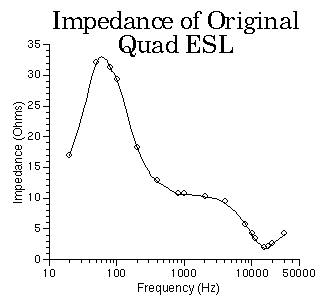
source: http://www.quadesl.com/quad_main.html -
MRH - this is gonna take me a while thanks for posting up - I'm getting a good education here
another piece of info for the other laymen - Parts Express lists a DC resistance spec on the replacement drivers I was looking at. I think this will get me close to the right speaker. DC spec on OE driver is 3.2Ω. DC spec on first replacement driver I ordered is 5.8Ω. so this messes up the stuff that WLD mentioned right? and probably explains why I'm getting higher frequencies into the sub?I disabled signatures. -
This is what many DIY'ers use: http://www.parts-express.com/dayton-audio-dats-dayton-audio-test-system--390-806
Here's a better version: http://www.woofertester.com/wt2product.htm"He who fights with monsters should look to it that he himself does not become a monster. And when you gaze long into an abyss the abyss also gazes into you." Friedrich Nietzsche -
The better one understands the 'science', the more - shall we say - critically may one evaluate the value of hifi products such as cable elevators, interconnects with batteries in 'em, quantum purifiers, magic pebbles, etc. ;-)
(note that I make no value judgement above -- I'm just encouraging engaging one's critical thinking skills before takin' out one's credit card!)
Back - sort of - on topic: yes, the "DCR" of a speaker is related to its nominal impedance, but the relationship isn't really 'predictable'... the DCR pretty much reflects the length and cross sectional area of the wire in the voice coil. The impedance also is impacted by the design of the voice coil and the way it interacts with the loudspeaker's magnet (the size of the magnetic 'gap'; the strength and geometry of the magnet).
As someone alluded to in an earlier post, it gets really interesting because current can flow both ways in a speaker; if you move the cone, you turn the magnet and coil into a generator! This so-called "back EMF" opposes the flow of the amplifier's signal to the speaker -- and the impact of this on the speaker's operation depends on the amp, the speaker, the speaker enclosure... and the room or acoustic space in which the speaker operates! It's actually kind of amazing that the danged things can work as well as they do.
Back to the OP -- I guess I'd really recommend picking up a few books on loudspeaker design and reading 'em. Vance Dickason's Loudspeaker Design Cookbook is a classic, but it's not my favorite. I like Ray Alden's books; David Weems' books are also very good. All of these are mixtures of a little theory and a lot of practical application.
As a rule of thumb, the DCR is usually a bit less than or equal to the nominal impedance. Usually. ;-) -
hahahahahaaaaaa!!!
FINALLY! haha
seriously though, thanks for taking the time to post up all the information. I never really thought about how speakers work, not like this anyway.I disabled signatures.


