Favorite Upgrade, Addition, and/or Game Changer in your System..

Toolfan66
Posts: 18,191
 Take Two, not sure what I did, or what happened to yesterday’s thread. Sorry Tom, I know you posted..
I believe we had a thread like this many moons ago, and if memory serves me correctly, it was very interesting, and informative. So maybe we can do it again.
I have been very fortunate to do some pretty big upgrades the last 5 years, so there is many on a list I could pick from, but, I will pick the biggest game changer for me, and that is adding subs to my system, they just round everything out in the room, and gives the music a fuller feel.
I actually hate the fact I didn’t do it sooner.
Go!!!
Comments
-
Try #2.
I am unable to choose just one, but I will share the most significantly sound improving items I have ran across for my system to date. The Rythmik F-25's definitely will get an honorary mention, as they are fantastic subs.
Snake River Audio Takshaka cables.
EtherRegen/Mutec REF 10 SE120 Master Clock combo.
Snubway/MC combo.
QSA Red and Black fuse.
Tom
~ In search of accurate reproduction of music. Real sound is my reference and while perfection may not be attainable? If I chase it, I might just catch excellence. ~ -
Tubes
-
An abundance of power - going from the 225wpc of the McCormack to the 575wpc of the Silver 9t pair was one of the most impactful things I’ve done. The other big changes have been moving to better and better speakers.“Human beings are born with different capacities. If they are free, they are not equal. And if they are equal, they are not free.”
― Aleksandr Solzhenitsyn -
Replacing my good ol' Sonus Faber Cremona speakers with KEF Reference 1's last year was huge (along with the REL sub). I had to overcome a lot of internal inertia to make that change. After that is, no kidding, the Vera-Fi Snubway. I'm still floored by the changes that thing has made. I will definitely be getting the MC here soon.SystemLuxman L-590AXII Integrated Amplifier|KEF Reference 1 Loudspeakers|PS Audio Directream Jr|Sansui TU-9900 Tuner|TEAC A-6100 RtR|REL T/9X SE Sub
-
Rock solid wifi and the addition of a streamer bought here from the Polk classifieds tops my list. I can't remember ever being so happy replacing a unit as I was the day I replaced my fm tuner with a streamer.
-
I've got to say set up. And not my own set up. I worked with my gear in my room for over 2 years and it always felt like something was off or being left on the table. I kept doing down gear research rabbit holes. Then Skip came over one afternoon and spent about 3 hours working on the set up, and I have to say he accomplished more in those three hours than I did in 2 years. It did require a few tools I didn't own (nothing crazy, mostly just various leveling tools beyond a bubble level), but no new equipment was brought into the equation.
While plenty of other gear has made big impacts, and is certainly more fun than a set up, I encourage everyone to seek out a professional you trust to bring their expertise to your room set up. You can read every strategy on the planet, but it's hard to beat good ol' fashion experience.
And for those that want tips on where to find someone to assist with a set up - go to shows. If a dealer can make a hotel room sound pretty good with only an evening or two to work with, they can probably help make your room sound pretty good as well.Analog: Hana ML > VPI Prime Signature 21 > Bob's Devices Sky 20-S > Sutherland 20/20 w/LPS
Digital: Cambridge CXC / Streaming > Cambridge CXN v2
Norma IPA-140 > Rosso Fiorentino Volterra
Hifiman EF600 > Hifiman Arya Stealth
Discogs -
I think it would have to be my Prima Luna Evo 400 preamp.
Brought my system to life in a way that brought me back into the music and an actual desire to fire the system up and want to re-invest in my music reproduction.
Lots of other refinements and "oh that's nice" improvements from other stuff; like my Eversolo A8 DAC/Preamp, and like @Jetmaker737, the Vera-Fi Snubway.
But I don't think either of those would have even made it into my home without first taking the plunge and bringing the Evo 400 home. -
It was a tube preamp for me, too: Joule Electra LA-100. My wife commented on the sound improvement from another room. It has since left the building, but it was a revelation.
-
It was a tube preamp for me, too: Joule Electra LA-100. My wife commented on the sound improvement from another room. It has since left the building, but it was a revelation.
It has since left the building
The wife or the Joule?
-
displayname wrote: »I've got to say set up. And not my own set up. I worked with my gear in my room for over 2 years and it always felt like something was off or being left on the table. I kept doing down gear research rabbit holes. Then Skip came over one afternoon and spent about 3 hours working on the set up, and I have to say he accomplished more in those three hours than I did in 2 years. It did require a few tools I didn't own (nothing crazy, mostly just various leveling tools beyond a bubble level), but no new equipment was brought into the equation.
I can completely agree with this! I have the tools he uses, plus some more to get exacting placement for my speakers. Once you get the speakers truly set up, it is amazing just how sharp and focused everything gets with imaging. It can make a jumbled mess sound so much more precise and everything just falls into place. Here is what Skip and I use;
DigiPas DWL-1300XY 2 axis precision digital level
Takamine GM160 Pro self leveling 16 line laser
Bosch Professional GLM20 digital tape measure
Stanley Powerlock tape measure
Johnson 40-6184 laser level
Once you get the general location for optimal bass and the least amount of room nodes at your listening position (Jim Smith's book, "Get Better Sound" can help you out with that, if you aren't familiar with the process), Forget measuring by using the walls. Walls are almost never plumb. Use the 16 point laser to align the speakers parallel to the wall and find your exact sweet spot. Double check distances to your ear location with the digital tape measure to within 1/16", then use the Digi-Pas to level your speakers to within .001 degrees. Then double check all measurements again.
It does take time, as one slight adjustment of the spikes alters another measurement but when you hit it perfect, the end result is ear candy that sound SO much better than simply placing a speaker where you think it would sound good and playing with toe in. There is much more to it, and this is just the condensed version of what I do for speaker placement but I will tell you this. I can definitely tell when something is off now. When something doesn't sound just right, I'll break out the Digi-Pas and 10 times out of 10, the speakers got bumped or moved out of alignment. A quick readjustment and I'm back to business.
As for toe in? Please allow me to share some notes I have on the subject. This part is completely free. All it takes is your time.
Here are four simple techniques that will make your speakers sound better than you thought possible—without costing you a dime.
1) The relationship between the loudspeakers and the listener is of paramount importance.
The listener and speakers should form an equilateral triangle; without this basic setup, you’ll never hear good sound staging and imaging. The listener should sit exactly between the two speakers (called the “sweet spot”), at a distance away from each speaker that’s slightly greater than the distance between the speakers themselves. If you don’t have this fundamental relationship, you’ll never hear good soundstaging.
Setting the distance between the speakers is a trade-off between a wide soundstage and a strong center or “phantom” image. The farther apart the loudspeakers (assuming the same listening position), the wider the soundstage. As the speakers are moved farther apart, however, the center image weakens, and can even disappear. If the speakers are too close together, the soundstage narrows.
Speakers placed the optimal distance apart will produce a strong center image and a wide soundstage. A musical selection with a singer and sparse accompaniment is ideal for setting loudspeaker spacing and ensuring a strong center image. With the speakers fairly close together, listen for a tightly focused image of the singer exactly between the two speakers. Move the speakers a little farther apart and listen again. Repeat this move/listen procedure until you start to hear the central image become larger, more diffuse, and less focused, indicating that you’ve gone slightly beyond the maximum distance your speakers should be from each other for a given listening position.
2) Proximity of loudspeakers to walls affects the amount of bass.
The nearer the loudspeakers are to walls and corners, the louder the bass. You can reduce excessive bass by moving your speakers farther out into the room. How far into the room the speakers are positioned also affects the clarity of the bass because certain speaker locations don’t excite the room’s resonant modes as strongly. You can reduce these resonances by following the “rule of thirds” which states that, for the best bass response, the distance between the speakers and the wall behind them should be one-third the length of the room. This is often impractical, but one-fifth the room length is generally the next-best location.
3) The farther out into the room the loudspeakers are, the better the soundstaging—particularly depth.
Positioning loudspeakers close to the wall behind them can destroy the impression of a deep soundstage. Acoustically reflective objects such as a television or fireplace near the speakers can also degrade sound staging. A deep, expansive soundstage is rarely developed with the loudspeakers near the front wall; pulling the speakers out a few feet can make the difference between poor and spectacular sound staging.
4) Toe-in affects tonal balance, soundstage width, and image focus.
Toe-in is pointing a loudspeaker inward toward the listener rather than aiming it straight ahead. Toe-in is a powerful tool for dialing-in the soundstage and treble balance. There are no rules for toe-in; the optimal amount will vary greatly with the speaker and the room.
Toe-in increases the amount of treble heard at the listening seat. You can fine-tune a speaker’s treble balance by adjusting the amount of toe-in in small increments and listening after each adjustment.
Toe-in also increases soundstage focus and image specificity. When toed-in, many loudspeakers provide a more focused and sharply delineated soundstage. Images are more clearly defined, compact, and tight, rather than diffuse and lacking a specific spatial position. The optimal toe-in angle is often a trade-off between too much treble and a strong central image. With lots of toe-in, the soundstage snaps into focus, but the sound is often too bright. With no toe-in, the treble balance is smoother, but the imaging is more vague. You can find the best balance simply by listening and adjusting.
Toe-in also affects the sound’s overall spaciousness. No toe-in produces a larger, more billowy, less precise soundstage. Instruments are less clearly delineated, but the sound is bigger and more expansive. Toeing-in the speakers shrinks the apparent size of the soundstage, but allows more precise image delineation. Finally, identical (and I mean identical) toe-in for both speakers is essential to realistic soundstaging. There’s no substitute for a listen-adjust-listen process to realize ideal speaker placement.
I hope this helps someone who may be still struggling with imaging. As mentioned before. All it takes is your time. Measuring everything, using the tools I have just makes the process go much quicker, with more precision....but you don't necessarily need them. The good thing is, if you do decide to invest in these tools, it's a one and done deal. Then you can use them for the rest of your life, and help others out who may be in need of assistance with their rigs. In general, it takes me a good 3 plus hours to make sure all parameters are correct. It's definitely worth it though!
Tom
~ In search of accurate reproduction of music. Real sound is my reference and while perfection may not be attainable? If I chase it, I might just catch excellence. ~ -
displayname wrote: »I've got to say set up. And not my own set up. I worked with my gear in my room for over 2 years and it always felt like something was off or being left on the table. I kept doing down gear research rabbit holes. Then Skip came over one afternoon and spent about 3 hours working on the set up, and I have to say he accomplished more in those three hours than I did in 2 years. It did require a few tools I didn't own (nothing crazy, mostly just various leveling tools beyond a bubble level), but no new equipment was brought into the equation.
I can completely agree with this! I have the tools he uses, plus some more to get exacting placement for my speakers. Once you get the speakers truly set up, it is amazing just how sharp and focused everything gets with imaging. It can make a jumbled mess sound so much more precise and everything just falls into place. Here is what Skip and I use;
DigiPas DWL-1300XY 2 axis precision digital level
Takamine GM160 Pro self leveling 16 line laser
Bosch Professional GLM20 digital tape measure
Stanley Powerlock tape measure
Johnson 40-6184 laser level
Once you get the general location for optimal bass and the least amount of room nodes at your listening position (Jim Smith's book, "Get Better Sound" can help you out with that, if you aren't familiar with the process), Forget measuring by using the walls. Walls are almost never plumb. Use the 16 point laser to align the speakers parallel to the wall and find your exact sweet spot. Double check distances to your ear location with the digital tape measure to within 1/16", then use the Digi-Pas to level your speakers to within .001 degrees. Then double check all measurements again.
It does take time, as one slight adjustment of the spikes alters another measurement but when you hit it perfect, the end result is ear candy that sound SO much better than simply placing a speaker where you think it would sound good and playing with toe in. There is much more to it, and this is just the condensed version of what I do for speaker placement but I will tell you this. I can definitely tell when something is off now. When something doesn't sound just right, I'll break out the Digi-Pas and 10 times out of 10, the speakers got bumped or moved out of alignment. A quick readjustment and I'm back to business.
As for toe in? Please allow me to share some notes I have on the subject. This part is completely free. All it takes is your time.
Here are four simple techniques that will make your speakers sound better than you thought possible—without costing you a dime.
1) The relationship between the loudspeakers and the listener is of paramount importance.
The listener and speakers should form an equilateral triangle; without this basic setup, you’ll never hear good sound staging and imaging. The listener should sit exactly between the two speakers (called the “sweet spot”), at a distance away from each speaker that’s slightly greater than the distance between the speakers themselves. If you don’t have this fundamental relationship, you’ll never hear good soundstaging.
Setting the distance between the speakers is a trade-off between a wide soundstage and a strong center or “phantom” image. The farther apart the loudspeakers (assuming the same listening position), the wider the soundstage. As the speakers are moved farther apart, however, the center image weakens, and can even disappear. If the speakers are too close together, the soundstage narrows.
Speakers placed the optimal distance apart will produce a strong center image and a wide soundstage. A musical selection with a singer and sparse accompaniment is ideal for setting loudspeaker spacing and ensuring a strong center image. With the speakers fairly close together, listen for a tightly focused image of the singer exactly between the two speakers. Move the speakers a little farther apart and listen again. Repeat this move/listen procedure until you start to hear the central image become larger, more diffuse, and less focused, indicating that you’ve gone slightly beyond the maximum distance your speakers should be from each other for a given listening position.
2) Proximity of loudspeakers to walls affects the amount of bass.
The nearer the loudspeakers are to walls and corners, the louder the bass. You can reduce excessive bass by moving your speakers farther out into the room. How far into the room the speakers are positioned also affects the clarity of the bass because certain speaker locations don’t excite the room’s resonant modes as strongly. You can reduce these resonances by following the “rule of thirds” which states that, for the best bass response, the distance between the speakers and the wall behind them should be one-third the length of the room. This is often impractical, but one-fifth the room length is generally the next-best location.
3) The farther out into the room the loudspeakers are, the better the soundstaging—particularly depth.
Positioning loudspeakers close to the wall behind them can destroy the impression of a deep soundstage. Acoustically reflective objects such as a television or fireplace near the speakers can also degrade sound staging. A deep, expansive soundstage is rarely developed with the loudspeakers near the front wall; pulling the speakers out a few feet can make the difference between poor and spectacular sound staging.
4) Toe-in affects tonal balance, soundstage width, and image focus.
Toe-in is pointing a loudspeaker inward toward the listener rather than aiming it straight ahead. Toe-in is a powerful tool for dialing-in the soundstage and treble balance. There are no rules for toe-in; the optimal amount will vary greatly with the speaker and the room.
Toe-in increases the amount of treble heard at the listening seat. You can fine-tune a speaker’s treble balance by adjusting the amount of toe-in in small increments and listening after each adjustment.
Toe-in also increases soundstage focus and image specificity. When toed-in, many loudspeakers provide a more focused and sharply delineated soundstage. Images are more clearly defined, compact, and tight, rather than diffuse and lacking a specific spatial position. The optimal toe-in angle is often a trade-off between too much treble and a strong central image. With lots of toe-in, the soundstage snaps into focus, but the sound is often too bright. With no toe-in, the treble balance is smoother, but the imaging is more vague. You can find the best balance simply by listening and adjusting.
Toe-in also affects the sound’s overall spaciousness. No toe-in produces a larger, more billowy, less precise soundstage. Instruments are less clearly delineated, but the sound is bigger and more expansive. Toeing-in the speakers shrinks the apparent size of the soundstage, but allows more precise image delineation. Finally, identical (and I mean identical) toe-in for both speakers is essential to realistic soundstaging. There’s no substitute for a listen-adjust-listen process to realize ideal speaker placement.
I hope this helps someone who may be still struggling with imaging. As mentioned before. All it takes is your time. Measuring everything, using the tools I have just makes the process go much quicker, with more precision....but you don't necessarily need them. The good thing is, if you do decide to invest in these tools, it's a one and done deal. Then you can use them for the rest of your life, and help others out who may be in need of assistance with their rigs. In general, it takes me a good 3 plus hours to make sure all parameters are correct. It's definitely worth it though!
Tom
While I don't disagree with any of this, I do want to use this post to re-emphasize my point about hiring a processional you trust. Some people don't have that resource, or they simply want to learn how to do it. I more fall into the camp of time is money, and I want to spend my time doing leisurely things, like listening.
In the post above we are looking at $650 of equipment and reading materials. Most people will have some of those tools, but most people are also unlikely to have all of them. And then it gets down to the fine adjustments. At the end of the day, this is where lack of experience will show. You can get all the measurements very very close, but at the end of the day your room has doors, furniture, different materials, etc etc etc. All things that impact the sound. The final dial in has to be done by ear. And if you don't have the experience to know what each minor movement does, well then you have to try-listen-try again. Which is great experience, but you will inevitably make some moves and quickly realize that was the wrong direction, or the wrong parameter. It takes time. Where as someone who's set up loads of systems in loads of rooms, well they can take more educated guesses to arrive at the same conclusion much more quickly. And like I said, a good test of this is hifi shows and events. If someone can make a hotel room sound great for a show, they can probably make your room sound great too.
And THAT is where the value comes in. I often bring hifi back to car analogies. My wife's car needs new struts and an oil change currently. I *could* very much do that myself. I own probably half of the required equipment, but not all of it. But even with excellent instruction (which is readily available and generally free), it's still going to take me FAR longer to do then it would take for a quality to shop to do. I'm going to need to do some homework, and I'm likely going to need to redo at least one part of the process. Possibly multiple parts. And is that really how I want to spend a Saturday?
For those that do your own, I commend you. For those that want to learn it for themselves, it's a valuable skill. But don't write off hiring a trusted vendor for their time either. They can be an immensely valuable resource beyond just selling you gear. And I think that is often overlooked in this hobby.Analog: Hana ML > VPI Prime Signature 21 > Bob's Devices Sky 20-S > Sutherland 20/20 w/LPS
Digital: Cambridge CXC / Streaming > Cambridge CXN v2
Norma IPA-140 > Rosso Fiorentino Volterra
Hifiman EF600 > Hifiman Arya Stealth
Discogs -
There is only one problem with that. You have to be done with your system. Case in point. My 250 pound Tyler's have pretty much been in the same spot since about a week or so after I got them and determined the initial placement. After some recent cable changes a couple of months ago, it became apparent that they needed to move again, that they had lost something because the frequencies had changed and were so much more impactful/fast. This changed the reaction of the lower frequencies in the room.
So, I went back to square one and moved the speakers back and forth, side to side many times, until I hit that sweet spot of bliss again. Then I went through the whole rigamarole of measuring and optimizing that new location. The end result was a linear frequency layout from top to bottom and the ambience bloomed to something that I hadn't experienced in the room before. That one took me about 2 days (not always working on it though), as I literally started everything from scratch again. Pretty much all aspects changed. They were separated further out from each other, both speakers moved further out in the room and the toe in was changed. Fantastic end result.
As for things in the room? Yeah, any change now is pretty easy to detect when you move something, after the installation of the acoustical panels. I'm actually planning on getting two more absorbtion panels for the 2nd side reflections and possibly 2 more for the ceiling first and second reflection points.
Tom~ In search of accurate reproduction of music. Real sound is my reference and while perfection may not be attainable? If I chase it, I might just catch excellence. ~ -
I thought you were building a new room bro??
-
Per my signature ...
"One-owner Polk Audio RTA 15TL speakers refreshed w/ Sonicap, Vishay/Mills and Cardas components by "pitdogg2," "xschop" billet tweeter plates and BH5"
These speakers were so close to going to the landfill you wouldn't believe it. Then Ivan came along and the rest is history.
My sincere thanks to the all the current and past members of this forum who helped with bringing these vintage Polks back to their better-than-new condition. Much appreciated!
Brian -
Everything in my current setup made a huge difference on the whole. It is hard for me pinpoint a specific piece of equipment that stands above the rest. The Simaudio DAC was a profound step in the right direction, and the McIntosh MC2300 is the final piece of the puzzle that unifies the whole thing.
For 12 years now, my Carver tube amps have been the foundation upon which everything else was built. And the Legends have been superb.
I guess where I am going is that the biggest game changer for me has been experience and not being afraid to seek a new direction and try new things. Once you open your mind to the possibility that everything matters, only then can you put together a system that rewards your efforts.The Gear... Carver "Statement" Mono-blocks, Mcintosh C2800 Arcam AVR20, Oppo UDP-203 4K Blu-ray player, Sony XBR70x850B 4k, Polk Audio Legend L800 with height modules, L400 Center Channel Polk audio AB800 "in-wall" surrounds. Marantz MM7025 stereo amp. Simaudio Moon MiND2 Shunyata Triton/Typhon Rotel RP9400 Turntable
“When once a Republic is corrupted, there is no possibility of remedying any of the growing evils but by removing the corruption and restoring its lost principles; every other correction is either useless or a new evil.”— Thomas Jefferson
How many flies need to be buzzing a dead horse before you guys stop beating it? -
I thought you were building a new room bro??
Yes, but I am experiencing delays. I am still researching and in the design phase. That and I have made a huge investment in new cabling for my rig in the past 6 months and that has taken up a very large chunk of my budget. I also work in the REIT industry, which has been hurt by rising housing prices and high interest rates, so huge swaths of overtime have pretty much stopped. I could take out a loan, but am not willing to do so at the moment.
As far as designing the room, I am about 60-65% of the way there. The electrical plan is solid, the design layout is still up for changes. That will probably be the best "tweak" I could ever do. It just comes at a significant cost, even with me doing most of the work.
Tom~ In search of accurate reproduction of music. Real sound is my reference and while perfection may not be attainable? If I chase it, I might just catch excellence. ~ -
Years ago it was tubes and the rabbit hole that ensued.
Most recently it has to be the Pass Labs XA25 amplifier. This is amp is especially incredible for recreating the things in a recording that make my hair stand up and connect me to the music more than any other piece of gear I've owned.
Rather that rehash here's a link to my review thread.
https://forum.polkaudio.com/discussion/199380/finally-pulled-the-trigger
H9"Appreciation of audio is a completely subjective human experience. Measurements can provide a measure of insight, but are no substitute for human judgment. Why are we looking to reduce a subjective experience to objective criteria anyway? The subtleties of music and audio reproduction are for those who appreciate it. Differentiation by numbers is for those who do not".--Nelson Pass Pass Labs XA25 | EE Avant Pre | EE Mini Max Supreme DAC | MIT Shotgun S1 | Puritan Audio PSM136 Pwr Condtioner & Classic PC's | Legend L600 | Roon Nucleus 1 w/LPS - Tubes add soul! -
A game changer for me by far is just streaming. It really made this hobby a whole other level of fun versus cds... Just so much good music out there I have discovered from streaming.
- Not Tom ::::::: Any system can play Diana Krall. Only the best can play Limp Bizkit. -
A game changer for me by far is just streaming. It really made this hobby a whole other level of fun versus cds... Just so much good music out there I have discovered from streaming.
Absolutely
H9"Appreciation of audio is a completely subjective human experience. Measurements can provide a measure of insight, but are no substitute for human judgment. Why are we looking to reduce a subjective experience to objective criteria anyway? The subtleties of music and audio reproduction are for those who appreciate it. Differentiation by numbers is for those who do not".--Nelson Pass Pass Labs XA25 | EE Avant Pre | EE Mini Max Supreme DAC | MIT Shotgun S1 | Puritan Audio PSM136 Pwr Condtioner & Classic PC's | Legend L600 | Roon Nucleus 1 w/LPS - Tubes add soul! -
I agree with the addition of a sub as a game changer. I had started with two little subs, 10" and 12" drivers, cheap little subs.
When I purchased an Epik Empire, sealed with dual 15" drivers, it made a huge difference. A year later I purchased a second one. Still have them, going strong. They are phenomenal in 2ch and do a decent job for theater.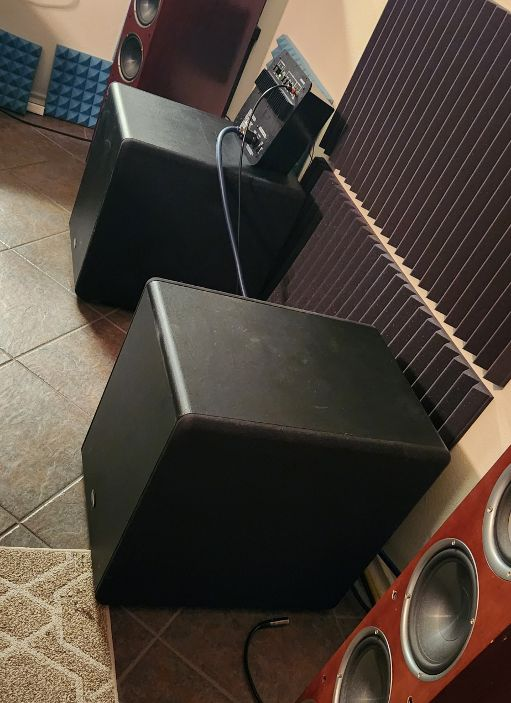
-
My favorite upgrade is alcohol.
It's fast and dramatic. -
Game changer for me was experimenting and learning more about room and speaker placement interaction. It's cool to read about it, but much better to do it.
-
I agree: setup, 'the golden triangle' for speakers location to MLP.
IMO,
1) acoustic treatments at the main reflection points. Adding acoustic panels made an enormous difference in my room.
2) miniDSP to align and tune subs,
3) Audyssey tuning using Acoustica, EVO 1, etc.My 7.4.4 DIY 4k Home Theater:
Polk LSiM 707 L-C-R, LSiM702 side surrounds, LSiM 703 rears
Polk LSiM 702s x 4 on the Ceiling Atmos speakers
Subs: Eminence NSW-6021-6 tuned to 14Hz, NX6000D (front),
2 x SVS PB12/Plus 2's (rear) miniDSP HD2x4
Denon X3700H Emotiva XPA11 Gen 3
XBox One X 4k & BD and streaming
Panasonic UB-420 4k player
HD-A35 HD DVD
Oppo BD-103D for hirez audio
Technics SL-D2 TT, Grado Gold Cartridge
JVC DLA-RS2100/NZ7 projector
Silver Ticket 135" microperf AT screen
Berkline 090 electric recliners with Aura Bass Shakers -
-
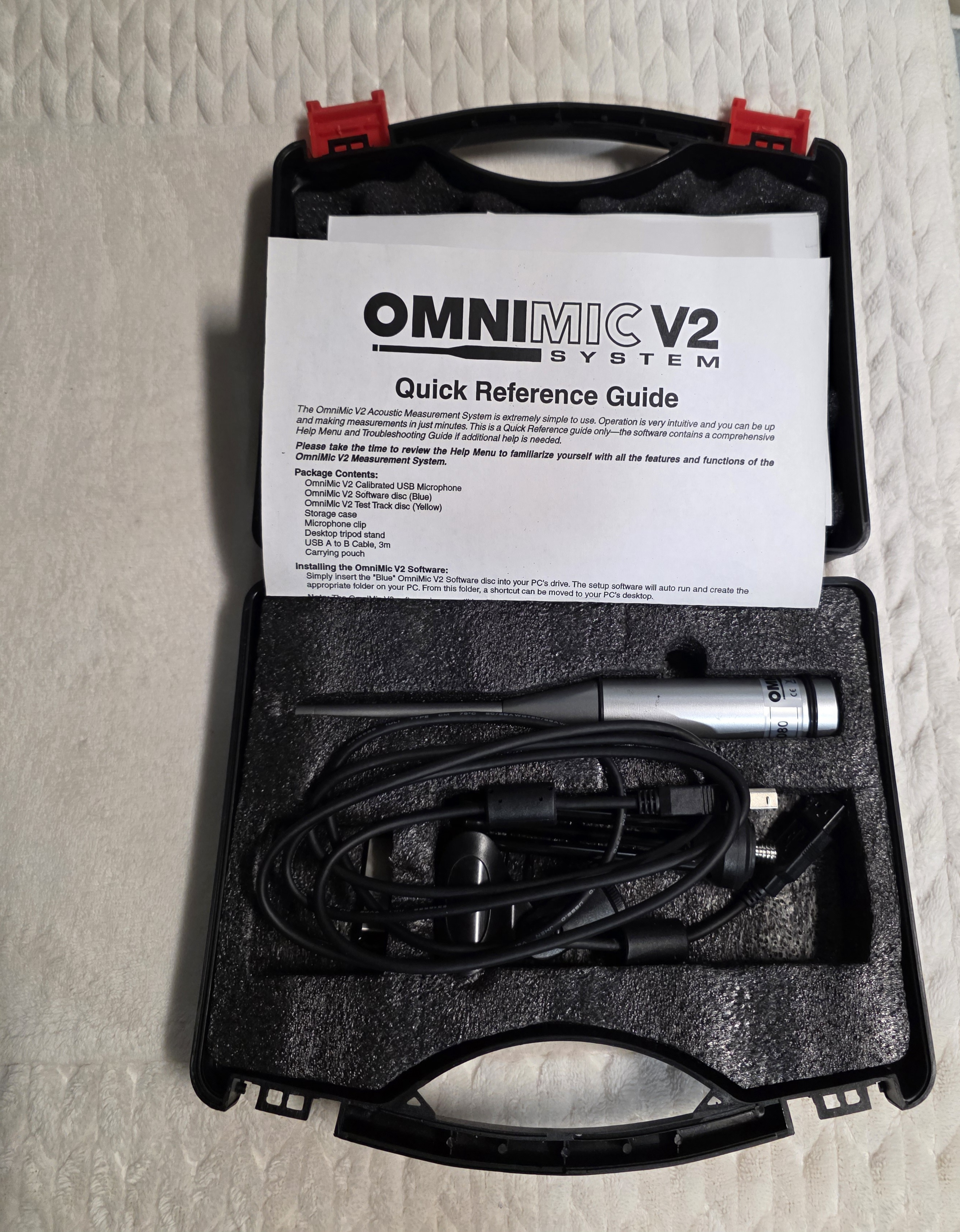
While not part of the system, since 2013, Dayton OmniMic V2 helped me with best placement of speakers, subs and acoustic treatments. There is also free room software available.
Salk SoundScape 8's * Audio Research Reference 3 * Bottlehead Eros Phono * Park's Audio Budgie SUT * Krell KSA-250 * Harmonic Technology Pro 9+ * Signature Series Sonore Music Server w/Deux PS * Roon * Gustard R26 DAC / Singxer SU-6 DDC * Heavy Plinth Lenco L75 Idler Drive * AA MG-1 Linear Air Bearing Arm * AT33PTG/II & Denon 103R * Richard Gray 600S * NHT B-12d subs * GIK Acoustic Treatments * Sennheiser HD650 *


