Building a vacuum tube tape preamp
Comments
-
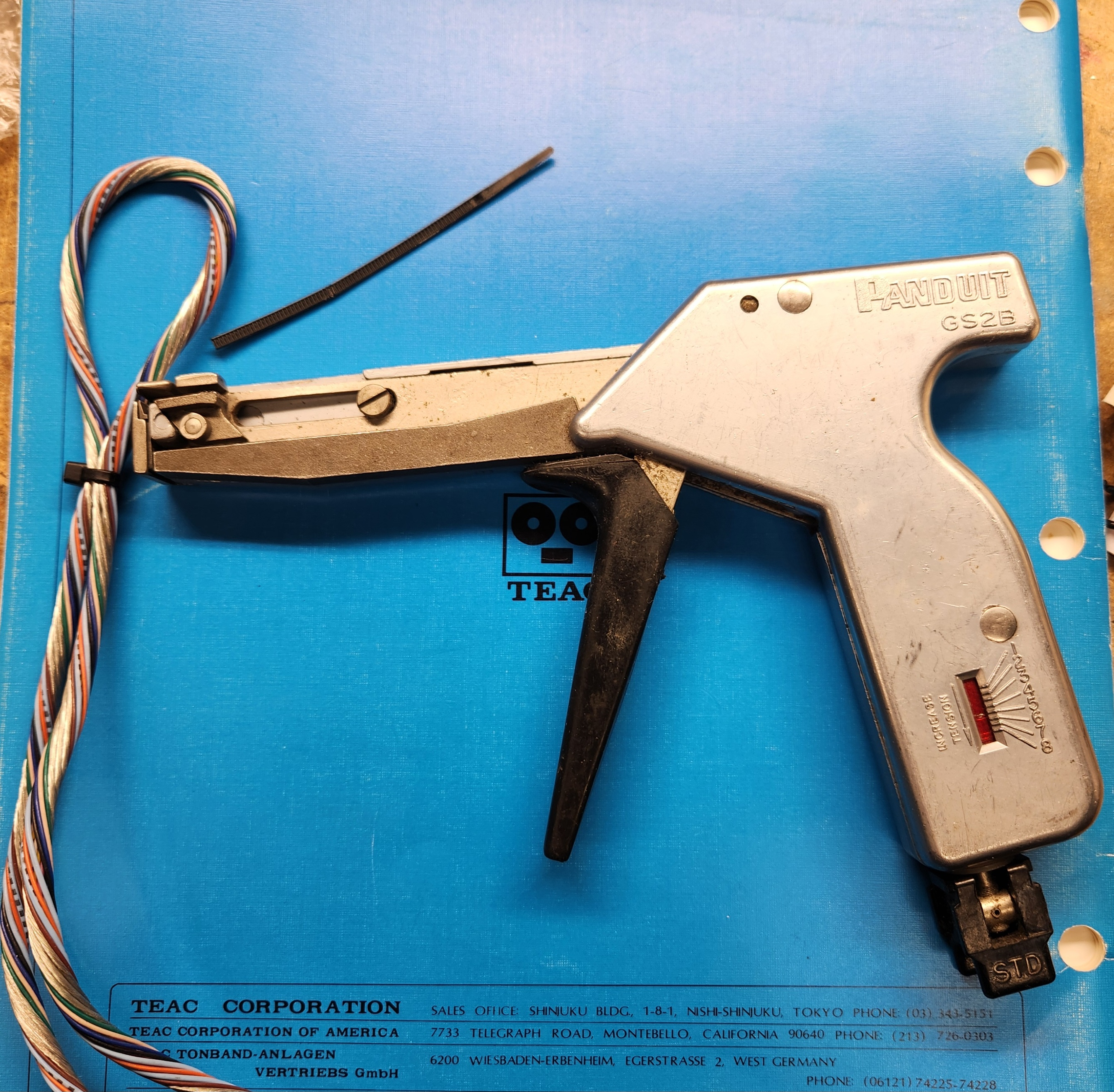
When Zip tying a harness, I always use my trusty Panduit GS2B cable tie installation tool. It sports three quick-flip tension settings for mini, intermediate and standard ties at bottom of grip with a tension scale on side. This ensures proper and consistent tension, so your wiring has equal power and signal choke at all tie points. This results in balanced power and signal restriction for each channel. When squeezed, the built-in knife blade conveniently slices off the excess tie cleanly.

Salk SoundScape 8's * Audio Research Reference 3 * Bottlehead Eros Phono * Park's Audio Budgie SUT * Krell KSA-250 * Harmonic Technology Pro 9+ * Signature Series Sonore Music Server w/Deux PS * Roon * Gustard R26 DAC / Singxer SU-6 DDC * Heavy Plinth Lenco L75 Idler Drive * AA MG-1 Linear Air Bearing Arm * AT33PTG/II & Denon 103R * Richard Gray 600S * NHT B-12d subs * GIK Acoustic Treatments * Sennheiser HD650 * -
that looks like a handy tool. I like the old gear that used string to bundle up all the wires. I guess that was done on a loom with all the wiring in a harness.
-
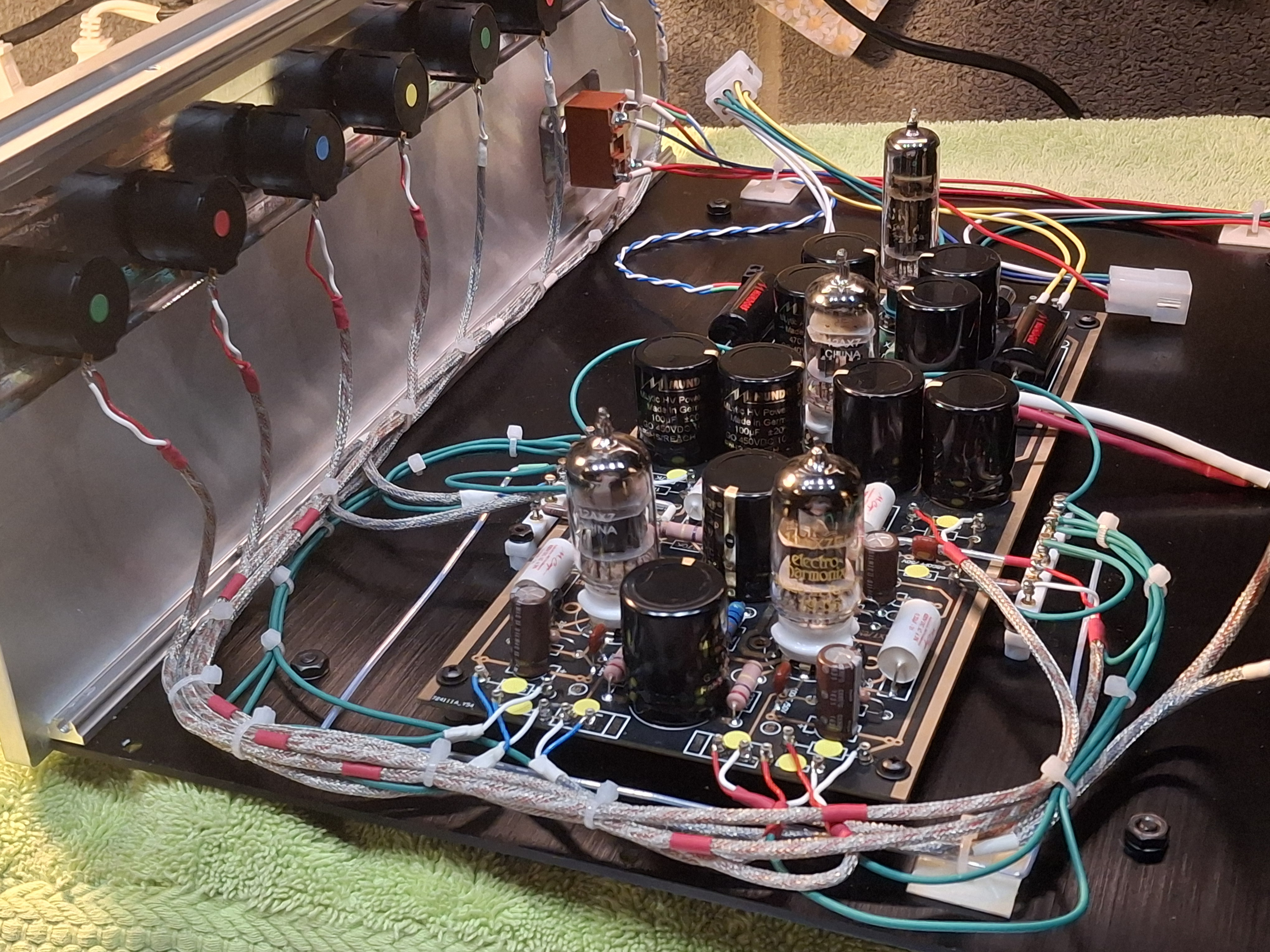
Finished the right channel connections. Now to begin calibrating the preamp to the Tandberg.
-
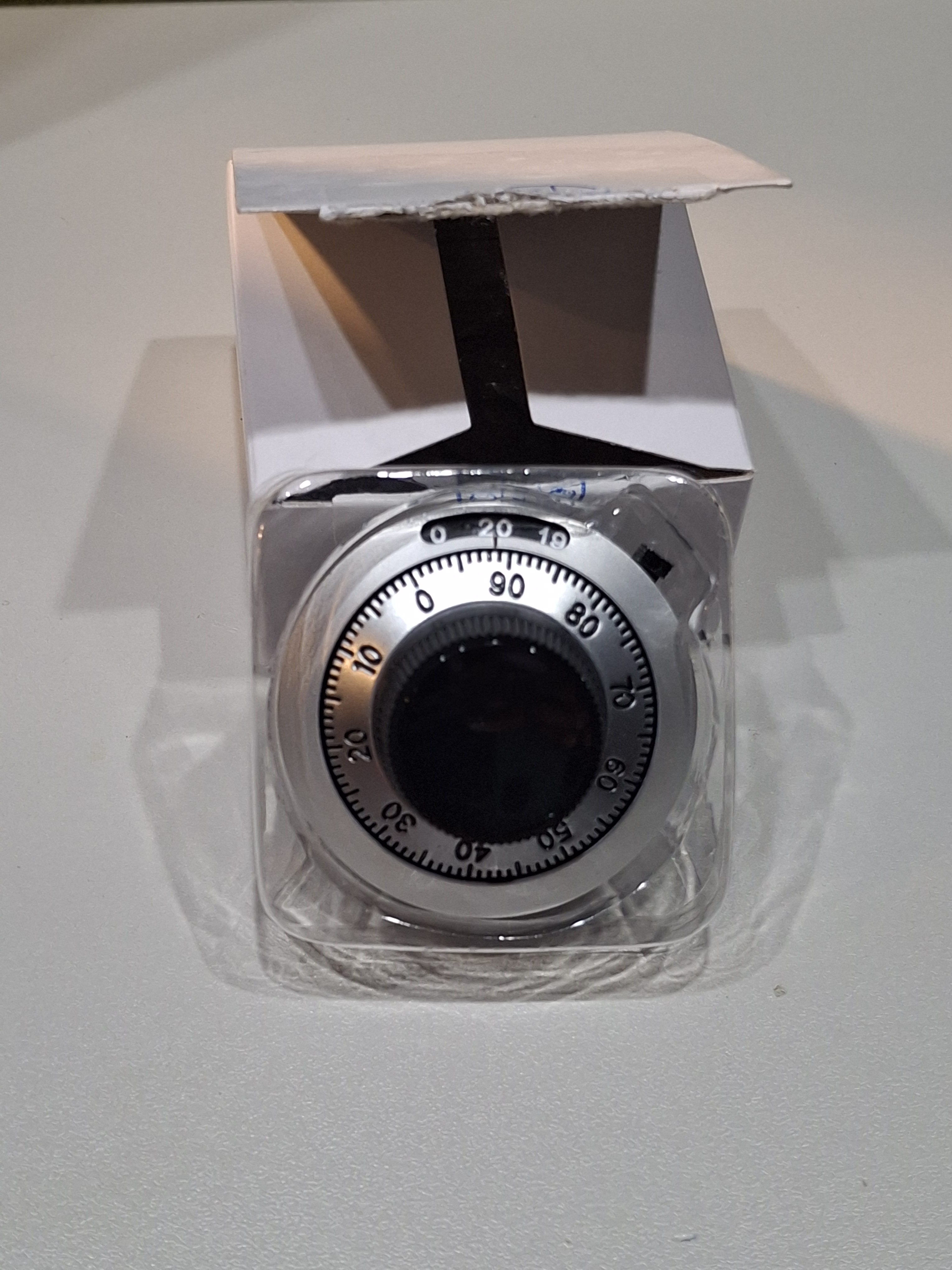
Still having problems with finding a suitable control knob. I ordered one that I thought might work but the shaft of the potentiometer doesn't come forward enough to be secured by the set screw on the knob. I'm about 1mm short.
-
High marks! Outstanding workmanship! Interested in the calibration process. Do you have a service manual written for it yet?

Darn shame about the knob. Extensions would push knobs out too far.
Are the potentiometers flush to inside chassis, like no nut or washer used there?
The other option other than finding different knobs would be to disassemble, ugh, machine recess for knobs in the front or rear of panel for potentiometers.
Have you considered knobs with dial plates? Space permitting of course. I'm guessing you'd need marks for the full 360 degrees.
EDIT: Never mind, forgot about the multiturn potentiometers, you need a counter.
Post edited by SCompRacer onSalk SoundScape 8's * Audio Research Reference 3 * Bottlehead Eros Phono * Park's Audio Budgie SUT * Krell KSA-250 * Harmonic Technology Pro 9+ * Signature Series Sonore Music Server w/Deux PS * Roon * Gustard R26 DAC / Singxer SU-6 DDC * Heavy Plinth Lenco L75 Idler Drive * AA MG-1 Linear Air Bearing Arm * AT33PTG/II & Denon 103R * Richard Gray 600S * NHT B-12d subs * GIK Acoustic Treatments * Sennheiser HD650 * -
Well, the next step is to get some new tubes. The ones I've been using are pretty sketchy, just ones lying Around from old projects. There's some noise on one channel and I'm pretty certain it's tube related. I've ordered some Mullards from Tube Depot that seemed reasonable, all things considered.
Knobs is a continuing issue. I didn't think it through when I drilled the faceplate, but any knob with a counter requires a small hole below the dial to keep the outside part of the dial from turning when the knob is turned. The second problem is that there needs to be more of the potentiometer outside of the faceplate so the dial has something to lock on. I may have to visit my machinist friend again.
The calibration process involves mostly learning how the various adjustments effect the playback response. If the playback head has a high frequency resonance then the input loading can be used. The gain adjustment can be used to carefully match the two channels, but can also lead to oscillation. The sections of the feedback that influence the bass and treble are going to be dependent on the characteristics of the transport and how a test tape looks when connected.
At this point the LED lights up and that's a beginning, right? -
Well, the next step is to get some new tubes.
ABOUT DANG TIME !!! Do you know how many times I've started a response to those Electro-Harmonix tubes !? I mean I'd take a set of GE tubes over those and I do not like GE tubes at all...... 
-
You are absolutely right, I should have addressed that months ago. It always got pushed back because something else needed attention. This is where a project manager would have helped, also a budgeting department.
-
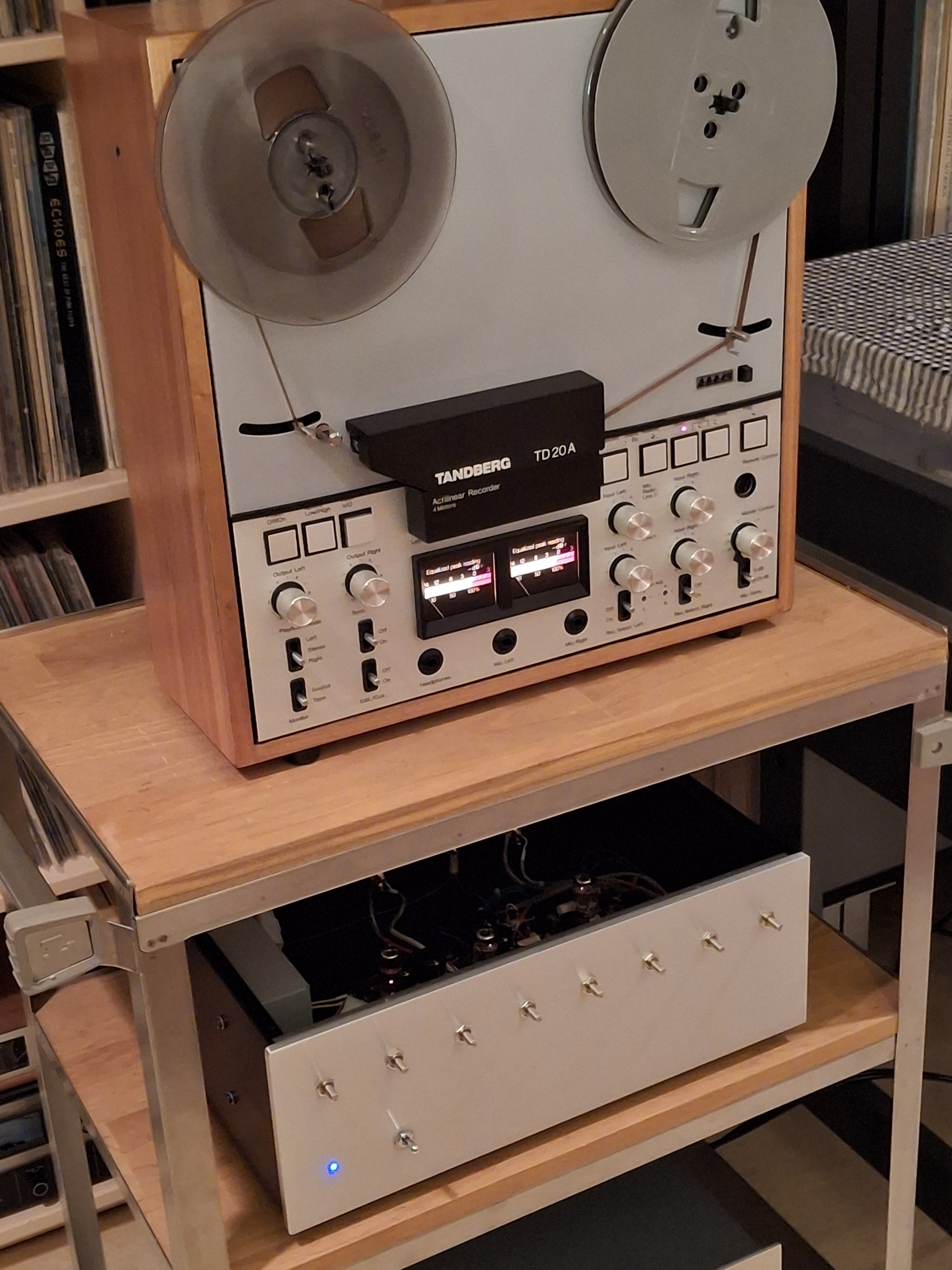
I dug around in my tube inventory and found some more suitable choices, channels seem fine. I did a frequency response measurement, the adjustments for treble, bass are working fine. Distortion was 0.38% for left and 0.82% for right. I hooked it up and started to listen and haven't stopped, really nice sounding. I've listened to Gershwin, Wes Montgomery and Jimmy Smith and now Blood, Sweat and Tears. I like it, very rich sounding.
-
High marks for you! Did you count turns? Just curious how many of the eight turns you used.
That is a really nice Tandberg. I've always seen them with black upper faces, sometimes the lower is black. Is it because you didn't read the where to find black paint thread or was it a custom choice by you?
Love BS & T. Remember the controversy when Blood, Sweat and Tears participated (or were forced) to do that government-sponsored tour to the Soviet satellite states?Salk SoundScape 8's * Audio Research Reference 3 * Bottlehead Eros Phono * Park's Audio Budgie SUT * Krell KSA-250 * Harmonic Technology Pro 9+ * Signature Series Sonore Music Server w/Deux PS * Roon * Gustard R26 DAC / Singxer SU-6 DDC * Heavy Plinth Lenco L75 Idler Drive * AA MG-1 Linear Air Bearing Arm * AT33PTG/II & Denon 103R * Richard Gray 600S * NHT B-12d subs * GIK Acoustic Treatments * Sennheiser HD650 * -
Thanks! So far the only adjustments I've used are the high and low frequency ones, I used a signal generator as an input and looked at how close the response compared with the NAB playback curve. I've been working with Kevin Barrett at KAB Electro Acoustics in converting his reverse RIAA device into an NAB curve. That way I can see how the EQ differs from flat. The input loading adjustment is there to compensate for any playback head resonances which will show up when the deck is connected. I would like a bit more gain from the circuit, but want to see how changing the gain effects headroom and distortion. The left and right outputs were exactly the same, so no need to change for that reason.
I changed the color of the upper plate to grey from black, I had scratched the old plate when I didn't have the speed change push button bracket set correctly so I decided to get it powder coated. It looks a bit less severe and I like grey for some reason.
The BS&T is the Child Is Father to the Man album, one of my favorites. I didn't know about the forced tour, that's wild. -
Great color choice for that only one Tandberg look!
I've never checked out all of KAB's products and didn't know he offered one. That is really nice of him to help out.
I have a Hagerman iRIAA2. Buying was faster than building one. You may recall I read some threads condemning the NAB/RIAA PEC modules in the old Scott 340 and 399 receivers I refurbished for Ed the SRT king.
You suggested testing them with the inverse RIAA filter and I found nothing wrong with the RIAA curve throughout the frequency range. That saved me quite a bit of time and effort making them. Thanks again for that!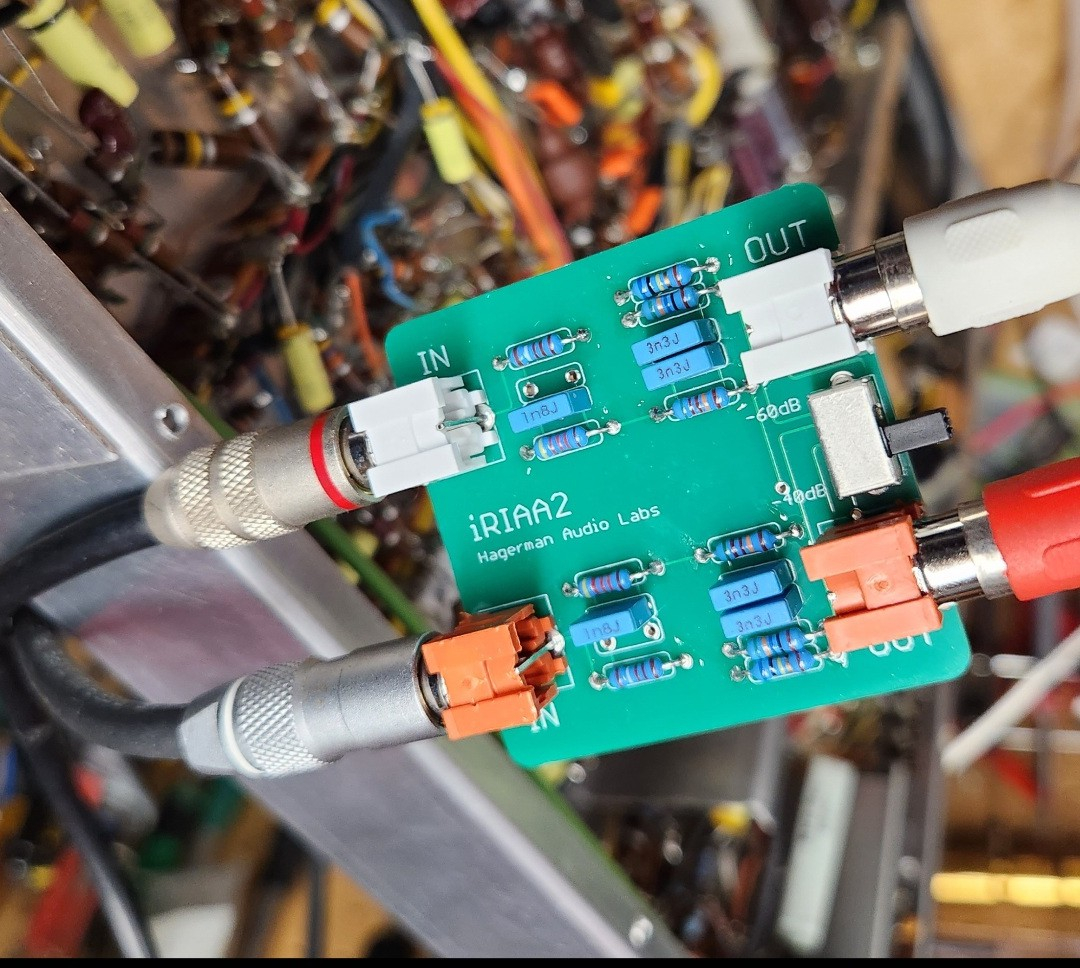
For those who may not know, the PEC (printed electronic circuit) was an ancestor of the hybrid integrated circuit (IC). It contained the NAB/RIAA curves that would be selected by switch on front panel. There would be one for each channel.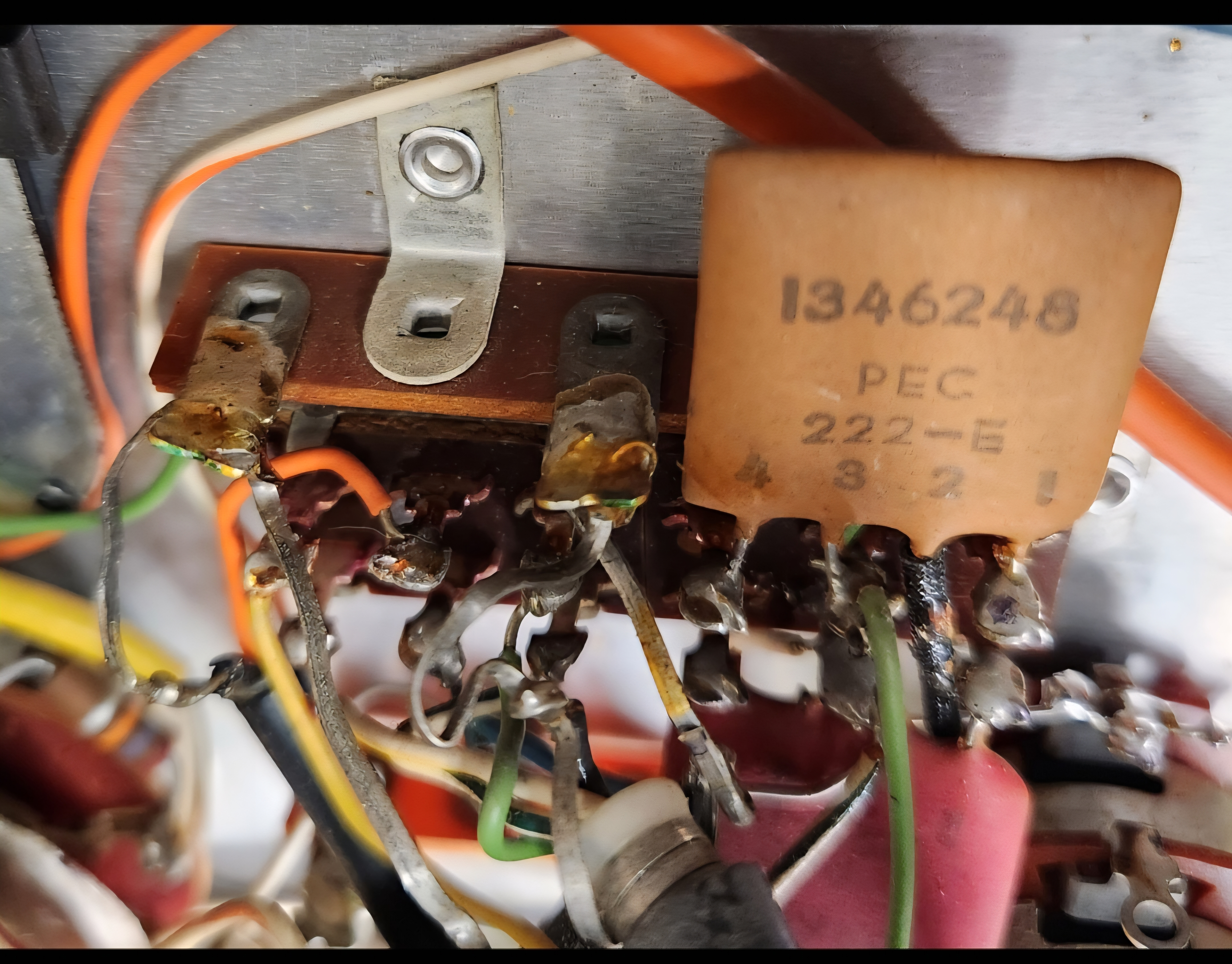
Post edited by SCompRacer onSalk SoundScape 8's * Audio Research Reference 3 * Bottlehead Eros Phono * Park's Audio Budgie SUT * Krell KSA-250 * Harmonic Technology Pro 9+ * Signature Series Sonore Music Server w/Deux PS * Roon * Gustard R26 DAC / Singxer SU-6 DDC * Heavy Plinth Lenco L75 Idler Drive * AA MG-1 Linear Air Bearing Arm * AT33PTG/II & Denon 103R * Richard Gray 600S * NHT B-12d subs * GIK Acoustic Treatments * Sennheiser HD650 * -
I adjusted the gain so that 0.006V in would give 0.6v out giving a gain of 40.0dB up from 33.98dB before adjustment. I rechecked the frequency response and it's very similar to previous measurements. The top end is rolling off about 2dB @ 10kHz on both channels, I'll wait for the reverse NAB from KAB, it should come next week. Curiously the THD went from 0.8% to 0.2% on the right channel and from 0.36% to 0.21% on the left. The gain is increased by reducing the negative feedback ratio which should increase distortion, not the reverse. But, I'll take it.
I had asked Hagerman Audio if they would consider doing an NAB version and after a day or so declined. KAB on the other hand was completely with it, really interested in making a new product. -
Inspired by this thread, I pulled the Akai M-8 RTR tape deck from my dad's collection out of storage.
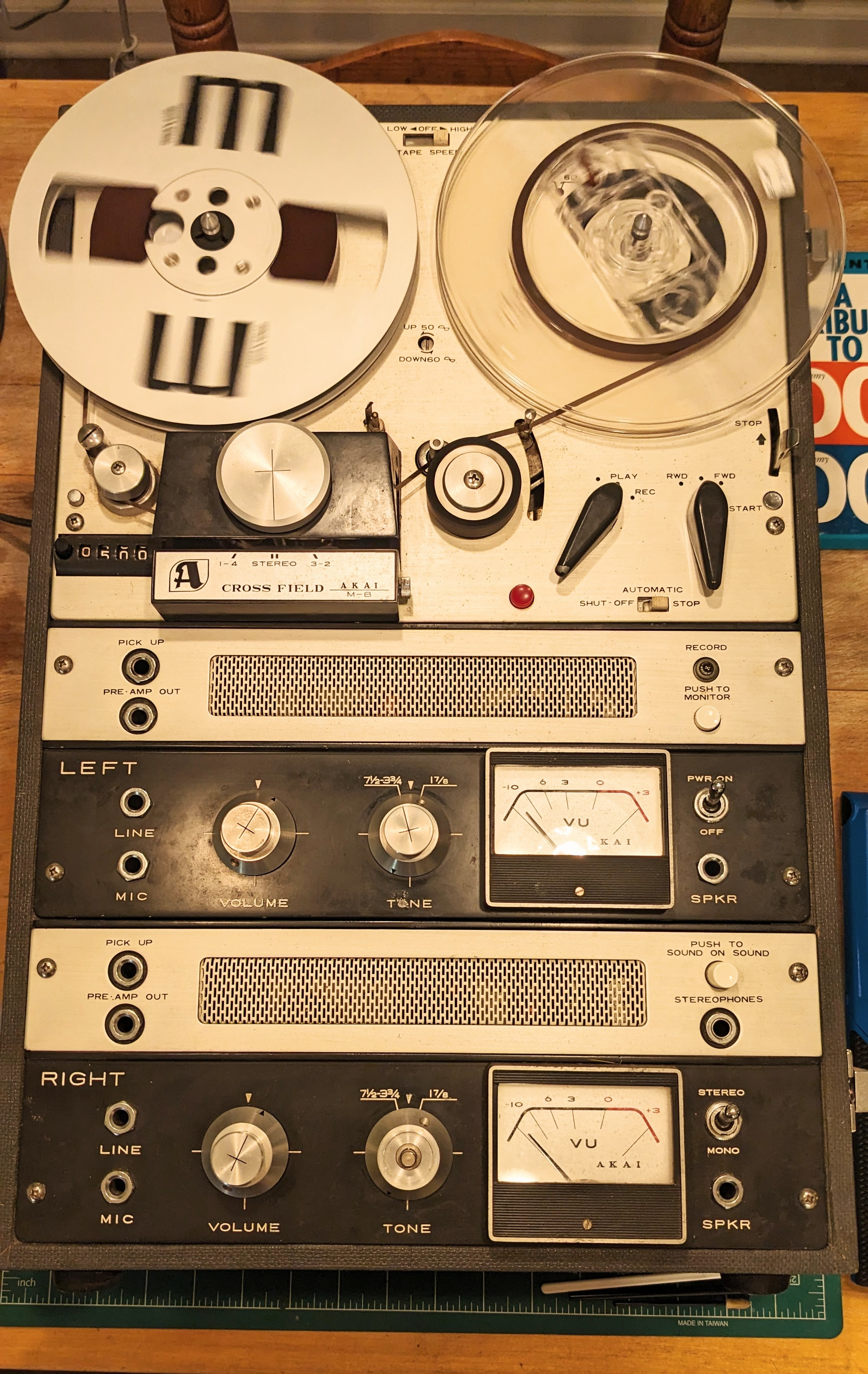
This model has separate L/R pre-amp tube stages, along with separate output stages, which can drive the integrated speakers that point upward from the top of the tape deck, or it can connect to external speakers. Of course, it has pre-amp outputs as well for connecting to a proper system.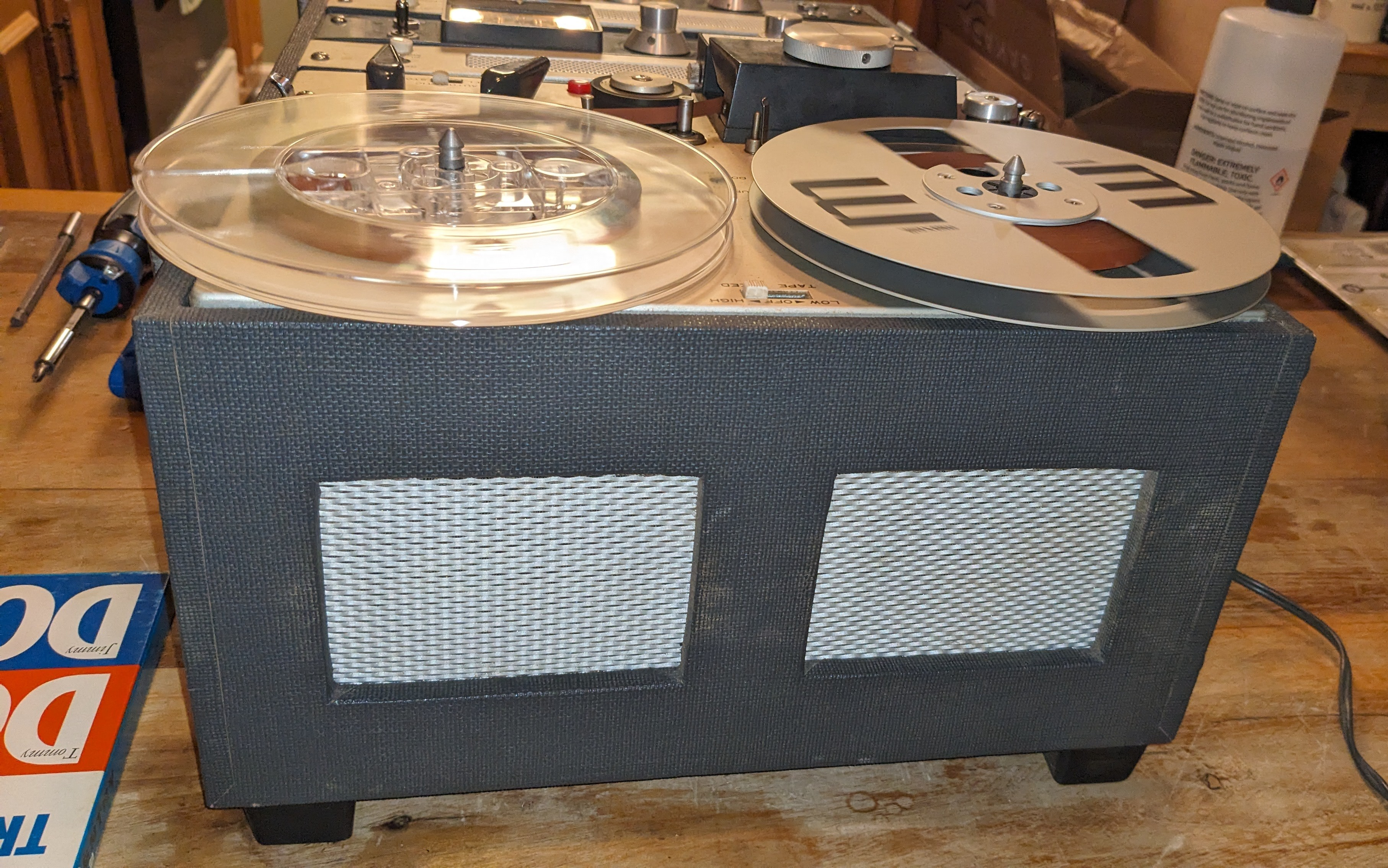
The full tube complement is 2 X 6267(EF86), 2 X 12AD7(12AX7), 2 X 6BQ5, 2 X 6X4, and 1 X 6AR5.
Some folks pull the amps out, and convert them into low-wattage guitar amps, which is apparently because of the 6267 tubes, which were also used in vintage VOX guitar amps. There is quite a bit of information about this on the web. All the input and output sockets are 1/4" (no RCA), which could be another convenient reason for usage with guitars.
It has a couple of interesting features for EQ/Tone Control. For EQ, it has one setting for 1 7/8 IPS, and another for 3 3/4 and 7 1/2 IPS. I think the idea is that for recording normal speaking/speeches at 1 7/8, it has one EQ, and then for music recordings at 3 3/4 or 7 1/2, it has another EQ; I'm not too sure about all that. The deck also has tone controls, which I think are really just a low-pass filter, again similar to a guitar...from what I have read. In other words, there's no middle zero setting for the tone control - it just applies the low-pass filter at different levels, and doesn't really 'boost' any frequencies.
Anyway, one thing I could use some advice on is the input voltage setting. It has settings for 100/110/117/200/220/230. It is currently set at 110, but I'm thinking 117 would be more appropriate in my case. The CPS setting is at 60Hz, but I'm wondering why the voltage has been set at 110. Any thoughts on that?"This may not matter to you, but it does to me for various reasons, many of them illogical or irrational, but the vinyl hobby is not really logical or rational..." - member on Vinyl Engine
"Sometimes I do what I want to do. The rest of the time, I do what I have to." - Cicero, in Gladiator
Regarding collectibles: "It's not who gets it. It's who gets stuck with it." - Jimmy Fallon -
Man that 12AD7 is hard to get and from what I hear a fantastic tube. Mostly used in RtR for their super quietness in nature.
-
That's a pretty neat old school deck. My Bottlehead Eros phono uses two EF86 in the first gain stage.
I see that deck had the 50/60Hz selector in front panel. Most I've seen are inside the deck.
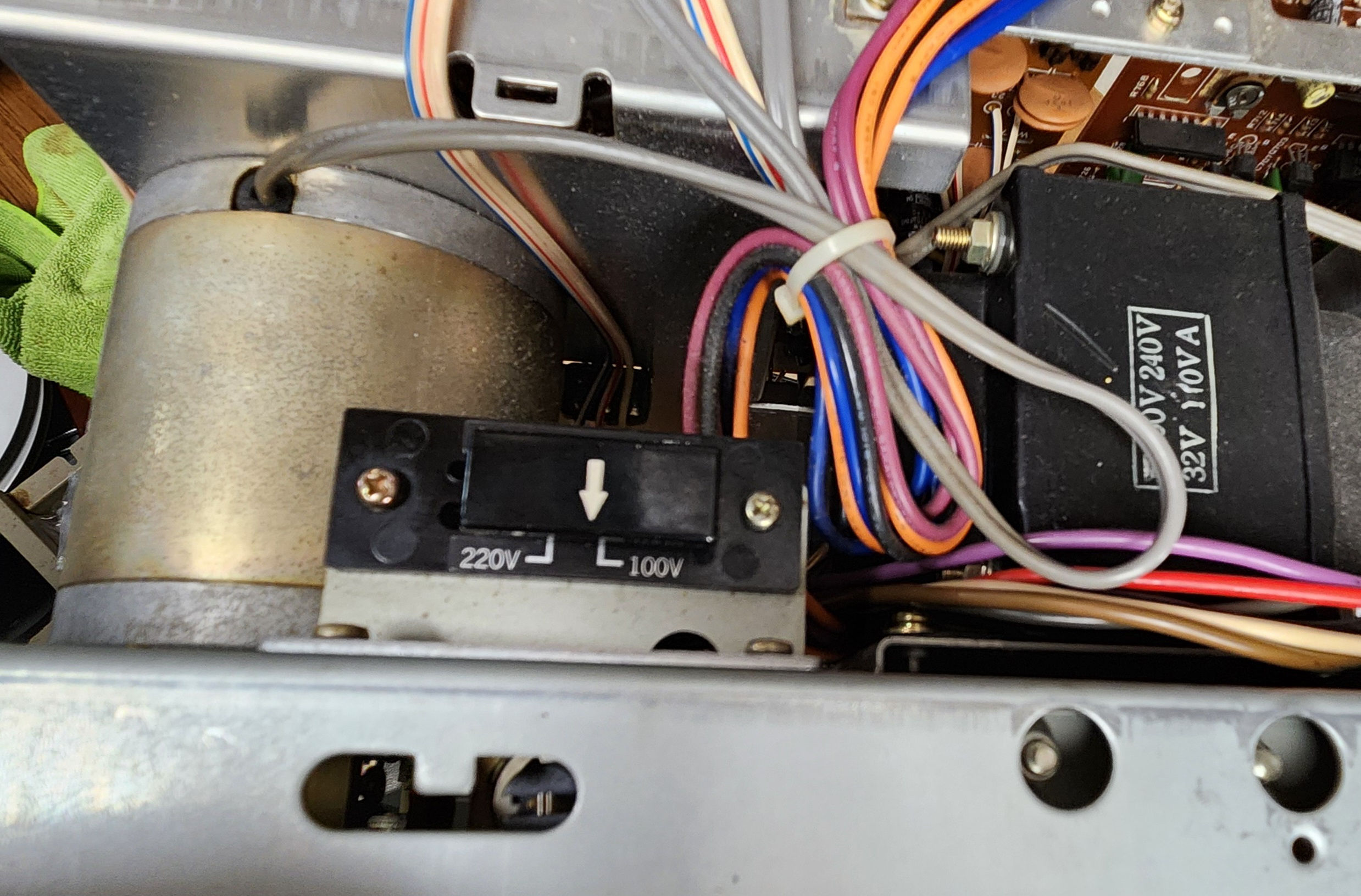
I haven't worked on many RTR decks, but I found two set at incorrect voltages. A Pioneer RT-71 was set to the Japanese voltage of 100. The other ended up as Carl's Teac X-1000r. It was also set to 100VAC instead of the 120 choice. My guess, if the deck was built in Japan they selected 100VAC. The owner's manual typically mentioned how to change voltage and Hz for your country in the first pages.
I chose 117 for the Pioneer since it was closest to 120. The X-1000r required removing cabinet to see/change the voltage setting while the Pioneer was outside and visible by the RCA input/outputs.
I'm fairly sure they were like that from day one. Incorrect voltage settings can tax the power supply and provide excess circuit voltage causing excessive heat and failure. Fortunately, the two decks work fine after setting correct voltage.
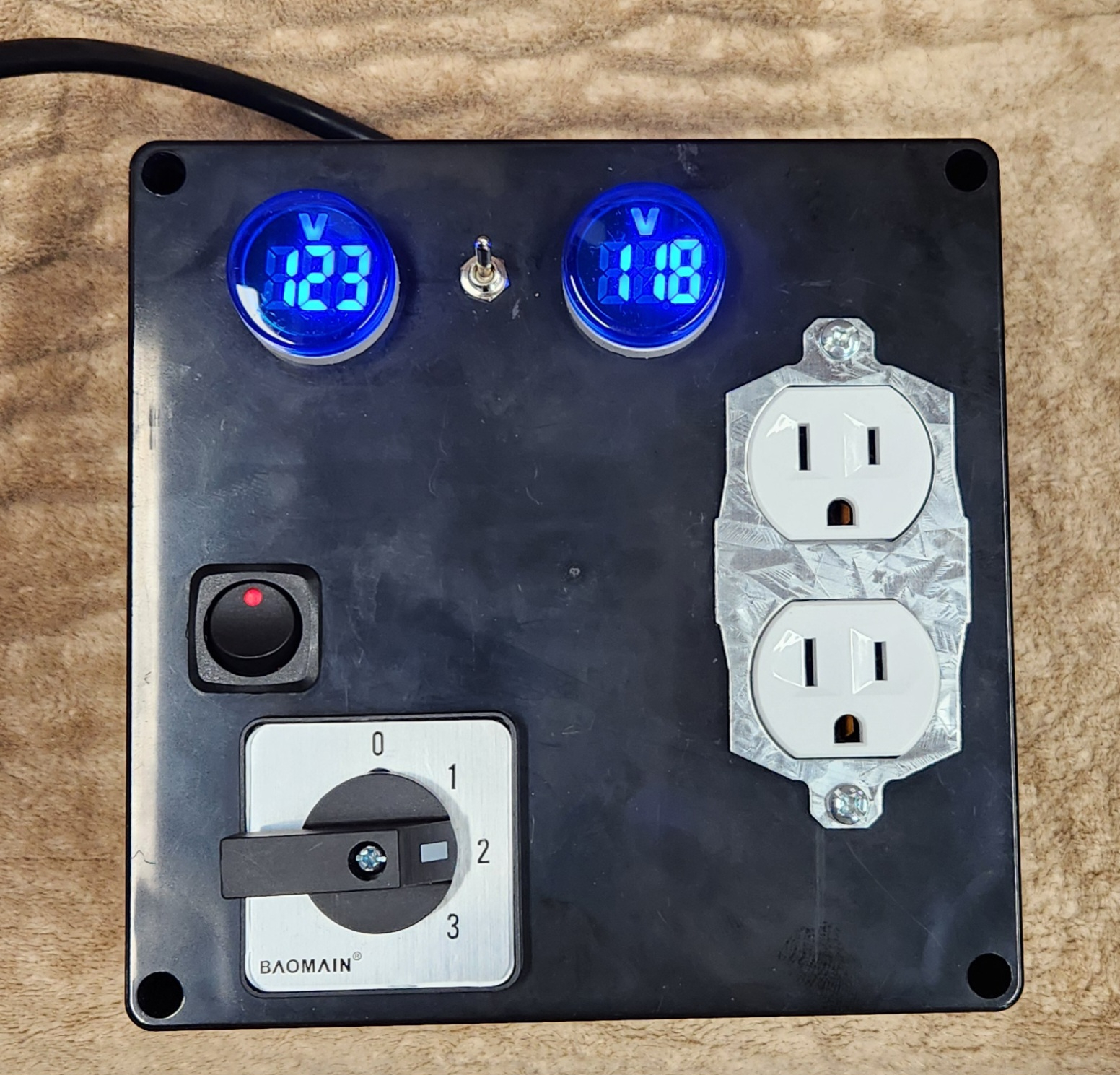
Present day, our mains here can be at 125VAC. On the old Scott 399 receiver I refurbed for Ed, I ended up building a bucking transformer for it. It has three speeds, line and two steps of reduction. At 125vac, the plate and heater voltage exceeded specs, enough to shorten tube life. The 399 was designed when mains were 115 or 117vac. One can tailor the bucking transformer amperage choice to the required load.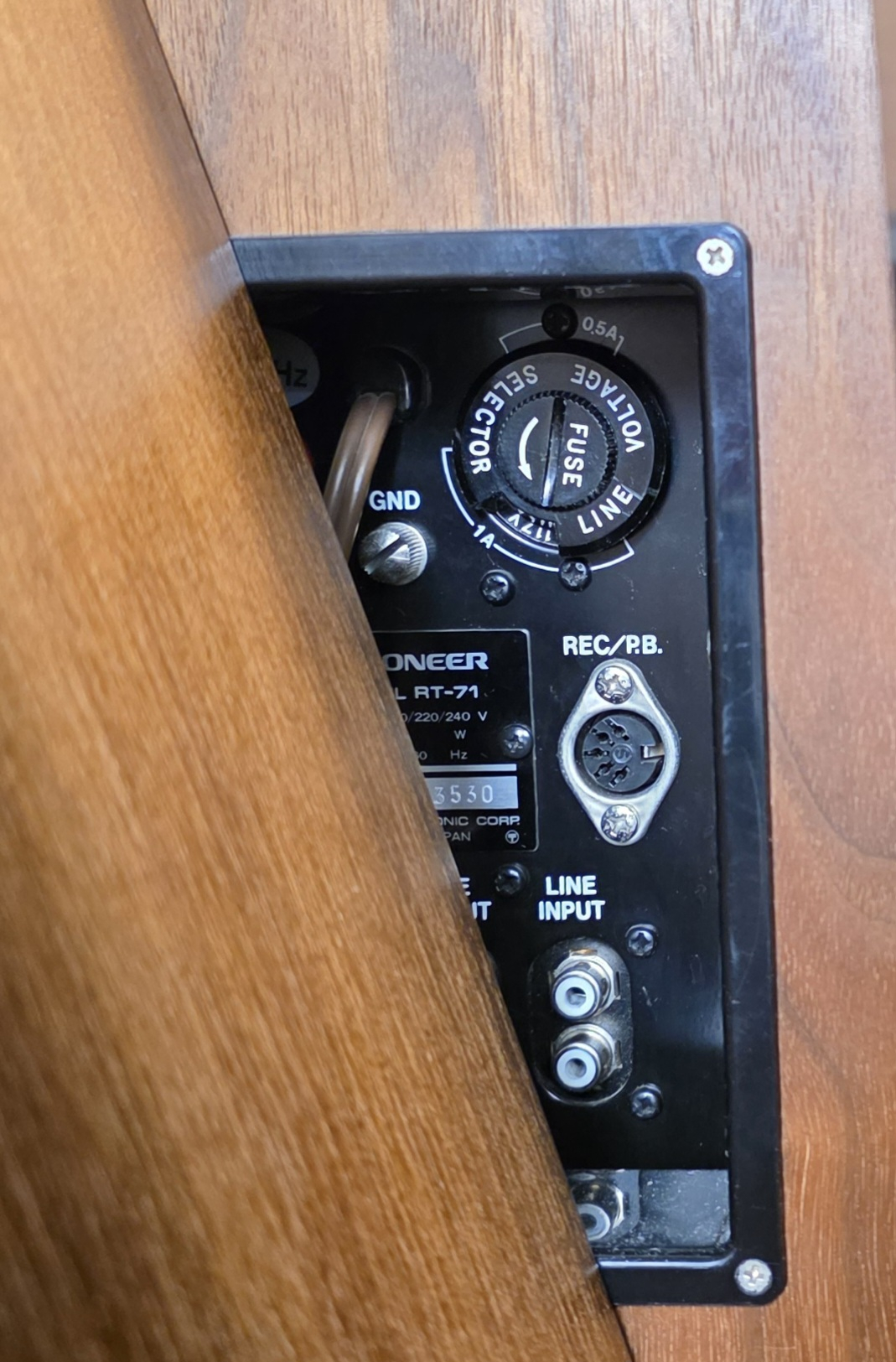
Post edited by SCompRacer onSalk SoundScape 8's * Audio Research Reference 3 * Bottlehead Eros Phono * Park's Audio Budgie SUT * Krell KSA-250 * Harmonic Technology Pro 9+ * Signature Series Sonore Music Server w/Deux PS * Roon * Gustard R26 DAC / Singxer SU-6 DDC * Heavy Plinth Lenco L75 Idler Drive * AA MG-1 Linear Air Bearing Arm * AT33PTG/II & Denon 103R * Richard Gray 600S * NHT B-12d subs * GIK Acoustic Treatments * Sennheiser HD650 * -
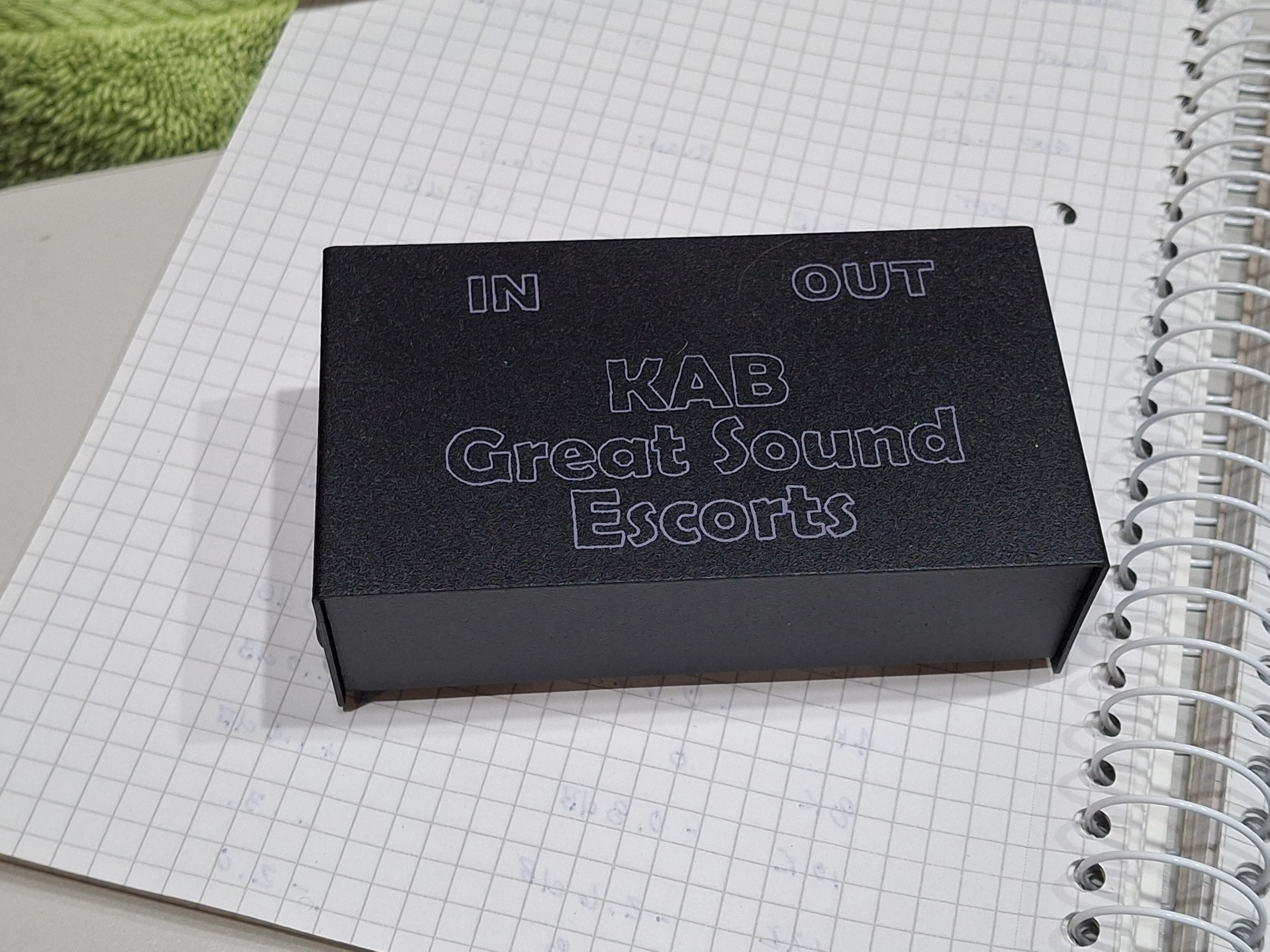
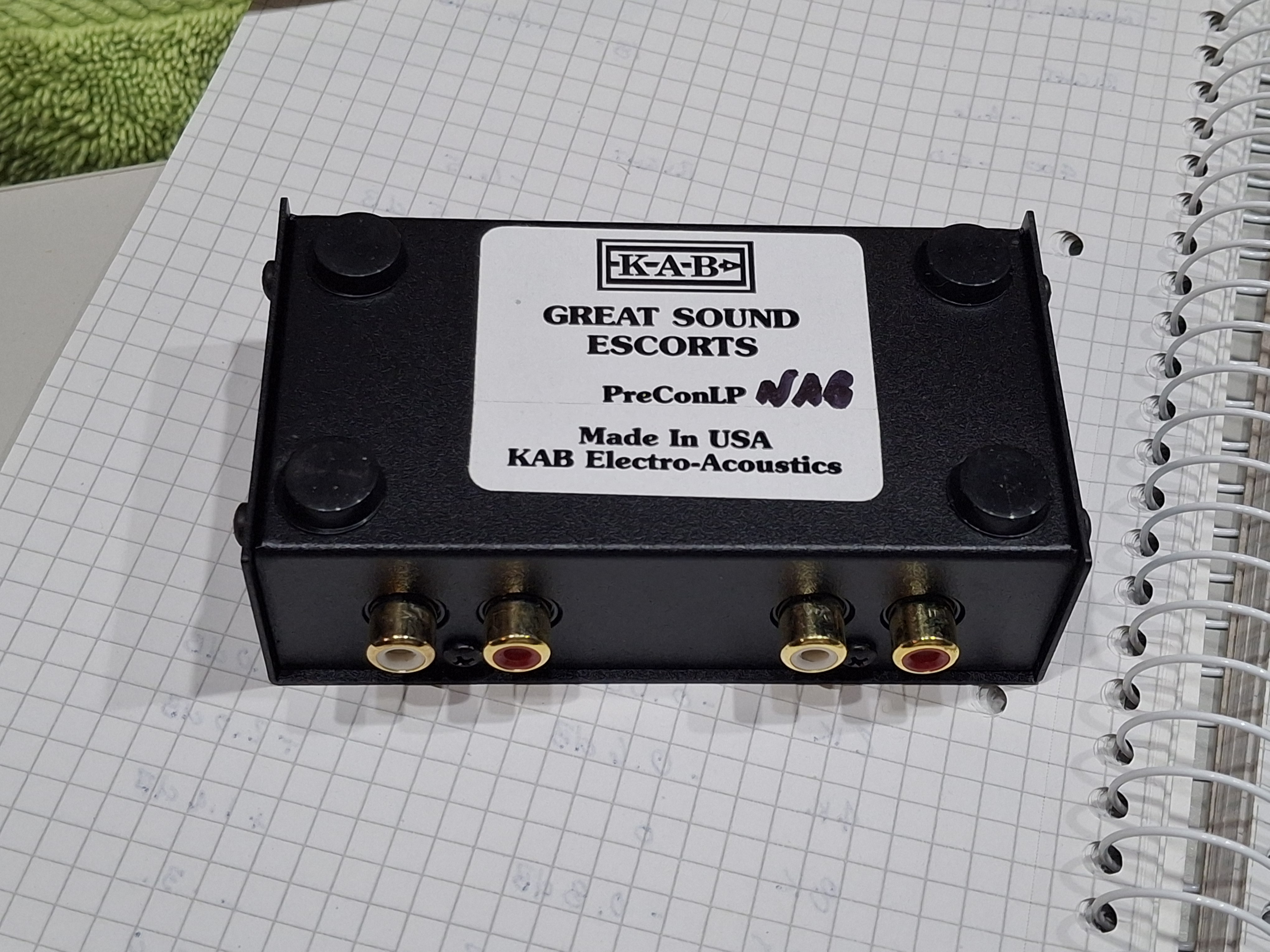
Lot's of cool toys happening here at Muppet Labs. I received the reverse NAB EQ device from KAB Acoustics and have been connecting it to several tape preamps and recording the frequency response. Still some things to work out.
-
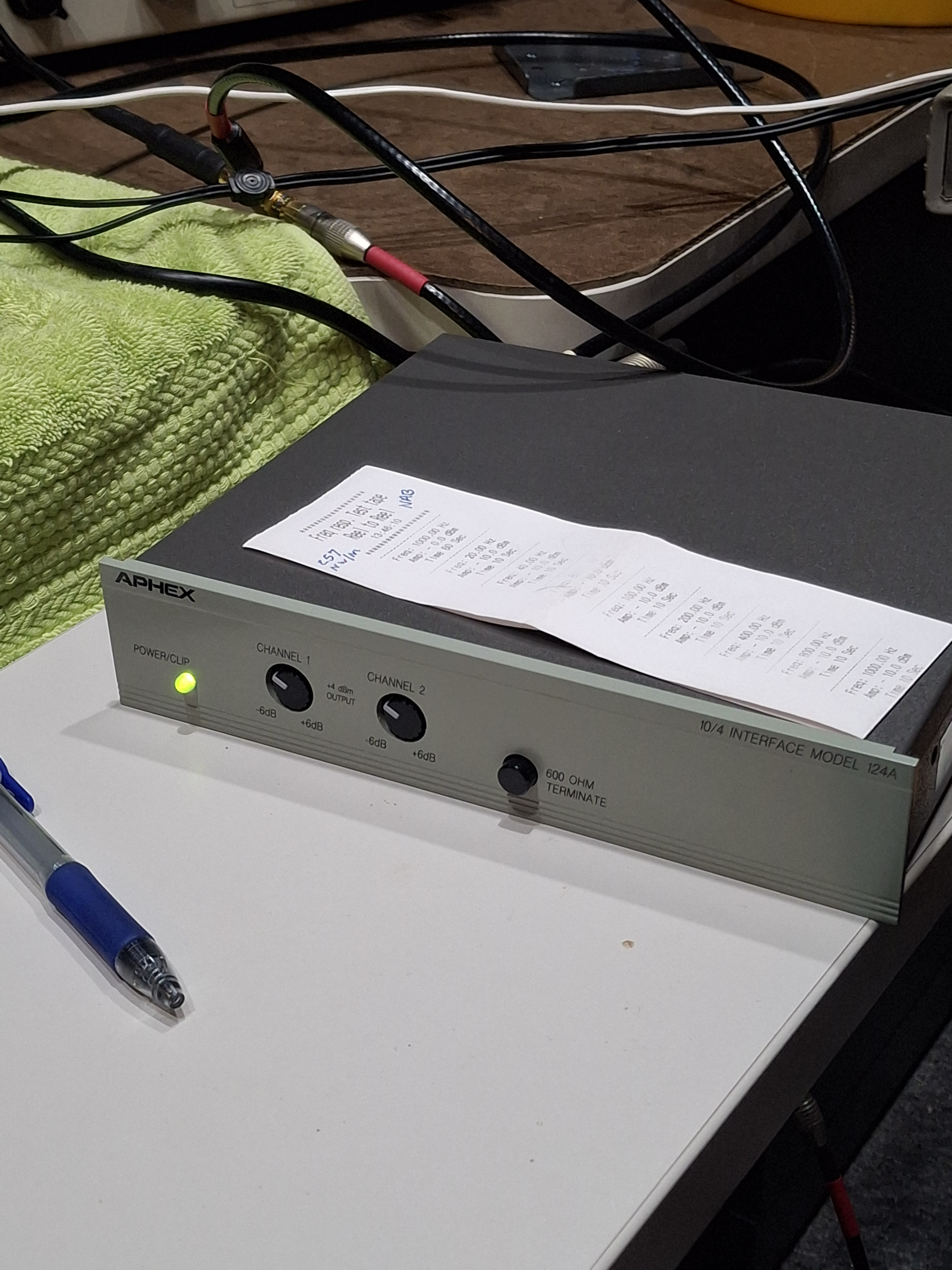
Then I got a very unique device from a company called Aphex, a company that makes a wide range of audio devices mostly used in the professional audio world. It's really two devices in one enclosure, it can take a balanced signal in and provide a single ended output with precision level adjustments. Or, it can take a single ended input with balanced outputs also with precision level adjustments. It is extremely neutral and has an excellent power supply. I can use it to set an output exactly at "0" dB on my meter and quickly see the deviations from linear as frequency is changed.
Post edited by SeleniumFalcon on -
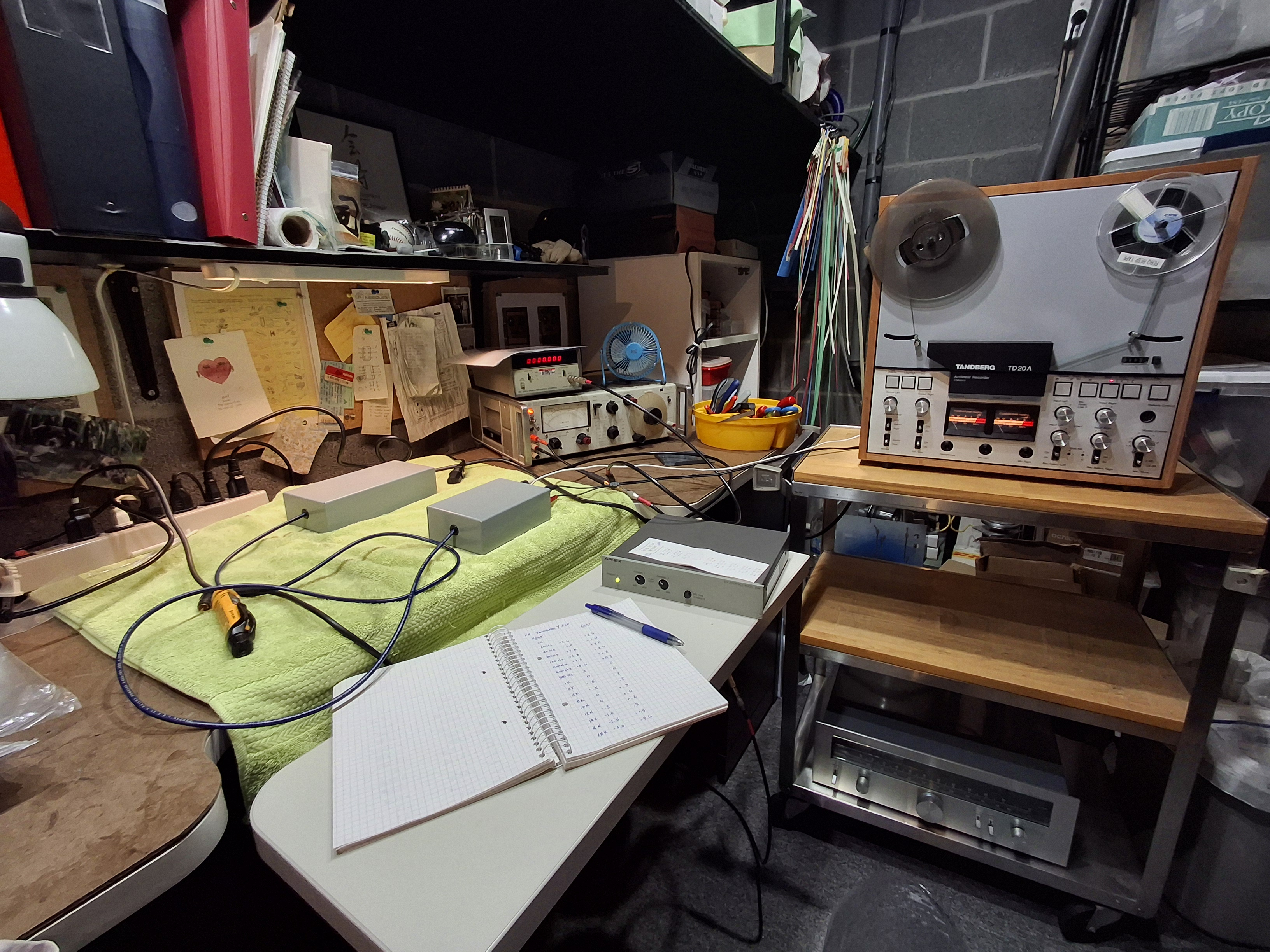
I'm using a calibrated tape to measure what happens when I use the Tandberg with an external playback preamp. Here it is connected to the Elliott Sound Products preamp which has no adjustment capability (as opposed to the Marantz which is the opposite). I'm finding that the Tandberg playback head exhibits a rise in the low frequencies due what is called "head bump" and a resonant peak at 8kHz followed by a rolling off at the upper end. Tandberg solves this problem in their onboard preamp section by having a variable resistor as the load and a frequency shaping EQ. By adjusting the input load and sculpting the EQ they achieve a flat response.
-
I have quite a bit of adjustment capability with the Marantz, input loading up to 100k ohms (the Tandberg schematic uses 500k ohm trim pots, I may need to add some resistance), bass and high frequency adjustments. My plan is to learn more about what Tandberg did, so I'm going to take the chassis out of the cabinet and measure what the factory settings were for the head loading. Also I'm going to reconnect the Tandberg playback preamp and see what the test tape looks like playing it via their circuit. It's possible the playback head is worn (it doesn't look too worn) which would throw off the results. It's possible the Tandberg isn't a good choice for an external preamp.
-
Are you wearing your Dr. Bunsen Honeydew labcoat? Neat toys!
So the 600 Ohm button on the Aphex. Is that to switch between 0dBu = 0.775V rms and 0dBV = 1V rms? It's like that on my Leader signal generator.
On the Teac A series, I read they added a level of boost at 7.5KHz in the record circuit to help early tapes like Scotch 203 to sound good. Later tapes didn't need the boost and some have changed Mica EQ cap values. You can get around it by biasing new tape at 1kHz and 10Khz instead of using the overbias method.
I've never tried head out playback to external phono amp on the decks so running with their playback circuitry.
Salk SoundScape 8's * Audio Research Reference 3 * Bottlehead Eros Phono * Park's Audio Budgie SUT * Krell KSA-250 * Harmonic Technology Pro 9+ * Signature Series Sonore Music Server w/Deux PS * Roon * Gustard R26 DAC / Singxer SU-6 DDC * Heavy Plinth Lenco L75 Idler Drive * AA MG-1 Linear Air Bearing Arm * AT33PTG/II & Denon 103R * Richard Gray 600S * NHT B-12d subs * GIK Acoustic Treatments * Sennheiser HD650 * -
I remember when Matt turned 50. Everybody was wearing lab coats and holding his photo in front of their face in the big meeting room when he walked in unsuspecting. I got the feeling he was a little embarrassed, but took it in good humor. I'm sure someone has a photo of that, somewhere. we had to give the lab coats back, I don't know if they rented them or what.
I figured out the difficulty with the KAB NAB network. My signal generator has a 600 ohm output and the network has an impedance of 1.1k ohms at 20kHz, so the top end was rolled off. I used the Aphex as a buffer and the response was flat with the ESP preamp. I then used a BK Precision generator with an output impedance of 50 ohms and the response was flat as well.
I think the Aphex can output 600 ohms for longer line connections in a studio application, where components can be 50' or more apart. It's really designed to allow consumer audio gear to match with pro gear. The balanced circuitry is transformerless and servo-balanced so transients are preserved. It's really handy and extremely well built. The schematic for the power supply is a textbook example for how they should be built. They can be found on eBay for very low prices, I found a NOS unopened.
-
You guys may not be fans of DSP, but the Parks Audio Puffin is basically a DSP phono stage, with MANY different EQ options, some of which might also be useful with a vintage tape deck...or at least give an insight into the options that these units are capable of.
Below is a screenshot from one page of the Puffin owner's manual, which may provide a window into the capabilities.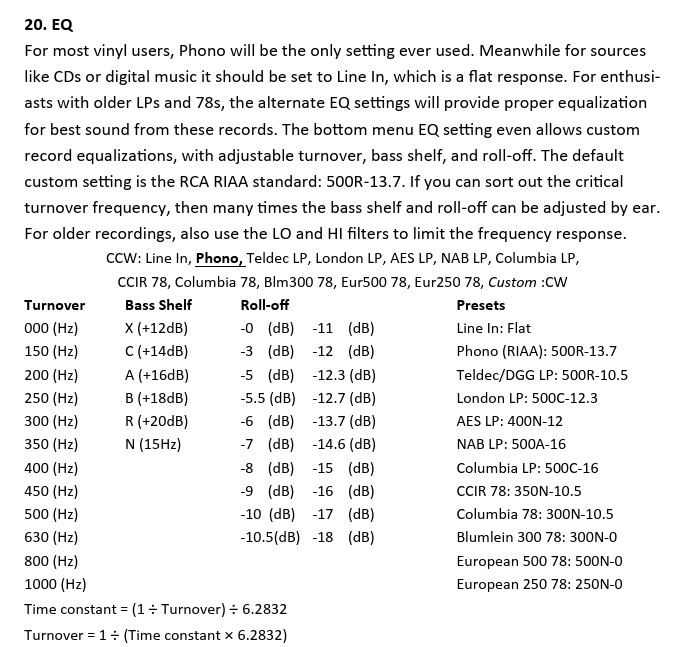
I realize that a phono RIAA EQ is different from what a tape deck might need, but this is just food-for-thought. Shannon Parks, the owner/operator/developer of Parks Audio products, is very accessible via email, and would likely be open to discussion about alternative EQ applications, that could be available as 'firmware' updates."This may not matter to you, but it does to me for various reasons, many of them illogical or irrational, but the vinyl hobby is not really logical or rational..." - member on Vinyl Engine
"Sometimes I do what I want to do. The rest of the time, I do what I have to." - Cicero, in Gladiator
Regarding collectibles: "It's not who gets it. It's who gets stuck with it." - Jimmy Fallon -
Thank you for your suggestion, that looks very promising! I'll contact them and ask if it's possible. Very cool!
-
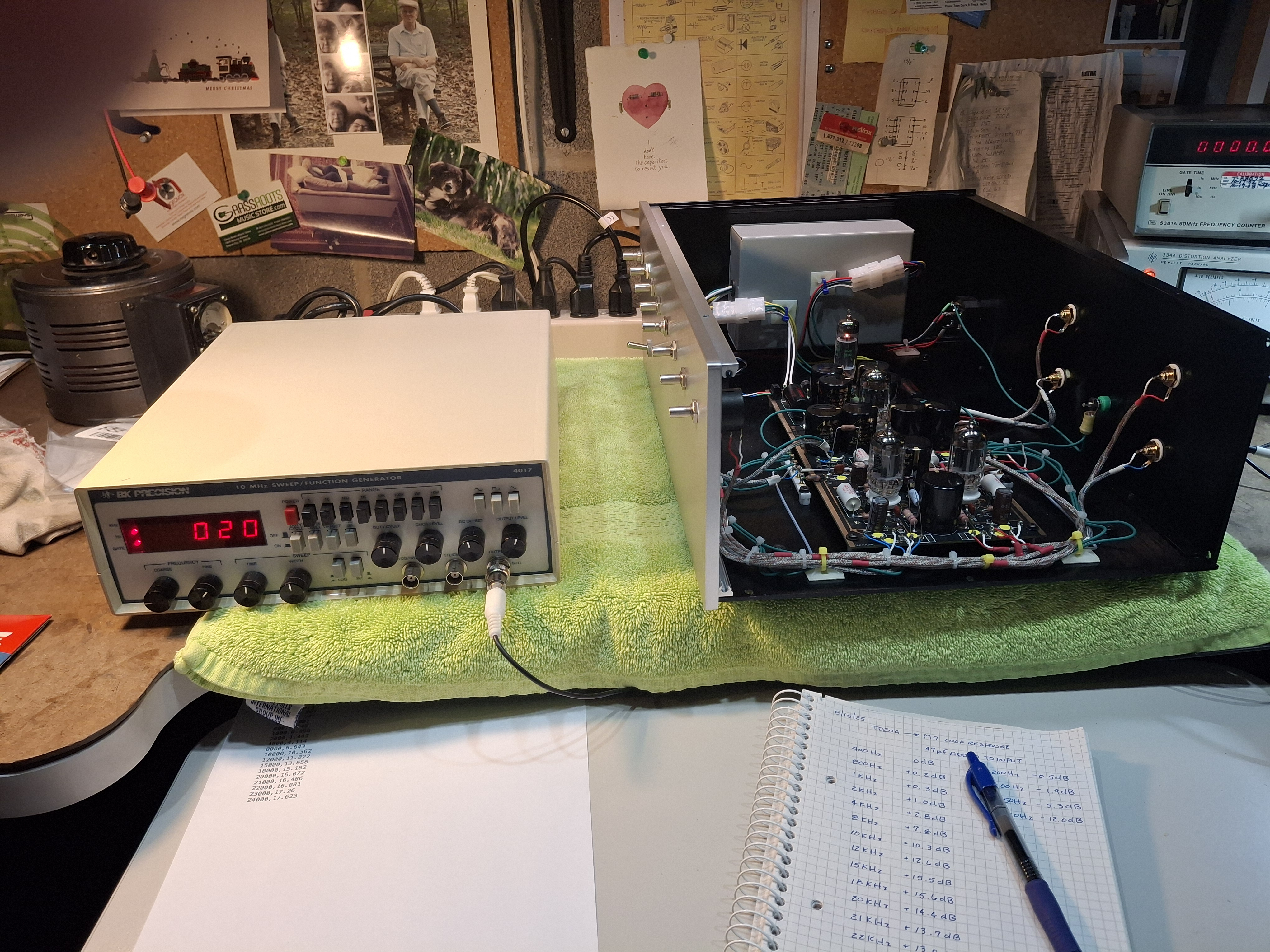
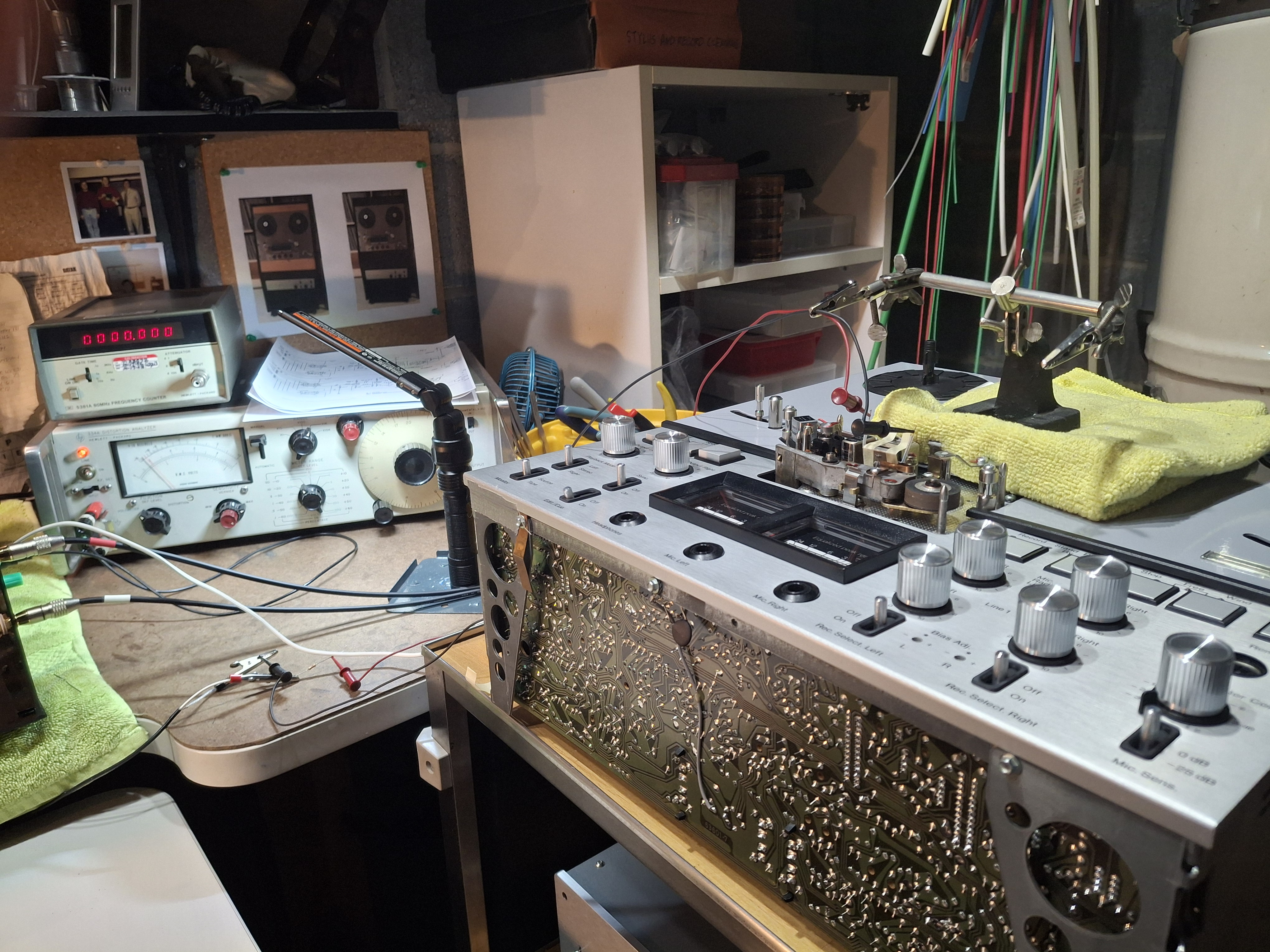
A bit of an update on this project. I've been trying to learn about how to convert a phono preamp to one that would function as a tape head preamp. I bought a Dynaco PAS2 in good condition and combined with an original construction manual have determined how going from "phono" to "tape head" was done. I've spruced it up a bit and bought a few of the many upgrade components available for it. I've begun learning how to mathematically analyze the Marantz 7 circuit and create ways of predicting the interaction of the gain stages and the feedback network. Rather than just turning a potentiometer and seeing how it effects the output I'd like to be able to predict what the changes might be and then see if the results confirm it. I bought a test instrument that I can now accurately measure a tape head's impedance along with connecting cable's capacitance. This allows me to predict what changes head loading can accomplish. I've made some improvements in using a flux loop to measure how an external preamp interacts with a playback head and begun to understand the mathematics and physics involved.
-
Here's a curve that I was able to measure showing how adding 47pF capacitance to the input loading effected the playback EQ versus an ideal measurement using a flux loop attached to the Tandberg's head. The goal was to be able to predict what the change would be and then see if it happened.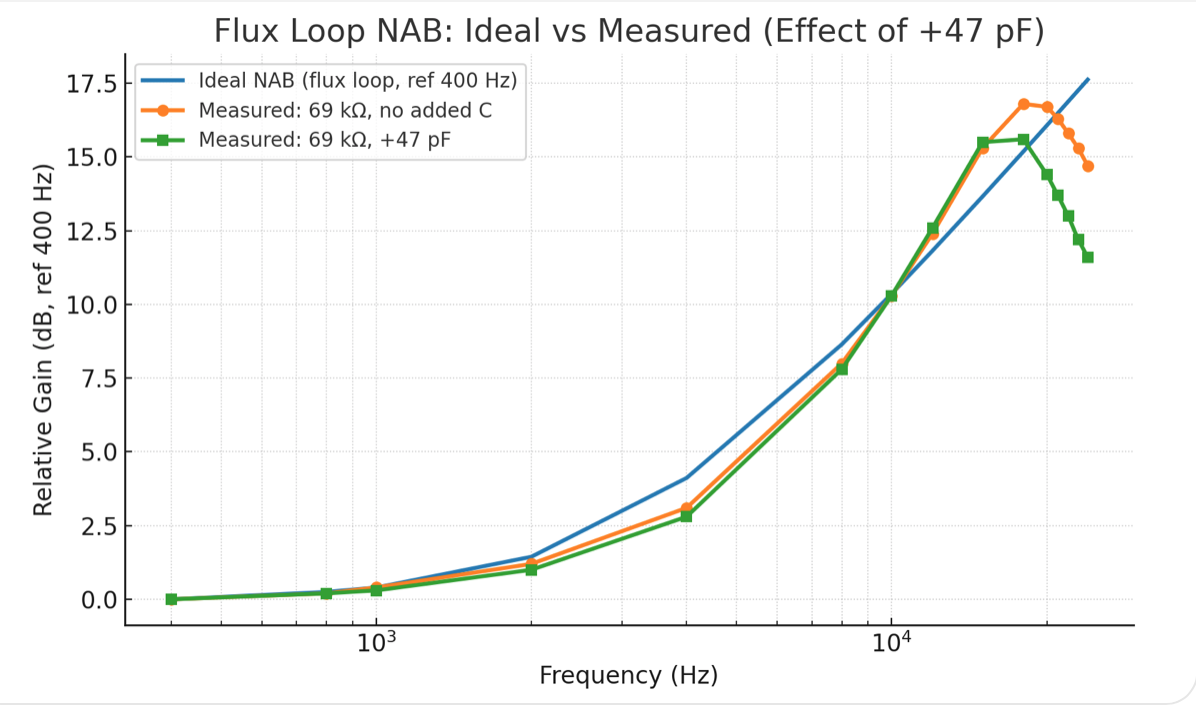
-
SeleniumFalcon wrote: »I remember when Matt turned 50. Everybody was wearing lab coats and holding his photo in front of their face in the big meeting room when he walked in unsuspecting. I got the feeling he was a little embarrassed, but took it in good humor. I'm sure someone has a photo of that, somewhere. we had to give the lab coats back, I don't know if they rented them or what.
I follow your discussion with deaf and dumb ears just to occasionally get tidbits like these. Thanks!Gustard X26 Pro DAC
Belles 21A Pre Upgraded with Mundorf Supremes
B&K M200 Sonata monoblocks refreshed and upgraded
Polk SDA 1C's modded / 1000Va Dreadnaught
Wireworld Silver Eclipse IC's and speaker cables
Harman Kardon T65C w/Grado Gold. (Don't laugh. It sounds great!)
There is about a 5% genetic difference between apes and men …but that difference is the difference between throwing your own poo when you are annoyed …and Einstein, Shakespeare and Miss January. by Dr. Sardonicus -
Back when that happened no one had today's phone/photo capability so only the HR people took the pictures. If that same thing happened today it would be everywhere.
-
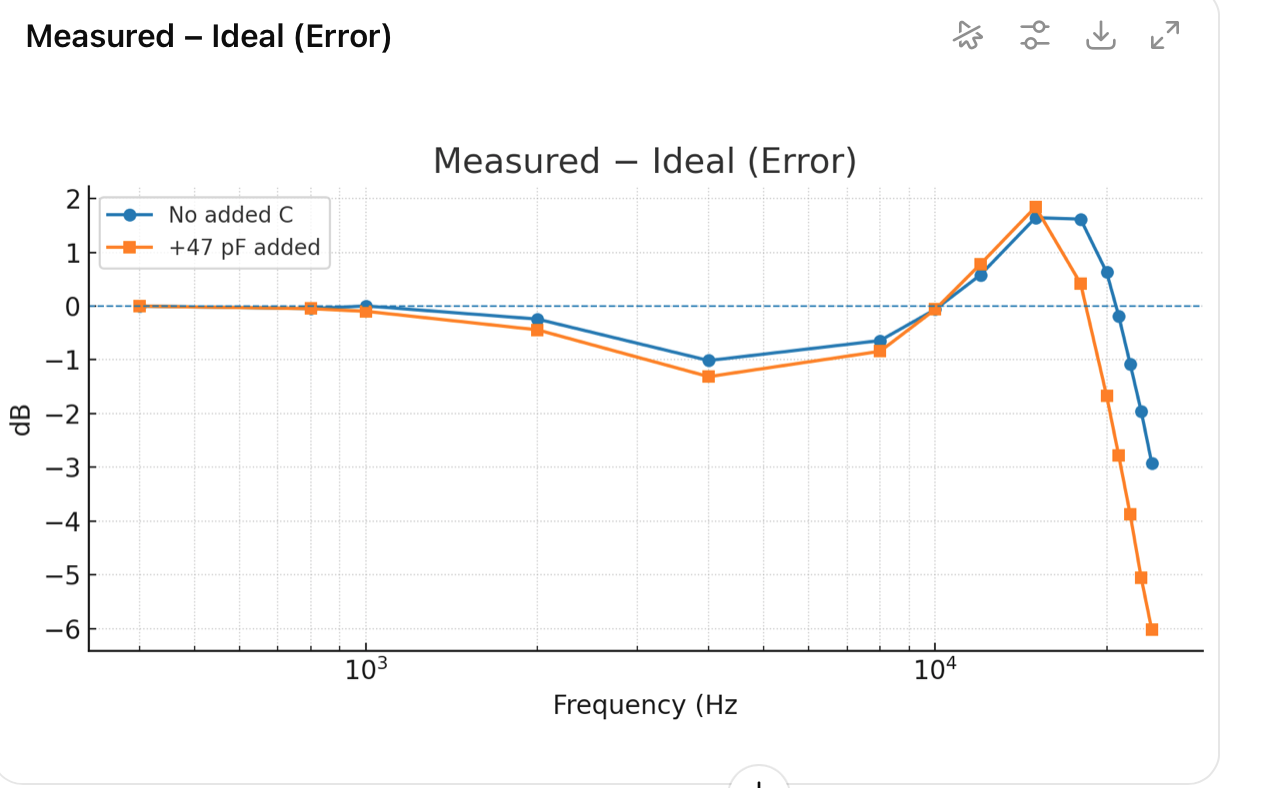
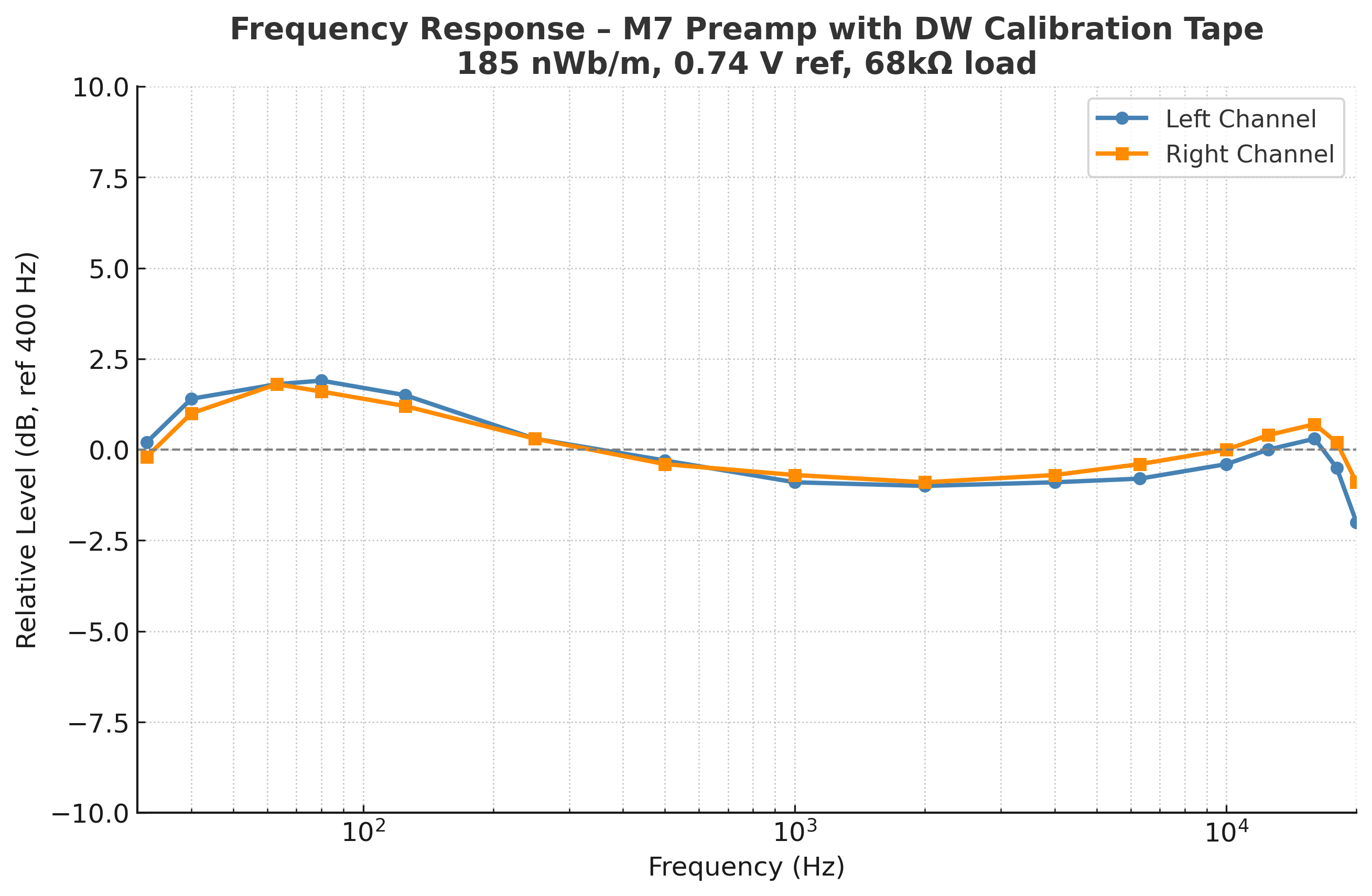
Some updates on this project. I've really learned quite a bit in building this preamp, mostly from online contacts. I've enlisted the help of a fellow in the UK who helped me with mathematical modeling of the circuit. And, also curiously from ChatGTP, who I refer to as "Chatbot" to my wife. I found it to be pretty amazing, I ask it to analyze some data that I feed it and it scrolls out a detailed description of what happened and the mathematical explanation and makes very detailed recommendations on what I should do next. The better my question the more helpful the answers. It's not perfect, I've found a couple of instances where it was wrong and I've corrected it. But, it can do mathematical computations and give answers that are very helpful. I measure the playback frequency response with a calibrated test tape and it suggests component changes that will result in flatter response. I order the parts and when they arrive put them in the circuit and re-measure the results and feed them to Chatbot. Here is my current playback response:
-
Another example of how I use Chatbot. I took a photo of my Barclay Crocker tape collection:
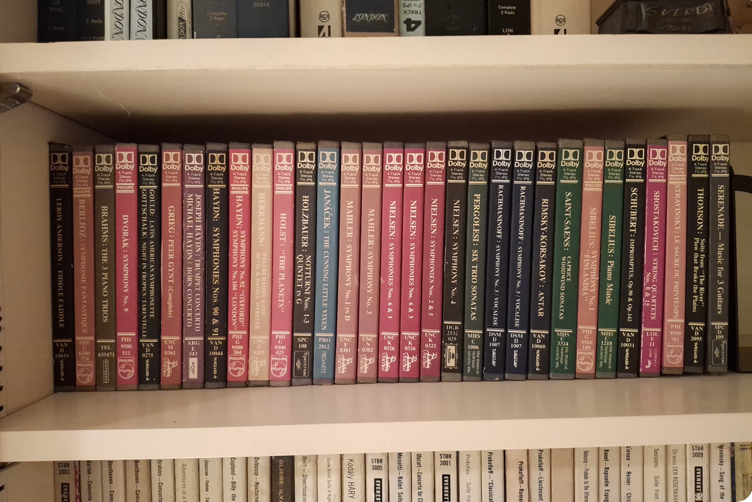
I asked it to read the labels and make a printable list of the titles, which it did. I then asked it to compare this list with known reviews of this series and search for any that I didn't have and see if any were available for sale. Which it found on eBay and I bought.
I've asked for book recommendations based upon my favorite authors and it did and I'm reading them. I've asked for music recommendations, no problem! I've even asked it to compose a few paragraphs as if it were Poe or Hemingway or Jack London or one of my favorite SF authors. It has an amazing, clever ability.


